The answer isn't simple. Drone spraying cost per acre in India shifts significantly depending on whether you hire a service or own a drone, how many acres you spray annually, your crop type, and where in the country you operate. Quoting a single number without that context leads to bad decisions — farmers overspend on hardware they can't justify, or choose the cheapest service and get poor results.
This article breaks down verified ₹ pricing ranges, the key cost drivers, a full component-by-component cost breakdown, and a practical framework to decide what makes sense for your farm or business.
Key Takeaways
- Hired drone spraying services in India typically cost ₹300–₹700 per acre; chemical inputs are almost always the farmer's responsibility
- Buying a drone ranges from ₹2.55 lakh to ₹8 lakh+ depending on capacity — upfront investment is high, but per-acre cost drops with higher annual usage
- Per-acre ownership cost hinges on five factors: tank capacity, annual acreage, battery replacement cycles, operator wages, and crop type
- Small and marginal farmers (under 5 acres) consistently save more by hiring a service rather than owning a drone
- Government subsidies under SMAM and Namo Drone Didi can shift the ownership math significantly, so check eligibility before making any cost comparison
How Much Does Drone Spraying Cost Per Acre in India?
There is no single national rate for drone spraying in India. What you pay depends on whether you're a farmer hiring a service or an operator who owns a drone — and how intensively that drone gets used.
Getting this wrong is costly. Farmers who buy drones for small landholdings often find that depreciation, batteries, and compliance costs push their effective per-acre cost well above what a hired service would have charged. Chasing the lowest service rate carries its own risk — poorly calibrated sprays underperform and wipe out any savings on inputs.
Hiring a Drone Spraying Service
According to Leher's 2026 analysis of the Indian market, hired drone spraying services in India cost ₹300–₹700 per acre. Gujarat's Agriculture Department separately caps its drone spraying support at 90% of cost or ₹500 per acre, whichever is lower — a useful reference for what state programmes consider a reasonable market rate.
Specialised applications on dense-canopy crops like sugarcane or cotton, or in challenging terrain, generally push toward the upper end of that range or beyond it.
What the per-acre service rate typically covers:
- DGCA-certified pilot's time and expertise
- Drone equipment and operational consumables
- Flight execution and coverage
What it almost always excludes:
- Pesticides, foliar fertilisers, or weedicides (farmer supplies these)
- Transportation costs if your field is remote
Owning and Operating a Drone
Purchase prices vary widely by payload capacity:
| Tier | Tank Size | Approximate India Price Range |
|---|---|---|
| Entry-level | 10 litres | ₹2.55 lakh – ₹4.5 lakh |
| Mid-range | 16 litres | ₹2.80 lakh – ₹4.5 lakh |
| Standard/Advanced | 10L hexacopter | ₹4.5 lakh + GST (Leher); ₹5.5–₹8 lakh + GST (market) |
| High-capacity | 20–25 litres | Price on request; no standardised listed price |
Ownership cost per acre is not fixed — it's a function of how many acres you spray annually. MU Extension's drone economics methodology illustrates this — high-utilisation custom applicators achieve significantly lower per-acre costs than low-utilisation farm owners, simply because spreading fixed costs across more acres lowers the effective rate per acre. The same logic applies directly in India:
- Fixed costs (purchase price, registration, insurance, AMC) stay constant regardless of usage
- Variable costs (batteries, maintenance, pilot wages) scale with acreage sprayed
- Break-even utilisation for most Indian operators falls in the range of 400–600 acres per year
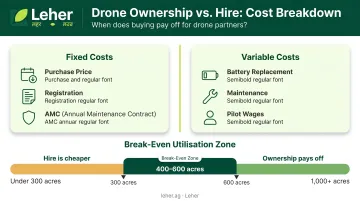
Operators clearing 1,000+ acres annually can bring ownership costs to ₹200–₹350 per acre. Below 300 acres, hiring a service almost always works out cheaper.
Key Factors That Affect Drone Spraying Cost Per Acre
Pricing for drone spraying is shaped by a combination of technical specs, operational patterns, and field conditions. Each factor below can shift your per-acre cost by ₹50–₹200 or more — knowing them upfront helps you compare quotes accurately.
Drone Type and Tank Capacity
Tank size directly determines how many acres a drone covers before needing a refill. Smaller tanks mean more refill cycles per day — which adds labour time and increases effective cost per acre.
Indicative coverage benchmarks from verified Indian sources:
- Marut AG 365 XP: ~4 acres per full battery; 40–45 acres/day
- Leher 10L hexacopter: 6 acres per charge; up to 50 acres/day
- IoTechWorld Agribot: up to 6 acres/hour
Drones with AI-assisted autonomous flight and variable-rate nozzles carry a higher purchase price, but reduce chemical waste and operator error — factors that affect long-term economics more than the sticker price suggests.
Acreage and Usage Frequency
Ownership costs — depreciation, battery replacement, interest on capital — are largely fixed. Spread across 200 acres per year, they're punishing. Spread across 1,500 acres, they become manageable.
For custom service operators, annual utilisation is the primary lever for reducing per-acre cost. The Namo Drone Didi scheme, for instance, is designed around Women SHGs generating at least ₹1 lakh/year in additional income by renting out drone spray services — an indication that consistent order flow is central to making ownership viable.
Crop Type and Terrain
Not all acres are equal.
- Flat paddy and wheat fields: standard flight speeds, lower cost per acre
- Sugarcane and cotton: dense canopy requires slower passes and more precise nozzle settings
- Uneven or fragmented terrain: increases repositioning time and reduces daily output
Regulatory spray buffers near water bodies or residential areas also reduce effective acreage per operating day, pushing up per-acre costs for operators in those regions.
Battery and Operator Costs
LiPo batteries for agricultural drones degrade over charge cycles. Key recurring cost benchmarks to factor into ownership calculations:
- DJI Agras T10 battery: rated for 1,000 charge cycles
- 22,000 mAh replacement packs: listed around ₹18,500 in the Indian market
- DGCA Remote Pilot Certificate (IGRUA, 2024): ₹75,000 + GST, plus ₹100 licence fee
- Entry-level certified pilot wages: ₹2–4 lakh/year
Because DGCA-certified pilots remain relatively scarce, their wages push hired service rates noticeably higher — a cost that often goes unaccounted in basic per-acre estimates.
Complete Cost Breakdown: What You're Actually Paying For
Drone spraying costs go well beyond the per-acre rate. Here's every component to account for:
One-time setup costs (ownership model):
- Drone unit: ₹2.55 lakh – ₹8 lakh+ depending on capacity
- Battery pack: ~₹18,500 per battery (most operators carry 3–5 for full-day operation)
- Remote Pilot Certificate training: ₹75,000 + GST
- DGCA licence fee: ₹100
- Digital Sky platform registration: confirm current fee at digitalsky.dgca.gov.in
- Transport and storage setup: variable
Recurring operational costs:
- Battery replacement (every 1,000 cycles per battery)
- Nozzle and motor maintenance — Indian field dust, humidity, and crop residue accelerate wear
- Annual drone insurance
- Operator wages: ₹2–4 lakh/year or per-acre commission
Compliance costs:
- DGCA Remote Pilot Certificate renewal
- State-level pesticide applicator certification where applicable
- PPQS SOP compliance for aerial chemical application
Input Savings: The Cost Offset Most Budgets Miss
PIB's Kisan Drone factsheet confirms that drone spraying saves 80–90% water versus conventional methods. ICAR-CPRI potato trials recorded only 20 L/ha water use versus 500–750 L/ha for conventional spraying. Leher's field operations report approximately 30–40% input savings alongside 90% water savings.
For Indian farmers paying ₹800–₹2,000+ per acre in chemical inputs, even a 25–30% reduction in pesticide use translates to a direct ₹200–₹600/acre saving — one that partially offsets the spraying cost on every job.
Government Subsidies That Can Reshape Your Numbers
| Scheme | Eligible Entity | Support Amount |
|---|---|---|
| SMAM | ICAR/KVK/State Agriculture Universities | 100% up to ₹10 lakh |
| SMAM | FPOs (demonstrations) | 75% of drone cost |
| SMAM | CHC cooperatives/FPOs/rural entrepreneurs | 40% up to ₹4 lakh |
| SMAM | Agriculture graduates setting up CHCs | 50% up to ₹5 lakh |
| Namo Drone Didi | Women DAY-NRLM SHGs | 80% up to ₹8 lakh |
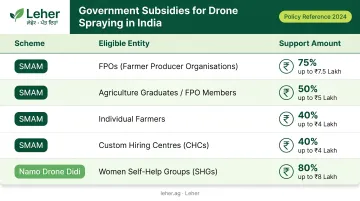
Note: PM-KISAN provides ₹6,000/year income support to farming families — it is not a drone purchase subsidy. Do not conflate the two when planning your budget.
Hiring a Drone Service vs. Owning a Drone: What Makes Sense?
For most Indian farmers — particularly those with small or fragmented holdings — this is primarily a volume and cash-flow question.
| Factor | Hiring a Service | Owning a Drone |
|---|---|---|
| Upfront cost | ₹0 | ₹2.55 lakh – ₹8 lakh+ |
| Per-acre cost (under 500 acres/year) | ₹300–₹700 (predictable) | High (fixed costs not recovered) |
| Per-acre cost (1,000+ acres/year) | ₹300–₹700 (unchanged) | Potentially lower than service rate |
| Compliance burden | Zero — borne by operator | Full DGCA, Digital Sky, training costs |
| Operational flexibility | Book when needed | Full control of schedule |
| Typical user | Small/marginal farmer | Large operator, agri-entrepreneur |
For farms under 5 acres, hiring a certified service is typically the more cost-effective choice once total ownership costs are factored in. The capital that would otherwise go into a drone purchase remains available for seeds, inputs, or other farm investments.
The calculation shifts for larger operators or entrepreneurs building a drone spraying business — at scale, and especially with subsidy support, ownership can become economically viable. For those who don't want to cross that threshold, app-based services like Leher offer a middle path: transparent per-acre pricing, DGCA-certified operators, zero compliance burden for the farmer, and a post-completion payment model where farmers pay only after the job is done.
How to Budget Correctly — and What Most Farmers Get Wrong
A drone spraying budget that works matches the solution to your actual acreage, crop mix, and operational capacity.
Key factors to weigh before committing:
- Annual acreage and crop mix (affects whether ownership is justifiable)
- Whether you'll operate the drone yourself or hire out (affects training cost)
- Existing infrastructure — vehicle access, water source at field, storage
- Subsidy eligibility under SMAM, Namo Drone Didi, or state schemes
- Total lifecycle cost over 3–5 years, not just Year 1 purchase price
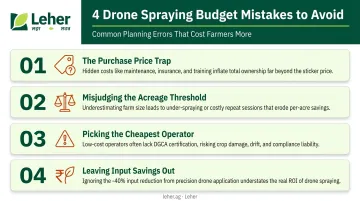
Most budget mistakes, though, come from what farmers overlook — not what they calculate incorrectly. Here's where things typically go wrong:
The purchase price trap: Battery replacement cycles, compliance costs, and annual maintenance rarely make it into the initial estimate. Together, these can add ₹50,000–₹1.5 lakh/year to ownership costs depending on usage intensity.
Misjudging the acreage threshold: Ownership only pays off with consistent, high-volume demand. Without a clear customer base or a large enough landholding, the per-acre cost of owning a drone often exceeds what a service provider charges.
Picking the cheapest operator without checking credentials: An uncertified pilot with a poorly calibrated drone can miss coverage, over-apply chemicals, or create regulatory liability. That per-acre saving disappears quickly when crop outcomes suffer.
Leaving input savings out of the math: The 30–40% reduction in chemical use from precision drone spraying is real, recoverable money. Factor it into your cost comparison from the start, not as an afterthought.
Conclusion
Drone spraying cost per acre in India spans ₹300–₹700 for hired services and varies widely for ownership depending on annual acreage, drone capacity, and utilisation. There is no single correct number — the right cost is the one that delivers reliable coverage, measurable input savings, and fits your farm's scale and cash flow.
Understanding every component — from batteries and DGCA compliance to operator wages and chemical savings — puts you in a position to make a confident, accurate decision for your farm.
Farmers who want precision drone spraying without the capital outlay or compliance burden can explore Leher's on-demand service: DGCA-certified operators arrive at your field, spray your crop, and you pay only after the job is done.
Frequently Asked Questions
How much does drone spraying cost per acre in India?
Hired drone spraying services in India typically range from ₹300–₹700 per acre, based on current market data. Ownership-based costs vary significantly depending on annual acreage — the more you spray, the lower your per-acre burden becomes.
How many acres can you spray in a day with a drone?
A standard agricultural drone covers 40–50 acres per day under good conditions (flat terrain, standard crops). Daily output drops with dense-canopy crops, frequent battery swaps, logistical delays, or irregular field layouts.
Is drone crop spraying profitable?
For custom service operators with consistent demand, yes. The Namo Drone Didi scheme targets at least ₹1 lakh/year additional income per SHG operator as a benchmark. Profitability ultimately hinges on utilisation rate, per-acre pricing, and how tightly operating costs are managed.
Is it cheaper to hire a drone spraying service or buy your own drone?
For farms under roughly 5 acres — or operators spraying fewer than 500 acres/year — hiring is almost always cheaper once full ownership costs are factored in: depreciation, battery replacement, and DGCA compliance. Owning makes financial sense at higher annual volumes or with significant subsidy support.
What are the hidden costs of owning a drone for spraying?
The most commonly missed costs are battery replacement (₹18,500 per pack), Remote Pilot Certificate training (₹75,000 + GST), Digital Sky registration, drone insurance, and ongoing maintenance — all of which compound quickly under Indian field conditions.
Does drone spraying save money compared to traditional spraying methods?
Yes, meaningfully so on inputs. Drone spraying delivers 80–90% water savings versus conventional methods, per PIB and ICAR data. Leher's field operations report approximately 30–40% reduction in chemical inputs — a direct ₹/acre saving that partially offsets the per-acre spraying cost.