
Introduction
Foliar spray fertilisation is the practice of applying diluted liquid fertiliser directly onto plant leaves, allowing nutrients to enter through the cuticle and stomata rather than through the soil-root pathway.
Results vary dramatically. Two farmers using the same product on the same crop can get completely different outcomes based on timing, concentration, and environmental conditions. Poor execution doesn't just waste inputs — it can burn crops and worsen the very deficiency you're trying to fix.
This guide covers:
- When foliar spray is actually the right call
- How to prepare and apply it correctly
- Which variables control results
- The mistakes Indian farmers most commonly make
Key Takeaways
- Foliar spray works best for micronutrients (iron, zinc, manganese, boron) and as a rapid rescue for visible deficiencies — not as a replacement for soil fertilization
- Apply during cooler morning or evening hours when stomata are active and evaporation is slow
- Use only water-soluble fertilisers at foliar-specific rates — soil-application concentrations will burn leaves
- Cover both leaf surfaces using a fine mist; the underside is where most stomata are concentrated
- No residual effect: reapply every 10–14 days throughout the deficiency window
How to Apply Foliar Fertiliser: Step-by-Step
Step 1: Diagnose the Deficiency and Select the Right Nutrient
Before you mix anything, identify what the crop actually needs. Visual symptoms give you a starting point:
- Interveinal chlorosis (yellow between leaf veins, green veins remain) — likely iron or manganese deficiency
- Stunted new growth, narrow or distorted leaves — likely zinc or boron deficiency
- General pale yellowing from older leaves upward — more likely a nitrogen or sulphur issue
Foliar spray is most effective for micronutrients — iron, zinc, manganese, copper, boron — and certain secondary nutrients like calcium and magnesium. WSU Extension confirms that macronutrients like nitrogen and phosphorus are required in quantities too large for leaf absorption at safe concentrations, and high concentrations cause salt burn.
One more thing worth checking before you spray: if the deficiency is caused by high soil pH locking out nutrients (common in calcareous soils across India), foliar spray is a short-term rescue only. Root-zone availability won't improve until soil pH is corrected.
Step 2: Prepare the Spray Solution
Only use water-soluble formulations. Granular fertilisers don't dissolve properly and leave residue on leaf surfaces.
Key preparation steps:
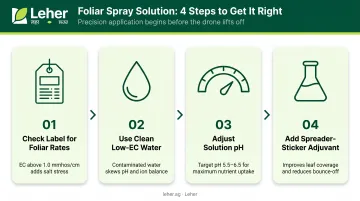
- Check the label for foliar-specific rates — these are lower than soil application rates
- Use clean, low-EC water — water with high salt content (EC above 1.0 mmhos/cm) can interfere with uptake and add unnecessary salt stress to leaves
- Adjust solution pH — pH affects nutrient solubility and how readily compounds penetrate the leaf cuticle; follow product-label guidance, as the optimal range varies by nutrient salt and formulation
- Add a spreader-sticker adjuvant — one to two drops per litre improves adhesion, extends contact time, and lowers surface tension so the solution spreads across the leaf surface rather than beading off
A 2019 study on foliar phosphoric acid in wheat confirmed that surfactant inclusion significantly improved both absorption and translocation — making this a low-cost step with meaningful payoff.
Step 3: Time the Application Correctly
Apply during cooler morning or evening hours, avoiding the heat of the day. High temperatures accelerate evaporation, concentrate fertiliser salts on the leaf surface, and sharply increase burn risk. UConn Extension specifically warns against spraying in direct sun and recommends early or late-day application.
Avoid spraying when:
- Rain is expected within a few hours — wash-off eliminates the entire application
- Wind is high — increases drift and uneven coverage
- The crop is visibly stressed from drought — stomata close under stress, reducing absorption
Step 4: Apply Using the Right Technique and Equipment
Use a fine mist nozzle and spray until the leaf surface is uniformly wet — but not so heavily that droplets are dripping to the ground. The goal is maximum surface contact, not runoff.
Cover both leaf surfaces. Stomata concentrate on the underside, yet most farmers spray only the top. This single omission significantly reduces nutrient uptake — with no visible sign it was done incorrectly.
Before any full-field application with an unfamiliar product, test on 3–5 plants and observe for 24 hours. New products and unfamiliar concentrations commonly cause phytotoxicity — a patch test prevents this.
For large-scale application across hundreds of acres, timing is a real constraint. Getting every acre sprayed in the early-morning window using manual knapsack sprayers simply isn't feasible for most Indian farm operations.
This is where drone-based spraying services like Leher become practically useful. Drone deployment covers up to 50 acres per day (roughly one acre in 5 minutes), uses GPS-guided flight paths for uniform fine-mist coverage, and requires only a single operator. The on-demand booking model through the Leher App lets farmers schedule sessions around crop stage, not around labour availability.
When Should You Use the Foliar Spray Method?
Foliar spray is a targeted intervention, not a routine fertilisation system. It bridges gaps that soil nutrition can't address quickly — but it cannot replace soil nutrition entirely.
Situations where foliar spray is the right call:
- Soil pH is too high or low, blocking root uptake of specific nutrients (especially iron in alkaline soils)
- Soil is too dry or waterlogged, limiting root activity and nutrient mobility
- Crop is at a critical growth stage and needs an immediate nutrient boost before the next soil application cycle takes effect
- Visible deficiency symptoms need rapid correction
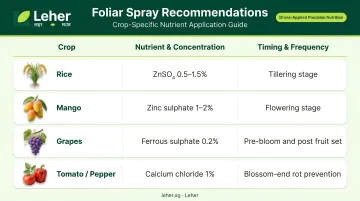
Indian extension research offers well-tested dose and timing guidance for common crops:
Proven applications from Indian extension research:
- Rice: TNAU recommends 0.5–1.5% ZnSO₄ foliar spray at tillering (25–30 DAT), repeated 2–3 times every 10–14 days for zinc deficiency; 1% urea at weekly intervals for nitrogen deficiency
- Mango: Two sprays of 1–2% zinc sulphate at flowering and one month later
- Grapes: Two sprays of 0.2% ferrous sulphate before bloom and after fruit set
- Tomato/pepper: 1% calcium chloride foliar spray for blossom-end rot when drought limits soil calcium uptake
Knowing when to hold back matters just as much as knowing when to spray:
When NOT to use foliar spray:
- Crop is under severe heat or drought stress — burn risk is high and stomata are closed
- Deficiency is widespread and systemic — soil intervention is required
- Macronutrient demand is high — full nitrogen requirements cannot be met via foliar application at safe leaf concentrations
Key Parameters That Affect Foliar Spray Results
Two farmers using identical products can get dramatically different results. These variables explain why.
Stomata Activity and Timing
Stomata open and close based on light, temperature, and plant water status. Nutrients enter primarily through open stomata and micro-pores in the waxy cuticle.
Spraying during midday heat — when stomata partially close and evaporation spikes — reduces absorption and concentrates salts on the leaf surface, causing burn. Morning and evening applications on well-hydrated plants consistently outperform midday timings.
Droplet Size and Coverage
Larger droplets run off leaf surfaces before nutrients absorb. A fine mist maximises contact area. Research on foliar nitrogen in wheat shows that fine to medium droplets (approximately 106–340 microns) outperform coarse applications on both retention and grain protein outcomes.
Optimal droplet size is also influenced by canopy structure, wind, and formulation — so treat nozzle selection as crop- and condition-specific rather than a fixed rule.
Fertiliser Concentration
Concentration is the primary phytotoxicity (leaf burn) risk in foliar application. Always use the label's foliar-specific rate — it will be lower than the soil application rate, and for good reason.
IFA's foliar fertilisation reference documents illustrate how dramatically crop stage shifts safe limits: peach urea thresholds are just 0.5–1.0% during the growing season, yet pre-leaf-fall applications can tolerate up to 5–10%.
Leaf Surface Characteristics
Young, soft leaves with thin cuticle wax absorb foliar nutrients more readily than mature, thick-cuticled leaves. Plants adapted to arid conditions or grown in high-light environments develop thicker, less penetrable cuticles. For crops with thicker wax layers — mature brassicas, onions — a quality spreader-sticker adjuvant becomes especially important to improve coverage and penetration.
Common Mistakes When Applying Foliar Fertiliser
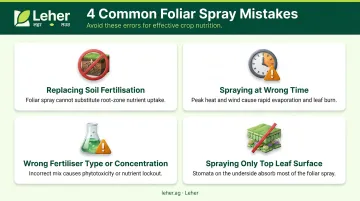
Foliar spraying is straightforward in principle but easy to get wrong. These four mistakes account for most failed applications in the field:
- Replacing soil fertilisation with foliar spray. Without adequate root-zone nutrition, foliar spray alone cannot sustain crop health. The two must work together — this is the most common field-level error.
- Spraying at the wrong time. Midday application combines fertiliser salt concentration with heat stress, and burn is the reliable result. Spraying just before rain is equally wasteful: the application washes off before any absorption occurs.
- Wrong fertiliser type or concentration. Granular fertilisers leave surface residue with no foliar uptake. Applying soil-rate concentrations to leaves causes phytotoxicity. When mixing foliar fertilisers with pesticides or herbicides, always run a jar test first — the University of Arkansas Extension documents how incompatible mixes form precipitates, alter spray pH, and cause crop injury. Test on a small area before full-field application.
- Spraying only the top leaf surface. Most farmers skip the undersides, yet the stomata-rich lower surface is where the majority of nutrient entry occurs. There is no visible sign this was done wrong, which is why it goes uncorrected.
Frequently Asked Questions
Can foliar spray replace soil fertilisation entirely?
No. Foliar spray delivers nutrients in quantities too small to meet macronutrient demand, and it has no residual effect. Healthy root-zone soil nutrition must be maintained alongside any foliar programme.
What is the best time of day to apply foliar fertiliser?
Early morning or late evening during cooler, low-wind conditions when stomata are active and evaporation is slow. Avoid midday application — heat concentrates fertiliser salts on leaf surfaces and causes burn.
Which nutrients work best as foliar sprays?
Micronutrients (iron, zinc, manganese, copper, boron) and secondary nutrients (calcium, magnesium) respond best. Macronutrients like nitrogen and phosphorus are impractical at foliar rates — the concentrations required for meaningful uptake carry a high burn risk.
How often should foliar fertiliser be applied?
Repeat applications are needed as there is no residual effect. TNAU's rice zinc protocol recommends 2–3 applications every 10–14 days; nitrogen deficiency correction calls for weekly intervals until symptoms resolve. Always follow crop- and nutrient-specific guidance.
Can foliar spray cause leaf burn, and how do I prevent it?
Yes — the two main causes are over-concentrated solution and midday high-temperature application. Use the label's foliar-specific rate, spray during cooler morning or evening hours, and test on a few plants before full-field application.
Is foliar fertiliser effective for all crops?
Effectiveness varies. Crops with thin cuticles — young tomatoes, leafy vegetables — absorb foliar nutrients readily. Thick-cuticled crops like mature brassicas and onions need a spreader-sticker adjuvant and more frequent applications.