Introduction
Indian farmers are caught between two hard realities: input costs keep climbing while the land available to farm keeps shrinking. Average operational holdings have dropped to 1.08 hectares, and small and marginal farms now account for 86% of all holdings across the country. At the same time, groundwater extraction in Punjab has hit 163% of sustainable levels — meaning farmers are drawing down reserves that won't recover easily.
Against this backdrop, precision agriculture offers a direct response: applying water, fertiliser, and pesticide only where and when crops actually need them. On a 1-hectare holding with thin margins, that accuracy isn't a luxury — it's what keeps the farm viable.
This article breaks down the concrete, on-ground benefits of precision agriculture for Indian farming conditions — where landholdings are small, rainfall is unpredictable, and there is no buffer for wasted inputs.
Key Takeaways
- Precision agriculture uses data, sensors, and targeted tools to apply inputs only where and when crops actually need them
- Key outcomes: lower water and pesticide use, reduced per-acre costs, and more consistent yields
- Works for small and marginal farms, including through service-based models that require no equipment ownership
- Drone spraying services like Leher have recorded up to 90% water savings and 30% pesticide reduction across Indian farms
- Starting with one precision tool and tracking results each season delivers growing returns over time
What Is Precision Agriculture?
Precision agriculture is the use of data-driven tools to manage crops and resources with greater accuracy — replacing uniform, guesswork-based decisions with targeted, field-specific ones.
It applies across the entire crop cycle:
- Soil preparation — soil sensors and mapping identify nutrient gaps before planting
- Seeding and planting — GPS-guided equipment ensures accurate spacing and placement
- Irrigation — moisture sensors trigger water delivery only when and where soil is dry
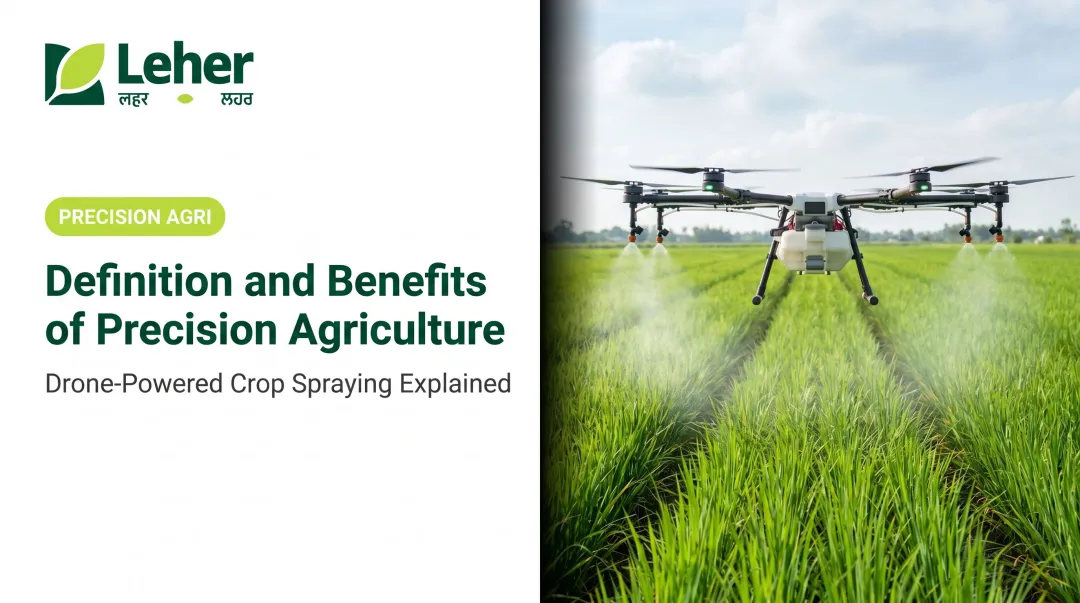
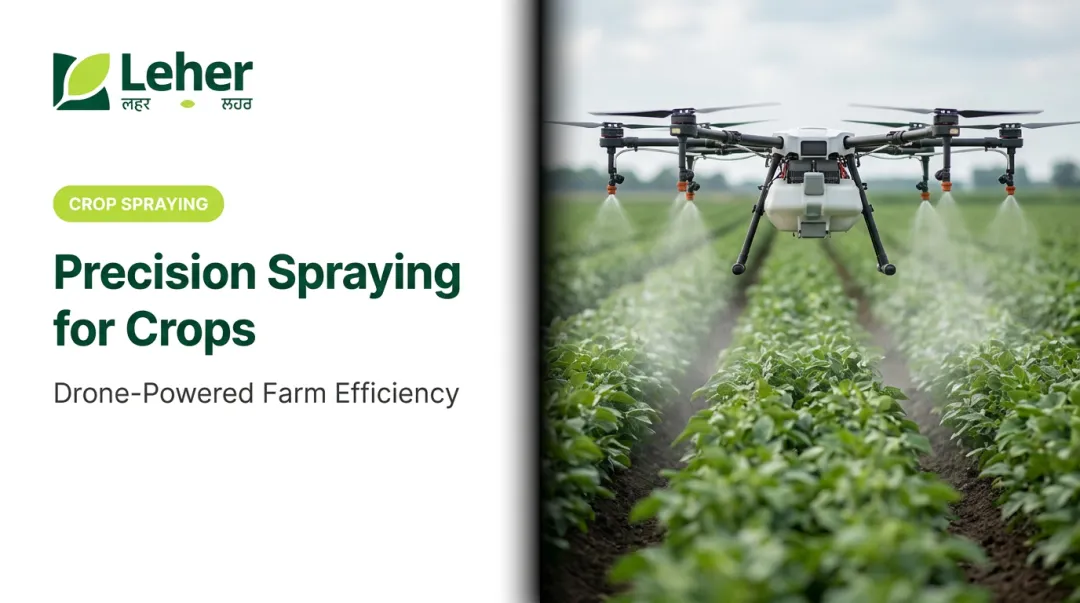
- Spraying — variable rate technology and drone-based systems target specific field zones, applying pesticides or fertilizers only where crops actually need them
- Harvesting — yield monitors record output variability across the field for future planning
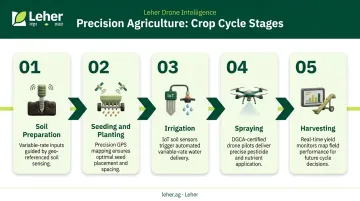
The FAO describes precision agriculture for smallholder farmers as a data-driven approach that improves productivity while reducing environmental footprint. When you know exactly what each part of your field needs, inputs go where they create value — and nowhere else.
Key Benefits of Precision Agriculture
For Indian farmers managing rising input costs, unpredictable monsoons, and soil stress, precision agriculture delivers measurable gains across three areas: profitability, land health, and crop monitoring.
Reduced Input Costs and Higher Farm Profitability
The most immediate benefit of precision agriculture is what it removes from your costs: wasted water, excess fertiliser, unnecessary pesticide applications, and the fuel to apply them.
Variable rate technology lets farmers apply fertiliser and pesticides at different rates across different zones of the same field — rather than applying the same amount everywhere regardless of actual soil condition or pest pressure. The result is less product used, less money spent, and no compromise on yield.
A 2021 study by the Association of Equipment Manufacturers (AEM) — conducted in the US context — found:
- 9% reduction in herbicide and pesticide use
- 7% improvement in fertiliser placement efficiency
- 6% reduction in fossil fuel use
- 4% increase in overall crop production
For Indian conditions, NITI Aayog and ICAR-NIAP reported that micro-irrigation — one of the most widely adopted precision water management tools — delivers:
- Water savings of 16% to 51% depending on crop and region
- Fertiliser savings of 12% to 37%
- Operational cost reductions of 25% to 40%
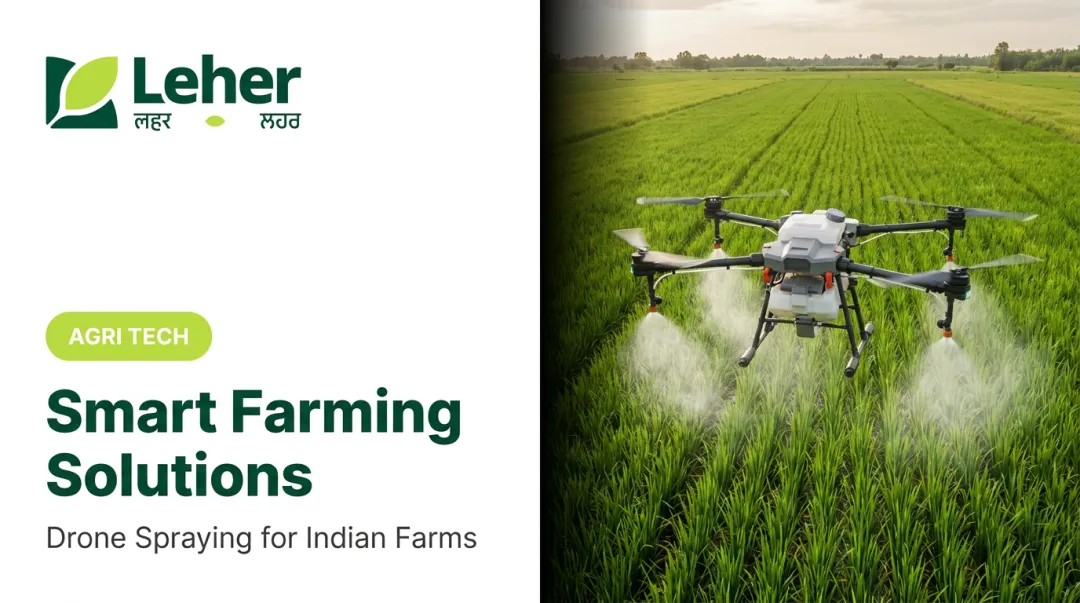
On the spraying side, Leher's drone-based precision spraying service has recorded approximately 90% water savings and around 30% reduction in pesticide use compared to conventional manual spraying across sugarcane, paddy, cotton, wheat, and vegetable crops in Indian field conditions. For rubber plantations specifically, Leher has documented up to 50% savings per hectare per round of spraying.
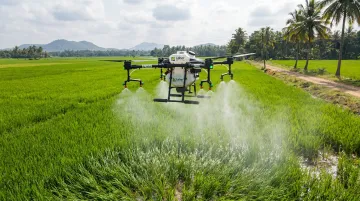
KPIs affected: cost per acre, fertiliser expenditure, pesticide spend, water consumption per crop cycle, net farm income.
Environmental Sustainability and Healthier Land
Precision agriculture's environmental case in India is not abstract. Nearly 30% of India's total geographic area is under some form of land degradation or desertification. Soil Health Card data shows 49% of sampled soils in India fall in the low organic carbon category, with average soil organic carbon sitting around 0.54% — well below healthy thresholds.
Uniform over-application of inputs accelerates this decline: excess water causes nutrient leaching, while excess pesticide disrupts soil biology, contaminates groundwater, and harms pollinators.
Precision practices interrupt this cycle:
- Targeted spraying prevents chemical drift into neighbouring plots and waterways
- Precision irrigation reduces over-saturation that causes nutrient runoff
- Lower chemical volumes mean less residue accumulating in soil across seasons
A 2024 peer-reviewed study found that pesticide residues in Indian surface water, groundwater, and soil already exceed WHO and BIS limits in several regions. Pesticides are currently applied to 16.7 million hectares of India's cultivated land. Reducing application volumes — even by 20–30% — across that area would materially change the contamination trajectory.
For crops where chemical intensity is already high — cotton, rice, sugarcane — and in states like Uttar Pradesh, Maharashtra, and Punjab where pesticide consumption is highest, precision spraying creates the most direct environmental benefit.
Improved Crop Monitoring and Smarter Decision-Making
Without field-level visibility, farmers can only react. A pest outbreak, a nutrient deficiency, water stress — by the time these are visible to the eye, yield loss has already begun.
Precision agriculture shifts this dynamic through early detection. Tools like drone-based remote sensing, in-ground moisture sensors, and crop health indices give farmers a detailed picture of what's happening in specific field zones before problems escalate.
Key monitoring capabilities include:
- Drone-based aerial imagery — identifies crop stress, uneven growth, and early pest infestation across the full field in a single pass
- Soil moisture sensors — trigger irrigation based on actual dryness, not a fixed schedule
- Yield monitors — record output variability across zones, building a decision-making baseline for the following season
- NDVI mapping — flags low-health zones that need targeted intervention
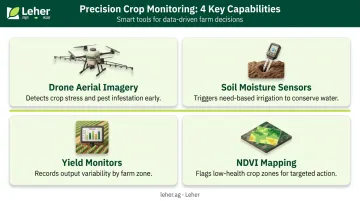
Early interventions cost less than emergency applications after damage sets in. A rice-wheat farming study in Karnal, India, found that precision water management increased net farm income by 18–23% and economic efficiency by 42–58% compared to conventional methods. Those gains trace back directly to earlier detection and faster response.
The ICAR-linked Indian Journal of Agricultural Sciences estimates that biotic stress — pests, weeds, and disease — causes 33% overall yield loss in India, with weeds alone accounting for 12.5%. Monitoring tools that catch these threats early cut directly into that figure.
What Happens When Precision Agriculture Is Ignored
Conventional uniform farming carries a hidden cost — one that grows larger with every season it goes unchallenged.
Over-application of water, fertiliser, and pesticide adds direct expense without matching yield gains. Gaps in treatment — areas that needed more than the uniform rate received — cause uneven crop growth and unpredictable harvests. Each season becomes harder to plan and budget.
Without field-level data, farmers respond to symptoms rather than causes. A sudden pest infestation triggers an emergency spray. Yellowing leaves mean extra fertiliser across the whole field, even if only one zone was deficient. The costs accumulate, but the root problem — unaddressed field variability — remains.
Repeated reactive cycles do more than strain budgets — they degrade the land itself:
- Soil organic carbon depletes from repeated over-application of chemicals and water
- Groundwater tables drop as irrigation continues beyond actual crop need
- Input dependency increases as degraded soil requires more inputs to produce the same output
- Farm economics deteriorate as cost-per-yield ratios worsen each season
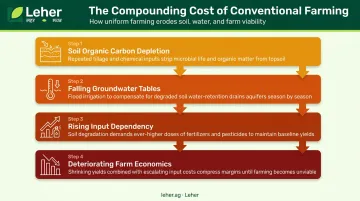
India already has 49% of sampled soils in the low organic carbon category. Continuing conventional practices accelerates this trajectory — and with it, the long-term viability of the farm as a productive asset.
How to Get the Most from Precision Agriculture
Precision agriculture doesn't require a wholesale technology overhaul to start delivering results. The value comes from consistent adoption and honest tracking — not from adopting every available tool at once.
Start with one entry point and measure from it:
- Choose a single precision tool — drone-based spraying, soil moisture sensors, or GPS-guided application
- Record baseline data — input volumes, costs per acre, and yield before the first season of use
- Track outcomes after each season — what changed in cost, yield, or input volume?
- Reinvest the savings — into the next layer of precision practice
For small and marginal farmers in India, the most practical entry point is a service-based model rather than equipment ownership. Through the Leher App, farmers can book on-demand drone spraying sessions — a trained DGCA-certified pilot arrives at the farm, sprays the crop, and payment happens only after the job is done. No upfront equipment purchase required, no maintenance overhead.
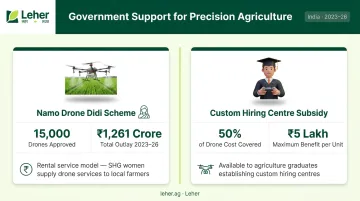
Government policy has made this service-access model more viable than ever. The Namo Drone Didi scheme approved 15,000 drones for women Self Help Groups to provide rental services to farmers, backed by a ₹1,261 crore outlay for 2023–26. Agriculture graduates establishing Custom Hiring Centres qualify for 50% of drone costs up to ₹5 lakh. Together, these schemes lower the barrier to entry for most Indian smallholders.
Each documented season narrows the guesswork — farmers who track input costs and yield across two or three cycles consistently identify where the next round of savings is hiding.
Conclusion
Precision agriculture's core value is control — over inputs, over information, and over outcomes. It replaces uniform guesswork with field-specific decisions, cuts over-application of water and inputs that uniform practices miss, and creates the conditions for a farming operation that improves season by season rather than degrades.
For Indian farmers managing small holdings, uncertain rainfall, and rising input costs, the entry point doesn't have to be complex. A single precision tool, applied consistently and measured over time, starts a compounding cycle that improves profitability and protects the long-term productivity of the land. For many farmers, drone-based spraying has become that first step: lower water use, more precise input coverage, and results visible within a single season.
Frequently Asked Questions
What are the 4 R's of precision agriculture?
The 4 R's stand for Right Source, Right Rate, Right Time, and Right Place. They form a framework for applying inputs like fertiliser and water precisely where and when crops need them — minimising waste and maximising the return on every input rupee spent.
How does precision agriculture reduce costs for farmers?
By applying water, fertiliser, and pesticides only where and when required, precision agriculture eliminates over-application. This directly lowers per-acre input costs while maintaining or improving yield — with Indian farmers reporting input cost reductions of 25–40% through precision methods like drone spraying.
Is precision agriculture suitable for small and marginal farmers in India?
Yes — service-based models remove the equipment barrier entirely. Through the Leher App, farmers book a drone spraying session, a certified pilot arrives at the farm, and payment is made only after the job is done — at per-acre rates, not upfront capital costs.
What is the role of drones in precision agriculture?
Agricultural drones handle precision spraying, crop health monitoring, and remote sensing. They enable targeted treatment of specific zones, cutting chemical and water use while giving farmers real-time data on crop stress, pest presence, and growth variability.
How does precision agriculture benefit the environment?
Precision agriculture reduces chemical runoff, lowers water consumption, decreases emissions from farm machinery, and slows soil degradation. In Indian conditions — where nearly 30% of land is already degraded — these outcomes directly extend the long-term productive life of agricultural land.
What is the difference between traditional farming and precision agriculture?
Traditional farming applies inputs uniformly across an entire field regardless of actual need. Precision agriculture uses data and technology to tailor inputs to specific field conditions — resulting in less waste, lower costs, and more consistent outcomes across the crop cycle.