
Aerial fertilizer application — the delivery of fertilizers to crops via airborne vehicles such as fixed-wing aircraft, helicopters, or drones, without ground equipment entering the field — directly solves this problem.
This guide is for Indian farmers, agribusinesses, and drone operators dealing with inaccessible terrain, flooded fields, or large-scale crop nutrition needs. Understanding how aerial application works, when it makes agronomic sense, and how to execute it correctly is what separates a timely intervention from an expensive mistake.
Key Takeaways
- Aerial fertilizer application delivers nutrients from the air while reducing the need for in-field ground machinery
- Most valuable when fields are flooded, crops are too tall for machinery, or terrain is unreachable
- Drones, fixed-wing aircraft, and helicopters are the main platforms; each suits different farm sizes and crop conditions
- Fertilizer type, weather conditions, and application timing determine whether it delivers uniform coverage
- It's a targeted intervention tool, not a default replacement for ground-based methods
What Is Aerial Fertilizer Application?
Aerial fertilizer application is the dispersal of fertilizer (liquid, granular, or soluble) over crop fields using aircraft or agricultural drones. It delivers nutrients without driving tractors or sprayers through the crop.
The goal is simple: get nutrients to crops on time when ground equipment cannot enter the field, especially during growth stages where delayed fertilization can reduce yield.
In India, the practical version is often drone-based foliar fertilizer spraying, because drones can work over wet fields, tall crops, and irregular plots with less crop disturbance.
Three related terms are worth distinguishing:
- Aerial fertilizer spraying: Liquid or soluble formulations, such as foliar blends or UAN solutions, delivered via boom nozzles onto foliage or the soil surface
- Aerial topdressing: Dry granular fertilizers, commonly urea, broadcast from aircraft; the New Zealand Ministry for Primary Industries notes fixed-wing aircraft applying dry bulk fertilizer on hill-country farms as a long-running topdressing practice
- Aerial pesticide application: Uses the same delivery method but applies plant protection products, not nutrients; in India, drone spraying operators must follow applicable DGCA operating rules and label directions for the input being applied
Why Aerial Fertilizer Application Is Used
The Agronomic Case for Timing
Nitrogen applied outside the critical window can reduce final yield, not just underperform. LSU AgCenter rice trial data found that pre-flood urea applied 1–5 days before flooding produced similar yields to optimal timing.
The same trials showed yield losses of 10% when application was 10 days before flooding and 20% at 15 days. When ground equipment can't enter a flooded field, aerial application may be the only way to stay inside that window.
Conditions That Make Aerial Methods Necessary
The NAAA confirms that aerial application is specifically suited for crops on rolling hills or in fields with soil too wet for ground machinery. In practice, this covers a wide range of Indian farming conditions:
- Waterlogged or flood-affected fields: paddy fields during active flood irrigation cycles
- Dense or tall-canopy crops: sugarcane and mature cotton where ground rigs cause physical crop damage
- Hilly or steep terrain: tea and rubber plantations on slopes where tractors can't operate safely
- Large contiguous blocks: farms where rapid coverage across hundreds of acres is critical
Without aerial access in these scenarios, crops can miss their effective fertilizer window. The result is mid-season nutrient deficiency that late application may not fully correct.
For foliar fertilizer, app-booked drone spraying services such as Leher help farmers apply nutrients when tractors would damage the crop or sink in wet soil.
How Aerial Fertilizer Application Works
The End-to-End Process
- Identify the need: Confirm crop growth stage, nutrient deficiency symptoms, or scheduled application window
- Select the fertilizer formulation: Choose liquid foliar blends, UAN (urea ammonium nitrate at 28% or 32% N), or granular urea for topdressing
- Engage an aerial service provider: Book a DGCA-certified drone pilot through an app such as Leher, or contract a licensed aerial operator
- Plan the flight: Set application rate, swath width, altitude, and buffer zones to prevent drift onto non-target areas
- Execute in parallel passes: Fly systematic lines over the crop at low altitude
- Monitor post-application: Check for nutrient uptake signs or phytotoxicity (leaf burn) over 10–14 days
Fertilizer Selection and Preparation
Liquid fertilizers are often preferred for foliar aerial spraying because they calibrate precisely, distribute uniformly through nozzles, and deposit directly on foliage. Common options include:
- UAN solutions (28–32% N) for cereal topdressing; K-State Extension warns that broadcast UAN above about 94 litres/hectare (10 gallons/acre) can cause leaf burn on young wheat
- Foliar micronutrient blends: Zinc, boron, and iron in chelated or soluble form; most effective aerially during vegetative stages
- Water-soluble NPK formulations: Useful for in-season supplemental feeding
Granular dry urea (46-0-0) is used for aerial topdressing but requires spreader-equipped aircraft and carries volatilization risk of 30–44% N loss when applied to moist soil followed by slow drying. NBPT-coated urea can inhibit volatilization for 2–10 weeks, buying time for rainfall or irrigation to incorporate the nitrogen.
Pre-Application Planning
Before any aircraft or drone takes off, confirm:
- Crop growth stage matches the target application window
- Wind speed is within acceptable limits (even moderate wind causes drift)
- Carrier water quality is suitable for liquid formulations
- Application volume per hectare matches the agronomic recommendation
Execution and Post-Application
The aircraft makes systematic parallel passes while a ground crew manages refilling at a staging point. A typical agricultural drone with a 10-litre tank moving at 5 m/s covers 1 acre (about 0.4 hectare) in approximately 5–7 minutes, according to Government of India Farmech/DAC nutrient-drone SOPs. After application, compare treated versus untreated zones over the following two weeks and watch for any signs of phytotoxicity.
Equipment Used for Aerial Fertilizer Application
The Three Platform Categories
| Platform | Best For | Key Limitation |
|---|---|---|
| Fixed-wing aircraft (for example, Air Tractor AT-802A with an 800-gallon hopper and 130–160 mph working speed) | Very large-scale operations; ~1,800 acres in a 12-hour day | Requires airstrip access; impractical for fragmented Indian holdings |
| Helicopters | Irregular, smaller, or terrain-complex fields | Higher operating cost; limited availability for routine farm spraying in India |
| Agricultural drones (UAVs) | Small-to-medium farms, inaccessible terrain, precision applications | Smaller payload; battery/refill logistics need ground crew |
Agricultural Drones in the Indian Context
For many Indian farms, drones are the most practical aerial fertilizer platform. As of early 2026, India had 38,500+ UIN-registered drones and 39,890 DGCA-certified remote pilots , an ecosystem that has grown substantially in just a few years and now underpins precision agriculture alongside land mapping, infrastructure, and other uses.
Leher's hexacopter agricultural drones use this service model for GPS-guided foliar fertilizer spraying with DGCA-certified pilots and liquid payloads. A single operator can cover up to 50 acres per day, depending on crop, field layout, and refill logistics.
Farmers book spraying sessions through the Leher App:
- Schedule the foliar fertilizer spray for a suitable date
- Receive a trained pilot at the farm on the scheduled day
- Pay after the spraying job is completed
Leher reports ~90% water savings and ~40% input savings compared to conventional spraying. Its service covers paddy, wheat, sugarcane, cotton, vegetables, tea, and rubber.
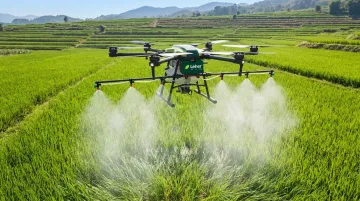
Leher's drone service is specifically suited to the terrain challenges that make aerial application necessary: waterlogged paddy fields, hillside tea and rubber estates, and dense-canopy crops where ground rigs cause damage.
For granular fertilizer topdressing, Leher-style drone spraying is designed for liquid foliar applications. Granular aerial topdressing usually requires spreader-equipped aircraft rather than standard spraying drones.
Key Factors That Affect Aerial Fertilizer Application
Getting the execution right matters as much as the decision to apply aerially. These five factors determine whether an aerial application delivers agronomic value or wastes input cost:
- Fertilizer formulation and concentration — High-strength liquids reduce spray volume but raise phytotoxicity risk; granular products need different spreading equipment.
- Weather conditions — Wind speed drives drift, while high temperatures can evaporate droplets before they reach the crop.
- Application timing relative to crop stage — Nitrogen applied at active tillering in rice or wheat usually gives the strongest response.
- Aircraft speed, altitude, and swath width — These settings control coverage uniformity; poor calibration creates streaks, skipped strips, or overlap zones.
- DGCA regulatory compliance — Drone operators in India must follow the Drone Rules, 2021 and Ministry of Agriculture SOPs for nutrients and agrochemicals.
For drone compliance, confirm the operator has a valid remote pilot licence, uses a DGCA-approved drone, follows green/yellow/red zone restrictions, and stays within the 400 ft / 120 m green-zone ceiling.
Before booking a spray, farmers and FPOs should confirm the crop stage, input label, weather window, and operator credentials. For app-booked services such as Leher, the trained pilot handles route planning and calibration, but agronomic timing still decides the result.
Subsidy note: FPOs can receive grants up to 75% of drone cost for demonstration use. Small/marginal, SC/ST, women, and North-East farmers are eligible for 50% assistance up to ₹5 lakh under SMAM.
Common Issues, Misconceptions, and When Not to Use Aerial Application
Misconception: Aerial Application Is Always Less Precise
Modern GPS-guided drones with calibrated nozzles can match the coverage uniformity of well-operated ground equipment, especially when tractor booms would skip, bog down, or damage the crop. In those cases, the precision concern is less about the aircraft and more about whether ground access is realistic.
Where Teams Misuse It
Aerial application is sometimes chosen for convenience rather than agronomic need. If a sprayer can enter the field without rutting soil or injuring the crop, the added cost rarely delivers a proportional yield benefit.
For Leher’s app-booked spraying model, this screening step matters before a DGCA-trained pilot is dispatched. The method should be selected when ground-based alternatives are genuinely impractical, not simply because aerial spraying is available.
When Aerial Application Should Be Avoided
Do not apply aerially:
- Soil-incorporated fertilizers: anhydrous ammonia must be injected, not broadcast from above
- Immobile nutrients such as phosphorus and potassium: crops get limited benefit when placement stays above the root zone
- High wind or rain-imminent conditions: drift and nutrient washoff can turn the pass into a loss
- Small, obstacle-heavy plots: power lines, trees, and structures create safety and coverage problems
Managing Urea Volatilization Risk
The fear that aerially applied urea always causes high nitrogen loss is overstated, but the risk is real. Losses of 30–44% N can occur under worst-case conditions, such as moist soil followed by slow drying.
Reduce that risk with three checks:
- Use NBPT-treated urea to slow urease activity until rain or irrigation moves urea into the soil
- Schedule the pass when rainfall or irrigation is likely within 24–48 hours
- Avoid peak-temperature hours, when evaporation is fastest
Frequently Asked Questions
What is aerial application?
Aerial application uses aircraft, helicopters, or drones to spread farm inputs such as fertilizers, pesticides, or seeds over crop fields. Farmers use it when ground machines cannot enter due to terrain, crop height, wet soil, or tight timing.
What is the foliar method of fertilizer application?
Foliar application means spraying a diluted nutrient solution directly onto crop leaves, where nutrients absorb through the leaf surface. It works best for micronutrients and secondary nutrients, and drones can apply it when ground equipment cannot enter.
What fertilizers can be applied aerially?
Liquid UAN, foliar micronutrient blends, and water-soluble NPK formulations suit aerial spraying. Dry urea can be topdressed with spreader-equipped aircraft, but fertilizers needing soil incorporation, such as phosphate, potassium, and anhydrous ammonia, are not suitable.
What are the main disadvantages of aerial fertilizer application?
The main drawbacks are higher per-application cost, spray drift risk in wind, limited fertilizer compatibility, and the need for certified pilots and regulatory compliance. Granular applications also carry volatilization risk if timing is poor.
Is drone-based aerial fertilizer application better than traditional aircraft spraying?
Drones are better for small-to-medium Indian farms because they need no airstrip, handle smaller plots, and spray with high precision. Traditional aircraft still suit very large farms where payload capacity and speed matter more.
Is aerial fertilizer application suitable for small farms in India?
Fixed-wing aerial application is usually uneconomical for small plots. Drone services booked per session through platforms like the Leher App make aerial fertilization practical for smallholders, especially in hilly, waterlogged, or hard-to-access fields.