Introduction
India feeds over a billion people, yet most of the farmers behind that effort are working with almost no data. According to the Agriculture Census 2015-16, 86.08% of India's 146.45 million operational holdings are smaller than 2 hectares — and the average farm has shrunk to just 1.08 hectares.
These smallholders largely depend on generalised seasonal advice and ancestral knowledge to decide what to spray, when to irrigate, and how much fertiliser to apply. Input waste, preventable crop losses, and thinning incomes follow.
Precision agriculture addresses this directly. Instead of regional generalisations, it delivers field-specific decisions grounded in real data on soil health, water availability, and crop conditions. India is at an early stage of this transition, but the pace is picking up. Affordable entry points like micro-irrigation, drone spraying services, and mobile advisory apps are making precision tools accessible beyond large commercial farms for the first time.
Key Takeaways
- Precision agriculture delivers the right input, in the right place, at the right time — cutting waste and lifting yields.
- Core technologies include drones, IoT sensors, GPS/GIS, remote sensing, and machine learning.
- Micro-irrigation has the widest footprint in India; drone-based spraying is the fastest-growing entry point.
- Key barriers: high upfront costs, fragmented holdings, limited digital literacy, and patchy rural connectivity.
- Government schemes and agri-tech startups are bridging the access gap — especially through service-based models.
What Is Precision Agriculture? The 3 R's Explained
What Is Precision Agriculture? The 4 R's Explained
The FAO describes precision agriculture as a data-driven farm management approach that improves productivity, yields, and profitability by giving crops and soil exactly what they need — nothing more, nothing less.
The operating logic is built around the 4 R's: the Right input, at the Right rate, in the Right place, at the Right time. A practical example: instead of spreading a uniform dose of urea across an entire paddy field, a farmer using a Leaf Colour Chart applies nitrogen only to the sections showing deficiency — cutting waste and protecting waterways from excess runoff.
More Than a Single Tool
Precision agriculture covers a range of tools that farmers select based on farm size, crop type, and budget:
- Low-cost entry tools — Leaf Colour Charts, soil test kits, drip lines
- Mid-tier tools — IoT soil sensors, mobile advisory apps, GPS guidance
- Advanced tools — Satellite remote sensing, variable-rate applicators, AI-powered yield prediction
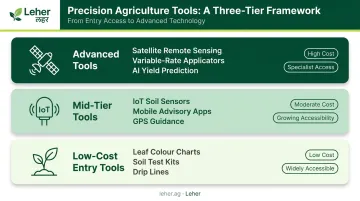
This range matters in the Indian context. A smallholder in Telangana and a commercial grape grower in Maharashtra will use different tools, but both can access some form of precision farming without investing in the complete set.
Key Technologies Powering Precision Farming in India
Precision farming in India isn't one technology — it's a layered toolkit. What a smallholder in Haryana needs differs from what a large sugarcane estate in Maharashtra requires. Understanding what each technology actually does helps farmers and agribusinesses pick what fits.
Drones and UAVs: Aerial Coverage at Low Cost
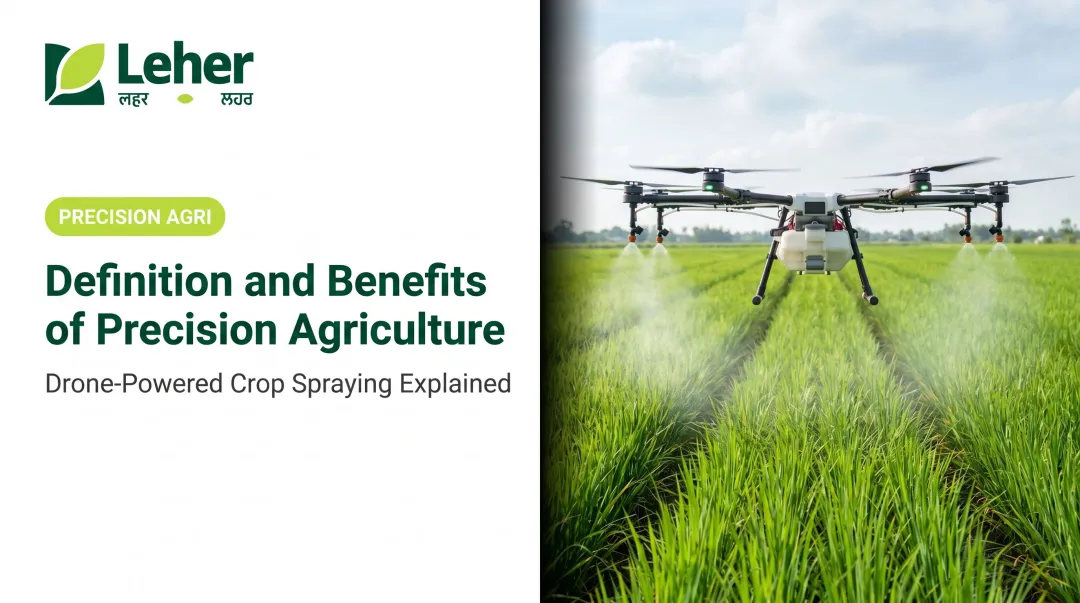
Agricultural drones give farmers an aerial view of their fields that simply wasn't available before. Multispectral imaging can detect crop stress, pest pressure, and nutrient deficiencies weeks before visible symptoms appear — allowing targeted intervention rather than blanket treatment.
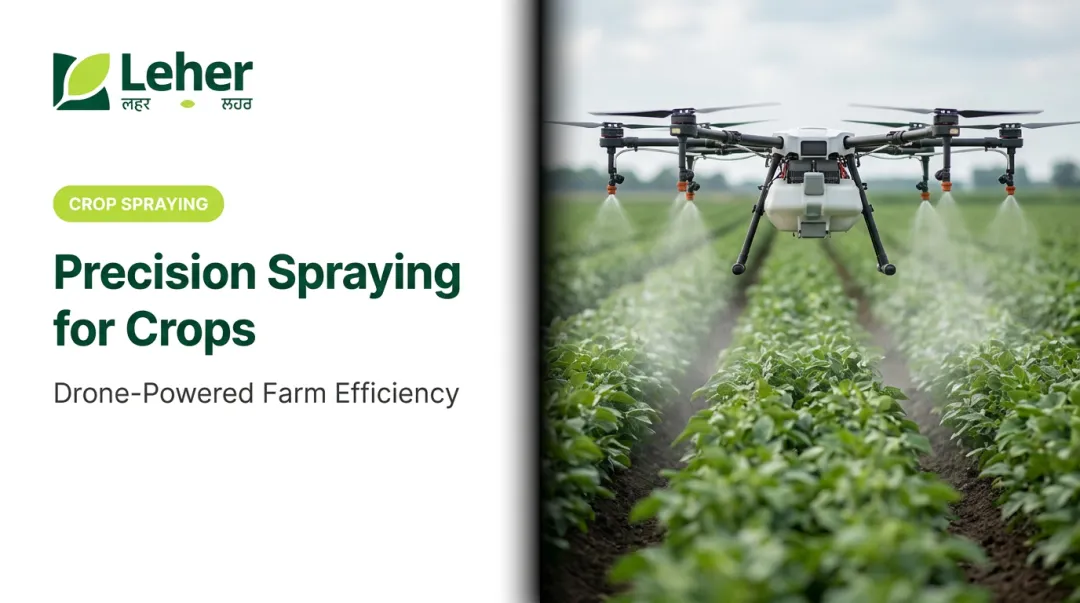
The water efficiency numbers are striking. ICAR research on drone-based potato spraying found drones used just 20 litres per hectare versus 500–750 litres with conventional spraying. A paddy efficiency study recorded drones covering 9 acres in 1.2 hours versus 34.3 hours manually — a 28.6x time advantage.
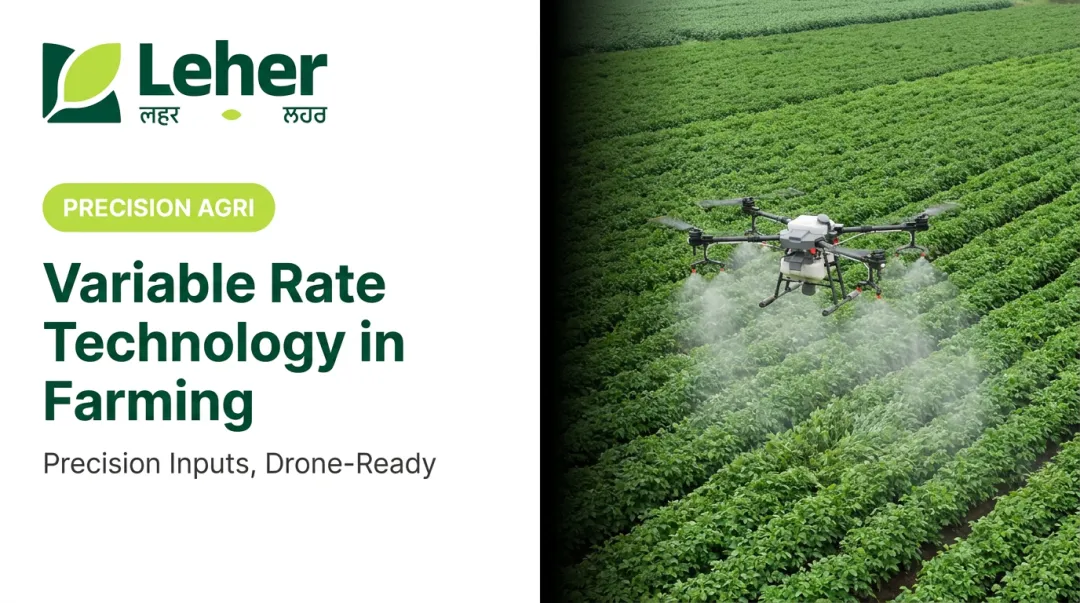
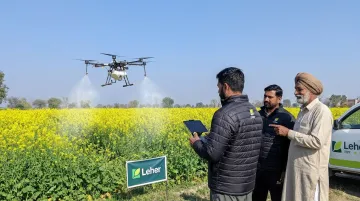
For Indian smallholders, the more important development is the drone-as-a-service model. Farmers don't need to own equipment. Companies like Leher deploy DGCA-certified pilots who arrive at the farm, spray the crop, and leave — with the farmer paying only after the job is done. Leher's drone spraying service reduces pesticide use by up to 30% and water consumption by up to 90% compared to conventional methods, and in 2024 alone the company served 6,500+ acres across 810+ farmers. This service model sidesteps the capital barrier entirely.
IoT Sensors and Soil Intelligence
Where drones observe from above, IoT sensors work from the ground up. Low-cost sensor kits can monitor soil nitrogen, phosphorus, potassium (NPK), pH, moisture, temperature, and humidity in near real-time. This data feeds advisory systems that tell farmers exactly what their specific plot needs — not a district-wide average recommendation.
Indian startups like Fasal offer precision soil-moisture sensors paired with crop-stage recommendations via mobile. Prototype systems using Arduino-type microcontrollers bring sensor costs within reach of smallholders, though deployment at national scale remains limited.
Remote Sensing, GPS, and AI Advisory
Satellite-based remote sensing and GPS/GIS tools allow farmers to map fields precisely, identify spatial variability within a single plot, and build yield maps. A practical example: laser land levelling in the north-western Indo-Gangetic Plains reduced rice-field irrigation time by 47–69 hours per hectare per season and improved yield by approximately 7%.
AI-powered advisory tools are addressing a different barrier: access. Several notable examples show the range of approaches:
- The ICRISAT–Microsoft AI Sowing App delivered sowing advisories without requiring app installation, using weather and soil data to recommend optimal windows
- IFPRI has documented generative AI voice advisories delivering agronomic guidance in Telugu, tackling the language barrier directly
- Offline-capable apps with regional-language support extend reach into low-connectivity rural areas where smartphone data is intermittent
Together, these tools bring plot-specific guidance to farmers who previously relied on generalised extension advice — or none at all.
Where Does India Stand? Adoption on the Ground
Precision agriculture in India is at a nascent stage. Current adoption concentrates in two areas: nutrient-use efficiency (NUE) tools like Leaf Colour Charts and optical sensors, and water-use efficiency (WUE) tools dominated by micro-irrigation.
Micro-Irrigation: The Widest Footprint
The PMKSY Per Drop More Crop scheme has covered 96.97 lakh hectares as of March 2025 — 46.37 lakh hectares under drip irrigation and 50.60 lakh hectares under sprinkler systems. This is the most scaled precision-input technology in India by any measure. Karnataka, Andhra Pradesh, Gujarat, Tamil Nadu, and Maharashtra lead physical achievement under the scheme.
Who Is Adopting Full Precision Packages?
The full precision agriculture package — GPS guidance, VRT equipment, soil sensors, drone monitoring — is viable primarily for:
- Semi-medium to large progressive landowners
- Commercial horticulture farms growing fruits, vegetables, and flowers
- Cooperative farms and FPOs with shared equipment economics
Tamil Nadu leads through the TNPFP (Tamil Nadu Precision Farming Project), which started in 2004–05 in Dharmapuri and Krishnagiri and scaled to 40,000 hectares covering crops like mango, banana, papaya, tomato, and chillies. Punjab and Haryana have adopted laser land levelling and optical N-sensors for wheat at meaningful scale.
The Service Model Changes the Equation
India's average holding size of 1.08 hectares makes hardware-heavy models difficult to justify. A drone that costs ₹5–10 lakh doesn't make economic sense on a 1-hectare plot. But a service that charges per acre — where a certified pilot brings the technology to the farm — removes that barrier.
This is why app-booked, pay-per-acre spraying services like Leher's offer a more practical route to adoption for India's 86% smallholder majority than individual equipment ownership. A farmer accesses precision spraying without capital outlay; a trained operator builds a viable rural business on per-acre revenue.
Measurable Impact: What Precision Agriculture Delivers
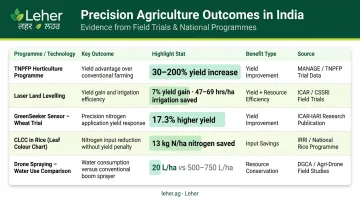
The evidence base for precision agriculture outcomes in India is growing, though much of it comes from project-specific or older studies. Here's what the data shows:
Yield and Input Savings
| Technology | Measured Outcome | Source |
|---|---|---|
| TNPFP horticulture | 30–200% yield advantage vs. conventional | CEEW review |
| Laser land levelling | ~7% yield improvement; 47–69 hrs/ha irrigation saved | Peer-reviewed IGP study |
| GreenSeeker + Nutrient Expert in wheat | 17.3% higher yield at 153–158 kg N/ha vs. blanket 120 kg | ICAR field trial |
| CLCC in rice | 13 kg N/ha saving (18.3% below farmer practice) | NRRI/KVK field study |
| Drone spraying (paddy) | 20 L/ha water used vs. 500–750 L/ha conventional | ICAR |
Environmental and Water Benefits
With nearly 97 lakh hectares now under micro-irrigation, water efficiency is where precision agriculture is already delivering at scale across India:
- Drip and sprinkler systems reduce water consumption compared to flood irrigation — a shift reflected in the rapid expansion of these systems nationwide.
- Drone spraying compresses water use from hundreds of litres per hectare to under 20 litres, with operators like Leher reporting up to 90% water savings versus conventional spraying methods.
- Laser land levelling reduces GHG emissions through energy savings and reduced cultivation time — though national-scale percentage figures haven't been published yet.
- Precision fertiliser management via CLCC can reduce urea use by 18.5–27.3% at equivalent yields, with associated reductions in nitrate leaching, according to CEEW's review of Indian trials.
Lower pesticide volumes and reduced chemical runoff also ease pressure on soil microbiomes, pollinators, and water bodies near farmland — an ecological benefit that compounds over growing seasons.
Why Adoption Remains Limited in India
Three structural barriers repeatedly appear across research and field evidence:
Cost and Risk Aversion
The full precision agriculture hardware package — GPS guidance, VRT equipment, soil sensors — is cost-prohibitive for most Indian farmers. The NSS 77th Round found average monthly income per agricultural household at just ₹8,337 during 2018–19. Even when long-term returns are positive, risk-averse smallholders in rainfed areas are reluctant to make large upfront investments with uncertain payback timelines.
Fragmentation, Literacy, and Connectivity
- Land fragmentation makes large machinery deployment logistically difficult — a drone service can navigate 0.5-hectare plots; a GPS-guided tractor cannot.
- Digital literacy gaps mean farmers and field staff need basic training to use advisory apps and sensor dashboards. According to the WEF, fewer than 20% of Indian farmers currently use digital technologies.
- Rural connectivity remains uneven — rural internet tele-density stood at 45.03 per 100 population as of March 2025, meaning real-time field sensor data transmission is unreliable in many farming districts.
Data Scarcity and Trust
Region-specific soil and climate datasets remain sparse across India's diverse agro-climatic zones, limiting the accuracy of ML-based advisory systems.
Farmer trust in technology-based recommendations over experiential knowledge is still developing. Solutions that accelerate real adoption tend to share a few traits:
- Involve farmers in co-design rather than top-down rollout
- Allow direct observation of results before full commitment
- Deliver visible outcomes quickly, reducing perceived risk
Government Initiatives and the Road Ahead
Several national programmes are actively accelerating precision agriculture adoption:
- Digital Agriculture Mission (approved September 2024) — ₹2,817 crore outlay covering AgriStack (geo-referenced farmer registry and crop sown registry), the Krishi Decision Support System, and Digital General Crop Estimation Survey. Pilots in UP, Gujarat, Maharashtra, Haryana, Punjab, and Tamil Nadu.
- SMAM (Sub-Mission on Agricultural Mechanisation) — supports drone acquisition for individual farmers (40–50% subsidy), FPOs (75% grant for demonstrations), and ICAR/KVK institutions (100% up to ₹10 lakh). As of February 2025, 527 drones approved for individual farmers and 1,595 for Custom Hiring Centres.
- Namo Drone Didi — ₹1,261 crore scheme targeting 15,000 drones for women Self-Help Groups during 2023–26, with 1,094 drones distributed in the first year.
- PMKSY Per Drop More Crop — ongoing micro-irrigation expansion; 55% cost subsidy for small and marginal farmers.
- 22 Precision Farming Development Centres (PFDCs) — established across agro-climatic zones to develop and disseminate affordable, India-specific PA technologies.
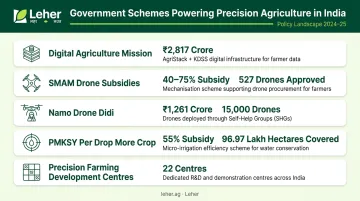
Taken together, these programmes signal a clear direction: public investment is building the infrastructure — physical, digital, and financial — that makes wider adoption viable. What happens next depends on how that infrastructure gets used.
The Realistic Path Forward
India's adoption trajectory won't follow a wholesale technology replacement model. The more likely path is gradual integration of affordable components:
- Micro-irrigation and drip fertigation continue expanding through PMKSY subsidies
- Drone services scale via CHC, SHG, and partner networks — farmers access precision spraying without owning equipment
- Mobile advisory apps with regional-language and offline capability reach smallholders through increasing smartphone penetration
- AgriStack builds the data foundation that makes AI-based advisory systems more accurate over time
The service-based model is the most practical near-term route for reaching the 86% smallholder majority. Companies like Leher send DGCA-certified pilots directly to farms: the farmer books via app, the pilot arrives and sprays, and payment happens after the job is done. No upfront capital. No equipment to own or maintain. Results visible within the same season.
Frequently Asked Questions
Is precision agriculture possible in India?
Yes — it's already happening. Micro-irrigation covers nearly 97 lakh hectares, drone spraying services are active across multiple states, and digital advisory tools reach millions of farmers via mobile. Scaling affordable, smallholder-friendly access remains the primary challenge — the technology itself is proven.
What are the R's of precision agriculture?
Precision agriculture is built on the 4 R's of nutrient stewardship: the Right input, at the Right rate, in the Right place, at the Right time. The framework applies not just to fertiliser but to water, pesticides, and seeds — ensuring every input is used where and when it actually delivers value.
What technologies are used in precision farming in India?
Current technologies include drip and sprinkler irrigation, GPS and laser land levelling, IoT soil sensors, agricultural drones for monitoring and precision spraying, satellite remote sensing, and mobile crop advisory apps powered by machine learning models trained on local soil and climate data.
What are the main benefits of precision agriculture for small farmers?
The most direct benefits are lower input costs, earlier detection of crop stress, and better planting decisions — all of which improve net income on small plots. Key gains include less fertiliser, pesticide, and water use, plus improved yields from data-informed decisions.
How are drones used in precision agriculture in India?
Drones monitor crops from the air to flag disease, pest damage, and nutrient deficiencies, and apply pesticides or fertilisers in precise, targeted doses. Drone-as-a-service models — where a certified pilot brings equipment directly to the farm — remove the need for smallholders to own hardware.
What is the difference between precision farming and traditional farming?
Traditional farming applies uniform inputs across a field based on broad regional averages. Precision farming uses real-time, location-specific data to match inputs to actual field conditions — cutting waste and improving both yields and environmental outcomes.