Introduction
Picture this: a smallholder farmer in Bihar walks his rice field on a Tuesday morning and notices yellowing patches spreading across a handful of leaves. Is it nitrogen deficiency? Bacterial blight? Rice blast? He isn't sure. The nearest agricultural extension office is two hours away. By the time he travels there, waits for an agronomist, and returns with an answer, the infection has already spread to a third of his plot.
This scenario plays out across millions of Indian farms every season. Crop diseases account for 6.5% of annual yield losses, and detection delays routinely turn contained infections into field-wide crises.
Image-based crop disease detection offers a direct solution. By analysing photographs or drone footage of plant leaves using AI algorithms, the technology can identify diseases early — often days before visible symptoms become obvious — and do so across entire fields at once.
This article covers how the technology works, the AI methods behind it, and how early detection connects to on-ground treatment for Indian farmers — including the role drone-based surveillance plays in making this scalable.
Key Takeaways
- Crop diseases cost Indian farmers 6.5% of annual yields — detection delays make losses worse
- AI models analyse leaf images through a five-stage pipeline — from capture and preprocessing through to classification — to identify disease with high accuracy
- CNNs trained on controlled datasets achieve 99.35% accuracy, but real-world field accuracy drops significantly
- Drone multispectral sensors detect plant stress before visible symptoms appear, giving farmers a critical head start
- Early detection delivers results only when paired with targeted treatment — drone-based precision spraying applies inputs exactly where disease is confirmed
Why Early Crop Disease Detection Is a High-Stakes Problem in India
India's major staple crops face a relentless disease burden:
| Crop | Key Diseases | Potential Loss |
|---|---|---|
| Rice | Blast, bacterial blight, sheath blight, brown spot | Blast alone can cause 75%+ losses during epidemics |
| Wheat | Yellow/stripe rust, brown rust, Karnal bunt | Stripe rust can cause 100% loss in susceptible varieties |
| Sugarcane | Red rot, smut, wilt | Red rot has affected Indian sugarcane for over 100 years |
| Cotton | Leaf curl disease, bacterial blight | Viral and bacterial spread is a persistent regional threat |
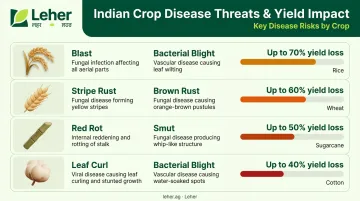
According to ICAR-NRCPB, rice blast alone can devastate more than 75% of annual yield during epidemic conditions.
For wheat, ICAR-IIWBR documented that coordinated surveillance and timely fungicide management in 2010–11 avoided an estimated 2–3 million tonnes of wheat loss — proof that early, organised response works.
The data makes one thing clear: the disease itself is rarely the deciding factor. The timing of detection is.
The Detection Delay Problem
Traditional disease identification relies on:
- Visual scouting — inconsistent, skill-dependent, and limited to what the eye can see
- Lab sample testing — accurate but slow, often taking days a farmer cannot afford
- Extension office visits — inaccessible for farmers in remote areas
Each day of delay matters. A manageable early-stage infection becomes a field-wide outbreak not because the disease is uncontrollable, but because the farmer didn't know it was there in time.
Early detection protects more than yields. Catching disease at the first sign also means:
- Fewer pesticides applied across the field
- Lower input costs per acre
- Less chemical burden on surrounding healthy crops and soil
How Image-Based Crop Disease Detection Works: The Full Pipeline
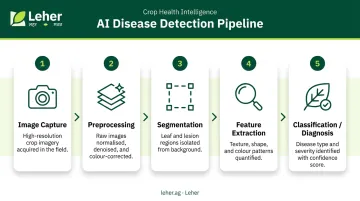
Between taking a photo of a diseased leaf and receiving an AI-generated diagnosis, five stages happen in sequence: image capture, preprocessing, segmentation, feature extraction, and classification.
Image Capture
Two primary capture methods exist, serving different needs:
- Close-up smartphone or DSLR photography — high leaf-level detail, accessible to any farmer with a phone, but slow for scanning large areas
- Aerial drone or satellite imagery — covers entire fields in a single flight, identifies disease hotspots at scale, though individual lesion detail is lower
The capture method determines what's detectable. Ground-level photography is better for diagnosing individual plant symptoms; drone imagery excels at spotting spatial patterns of disease spread across a field.
Image Preprocessing
Raw field images are rarely clean. Shadows, uneven light, and background clutter obscure disease symptoms. Preprocessing cleans up the image — reducing noise while preserving the edges of disease lesions — so the algorithm has clearer material to work with.
Common preprocessing techniques include:
- Noise filtering — smooths irrelevant variation while keeping disease boundary edges sharp
- Background removal — eliminates soil, adjacent plants, and other distractions from the analysis frame
Segmentation
With a clean image ready, segmentation isolates the leaf or diseased region from everything else — effectively cropping out the relevant part before analysis begins. Research published in Computers and Electronics in Agriculture demonstrates how algorithms like GrabCut can remove background clutter while retaining disease spots with high precision.
Feature Extraction and Classification
Once the diseased region is isolated, the system extracts measurable characteristics:
- Colour changes — yellowing, browning, darkening patterns distinctive to specific diseases
- Texture patterns — surface irregularity, lesion density, spread uniformity
- Spot shapes — circular lesions vs. elongated streaks vs. diffuse blotching
A classification model then matches these features to known disease patterns and delivers a diagnosis. A well-trained model can distinguish dozens of diseases across multiple crops simultaneously — at a speed and scale that manual scouting cannot realistically achieve across large landholdings.
Key AI and Machine Learning Approaches Used in Detection
Convolutional Neural Networks (CNNs)
CNNs are the current benchmark for plant disease detection. They learn to recognise disease patterns directly from thousands of labelled leaf images — no manual feature engineering required. In a widely cited 2016 study using the PlantVillage dataset, Mohanty, Hughes, and Salathé achieved 99.35% accuracy on held-out test images across 14 crop species and 26 disease categories.
That figure comes with an important caveat: when the same model was tested on external real-world images, accuracy dropped to approximately 31.4%. Controlled dataset performance and field deployment performance are not interchangeable — field conditions introduce lighting variation, background clutter, and image quality issues that benchmarks simply don't capture.
Support Vector Machines (SVMs)
SVMs offer a practical alternative when labelled training data is scarce or computational resources are limited. SVM-based methods using texture features like GLCM (Grey-Level Co-occurrence Matrix) and LBP (Local Binary Patterns) have demonstrated strong accuracy on multi-crop datasets. This makes them well-suited for Indian agricultural contexts where deep learning infrastructure may not always be available.
Transfer Learning
Transfer learning is what makes high-accuracy detection achievable without massive labelled datasets. Pre-trained models built on millions of general images are fine-tuned on smaller crop-disease datasets, cutting the data needed to reach reliable performance.
For Indian crops specifically, this matters: a study on rice leaf diseases using transfer learning (InceptionResNetV2) achieved 95.67% accuracy on rice blast and bacterial blight — diseases central to Indian agriculture — using a more modest dataset.
Smartphone-Based Mobile Apps
Apps like Plantix bring these models directly to farmers. Photograph a symptomatic leaf, and a trained model returns a real-time diagnosis. A 2022 peer-reviewed review of plant disease apps found notable gaps in current capabilities:
- 35% require uninterrupted internet connectivity
- Only 23.52% estimate disease severity
- Just 5.88% visualise the infected area
These gaps matter for farmers in areas with unreliable connectivity — and they set realistic expectations for what current apps can and can't do.
Ground-Level vs. Drone-Based Image Capture: What Works Best at Scale
Ground-level photography and drone imaging work best together — each layer filling gaps the other can't cover.
| Method | Strengths | Limitations |
|---|---|---|
| Smartphone photography | High leaf detail, low equipment cost | Slow for large areas, variable lighting |
| Drone RGB imaging | Wide area coverage, hotspot mapping | Less leaf-level detail than close-up |
| Drone multispectral imaging | Detects stress before visible symptoms | Higher equipment cost, needs local validation |
The Multispectral Advantage
Drones equipped with multispectral or infrared sensors can detect plant stress before a farmer sees anything wrong. By capturing changes in chlorophyll density and water content — reflected in red-edge wavelengths around 700–770 nm — these sensors identify stress responses that precede any visible symptoms.
Research on wheat yellow rust using multispectral UAV imagery demonstrated detection as early as 40 days after sowing, during the tillering stage — well before symptoms would register during manual scouting. That's roughly a two-week head start on intervention, which can make the difference between a contained outbreak and field-wide crop loss.
The Practical Workflow
A detection workflow for Indian farms combines both layers:
- Drone flights cover the full field on a scheduled basis, flagging disease hotspots with GPS coordinates
- GPS data guides ground-level inspection — farmers walk to flagged zones for close-up confirmation
- Treatment is targeted to affected areas only, avoiding unnecessary intervention across healthy plots
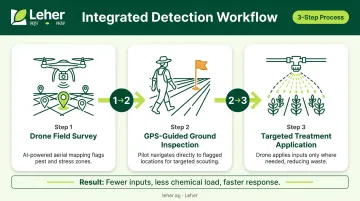
The result: fewer wasted inputs, less chemical load on healthy crops, and faster response where the disease is actually spreading.
From Detection to Targeted Treatment: Closing the Loop
Detection without action is just information. The gap between knowing disease is present and doing something precise about it is where most of the economic value is either captured or lost.
Conventional spraying applies chemicals uniformly across entire fields — treating healthy areas as aggressively as infected ones. This wastes inputs, increases environmental load, and doesn't actually improve treatment effectiveness where disease is concentrated.
Precision Drone Spraying as the Treatment Response
When disease hotspots are mapped through image analysis, drone spraying systems can deliver pesticides or fungicides specifically to affected zones, at the right dosage, with minimal drift. A 2025 adaptive UAV spraying study reported 30–50% pesticide-use reduction through precision application frameworks, with 62% lower off-target drift compared to conventional methods.
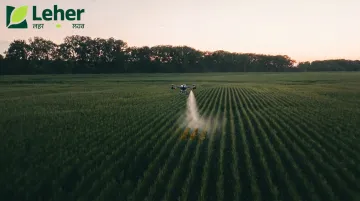
That's the gap Leher's drone spraying service is built to close. Leher provides on-demand precision drone spraying for Indian farmers across paddy, wheat, sugarcane, cotton, and other crops — covering up to 50 acres per day, delivering up to 30% less pesticide use and up to 90% lower water consumption compared to conventional spraying.
For a farmer who has used AI-based detection to identify disease hotspots, booking a Leher spraying session through the Leher App is the logical next step. A DGCA-certified pilot arrives, sprays the identified areas precisely, and the farmer pays only after the job is complete.
For smallholder Indian farmers, this combination — early detection feeding into targeted application — delivers measurable gains:
- Lower input costs from reduced chemical volumes
- Healthier crops treated at the right time, in the right zones
- Less chemical runoff into surrounding soil and water systems
Challenges and Limitations to Keep in Mind
Real-World Accuracy Gaps
PlantVillage benchmark accuracy of 99.35% gets cited frequently — but the 31.4% accuracy on external field images rarely does. Models trained on clean, well-lit laboratory images degrade sharply when exposed to variable lighting, shadows, partial leaf coverage, and background clutter in real fields.
A 2025 review of field deployment results puts a more realistic range at 70–85% accuracy in field conditions, with some traditional CNN models dropping to 53% on real-world datasets. Honest expectations matter — these tools are genuinely useful, but not infallible.
Dataset and Diversity Gaps
Most current disease detection models have been trained on datasets that don't adequately represent Indian crop varieties, regional disease strains, or the visual backgrounds of Indian fields.
A PlantVillage bias study demonstrated that a model trained on only 8 background pixels achieved 49% accuracy — far above random chance — revealing how heavily background artifacts skew results. India-specific disease image databases are still largely underdeveloped, which limits how well these tools perform for Indian farmers in practice.
The Asymptomatic Detection Limit
Current image-based systems — including both RGB and multispectral approaches — detect disease only after some form of symptom or stress signal has emerged. Latent infections, where plants carry a pathogen but show no visible or spectral signs yet, remain beyond the reach of visual image analysis.
For truly pre-symptomatic detection, farmers need complementary methods alongside image analysis:
- Soil testing — flags nutrient stress and pathogen presence before visual symptoms appear
- Molecular testing — identifies pathogens at the genetic level in early-stage infections
- Remote sensing indices — can detect early water or chlorophyll stress before lesions form
No single tool covers the full disease timeline. Image-based detection is most effective as one layer in a broader crop health monitoring approach.
Frequently Asked Questions
How accurate is image-based crop disease detection in real field conditions?
Lab-tested CNN models achieve 95–99%+ accuracy on clean datasets, but field performance typically falls to 70–85%, with some models dropping lower depending on image quality and dataset diversity. The controlled-condition figures are not a reliable guide to what farmers will experience in actual use.
Can Indian farmers use smartphones to detect crop diseases without technical expertise?
Yes — several apps allow farmers to photograph symptomatic leaves and receive AI-generated diagnoses. Reliability depends heavily on image quality and whether the app has been trained on locally relevant Indian crop varieties and disease strains. Internet connectivity is also a limiting factor for 35% of current plant disease apps.
Which crop diseases can be identified through image processing?
Common identifiable categories include fungal diseases (rice blast, wheat rust, powdery mildew), bacterial diseases (bacterial leaf blight, bacterial spot), and viral diseases (yellow leaf curl, mosaic virus). The specific diseases a system can identify depend entirely on what disease classes its underlying model was trained to recognise.
How does drone-based disease detection differ from walking the field manually?
Drones cover entire fields in a single flight, flag disease hotspots with GPS coordinates, and use multispectral sensors to detect plant stress before visible symptoms appear. Manual scouting covers less area, is slower, and depends entirely on individual observation skill and experience.
What is the role of image preprocessing in disease detection accuracy?
Preprocessing removes noise, normalises lighting, and strips out irrelevant background information — making disease features cleaner and more consistent for classification algorithms. Without this step, even powerful models struggle to isolate meaningful disease signals from cluttered field images.
How early can image-based systems detect crop diseases compared to traditional methods?
Multispectral drone imaging detected wheat yellow rust at 40 days after sowing (during tillering), before symptoms were visible to a walking farmer. A wheat rust early warning system in Ethiopia gave smallholders a three-week window to purchase and apply fungicides.