Spot spraying flips this logic. Instead of uniform coverage, it targets only the patches where weeds are detected — delivering treatment with surgical precision rather than blanket force.
For Indian farmers already managing thin margins, the case is direct. Weeds cause an estimated 31.5% overall yield reduction and roughly USD 11 billion in annual economic losses across major crops. Better weed control matters. But so does controlling input costs. Spot spraying addresses both.
This guide explains what spot spraying is, how the technology works, the difference between green-on-brown and green-on-green detection, what benefits farmers can realistically expect, and how drone-based services are making precision application accessible to India's smallholder farmers.
Key Takeaways
- Spot spraying applies herbicides only where weeds are detected — field trials show 47% to 90%+ herbicide savings depending on weed pressure and system
- Modern systems use cameras, AI, and individual solenoid nozzles to make spray decisions in real time
- Green-on-brown (weeds on bare soil) is simpler and more proven; green-on-green (weeds within a crop) is the harder, still-maturing capability
- India's average farm is just 1.08 hectares — drone-based spot spraying suits this scale far better than large ground equipment
- Drone-as-a-service models remove the need for equipment ownership, making precision application accessible to small and marginal farmers
What Is Spot Spraying and Why Traditional Spraying Falls Short
Spot spraying — also called targeted application, precision spray, or smart spray — applies herbicides or pesticides only to areas with confirmed weed or pest presence, rather than uniformly across an entire field.
The concept isn't new. Manual patch spraying has existed for decades. Modern sensor and AI-driven systems can now make real-time detection and activation decisions across hundreds of acres — a task that would take days manually now runs continuously at spraying speed.
The Problem With Broadcast Spraying
Traditional broadcast spraying operates on a flawed assumption: that weeds are uniformly distributed. They rarely are. When a uniform dose covers a field, the patches with no weed pressure receive unnecessary chemical treatment — driving up costs and exposing soil and water to compounds that serve no agronomic purpose at those locations.
This has real consequences:
- Higher per-acre chemical spend with no yield benefit in low-infestation zones
- Elevated residue levels in soil and runoff from over-application
- Accelerated herbicide resistance — applying chemicals where weeds may not even exist accelerates selection pressure on species that are present
Herbicide resistance is already a documented problem in India. Phalaris minor, a major wheat weed, first developed resistance to isoproturon in Haryana wheat fields in 1991, and over 1 million hectares in Haryana and Punjab became infested with resistant biotypes. The International Herbicide-Resistant Weed Database now records 548 unique resistance cases globally, involving 275 species across 76 countries.
Spot spraying directly reduces the selection pressure that drives resistance — by treating only infested patches, you eliminate chemical exposure in areas where no selection event would occur anyway.
Spot Spraying vs. Variable-Rate Application
These terms are sometimes used interchangeably. The distinction matters. Spot spraying makes a binary on/off decision per nozzle based on real-time weed detection. Variable-rate application adjusts dose continuously based on pre-mapped prescription data. Both are forms of targeted application, but spot spraying is reactive and in-the-moment, while variable-rate relies on prior field mapping.
Where Spot Spraying Delivers the Most Value
- Fallow field management before sowing
- Pre-emergence weed control in bare soil
- Post-harvest stubble management
- Increasingly, in-season crop applications (with green-on-green capable systems)
In India, the most relevant crops for spot spraying include rice, wheat, soybean, cotton, and vegetables — all high-input crops where reducing unnecessary chemical application has a direct impact on input costs and soil health.
How Spot Spraying Works: Sensors, AI, and Precision Nozzles
The Three-Step Workflow
A modern spot spraying system operates in a continuous loop as the machine moves across the field:
- Detect — cameras or sensors mounted on the boom or drone scan the field surface in real time
- Decide — onboard AI analyzes the visual feed and classifies each pixel as weed, crop, or bare soil
- Spray — individual solenoid-controlled nozzles activate within milliseconds to treat only the detected target
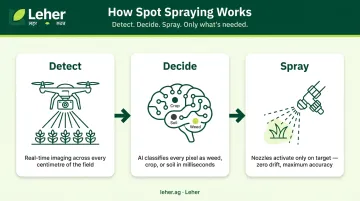
John Deere's See & Spray Ultimate — a large-scale tractor-mounted system — makes spray decisions within 200 milliseconds and scans over 2,100 square feet per second. These figures illustrate how fast the detect-decide-spray loop must run at field operating speeds.
Types of Detection Sensors
| Sensor Type | How It Works | Best For |
|---|---|---|
| RGB cameras | Detects color contrast between green plants and brown/bare soil | Green-on-brown applications |
| Multispectral/hyperspectral | Analyzes light wavelengths beyond visible spectrum | Crop-weed discrimination in canopy |
| Chlorophyll fluorescence | Detects plant material via biological signal, not color | High-contrast green-on-brown; some in-crop use |
The Role of AI and Machine Learning
The AI component is what separates modern spot spraying from older optical sensors. Systems are trained on large image datasets of specific weed species and crop plants, learning to distinguish shape, texture, and spectral signatures. More capable systems, such as Greeneye (which uses 24 cameras and 12 GPUs), identify individual weed species rather than simply detecting the presence of green material. Species-level identification means the system can trigger a targeted herbicide matched to that specific weed — rather than applying a blanket treatment across the entire area.
Nozzle-Level Precision
Once the AI flags a target, actuation happens at the nozzle level — not in large boom sections. Spot spraying systems activate individual nozzles, typically spaced 10–15 inches apart. Tighter spacing (10 inches vs. 20 inches, for example) delivers higher resolution coverage, reducing the chance of treating non-target areas.
Pulse-width modulation (PWM) solenoids enable the near-instant on/off response these systems require.
One important operational note: most commercial systems include a default broadcast mode. If the camera's view is obstructed — by dust, dense canopy, or boom sway — the system defaults to full broadcast rather than risk missing weeds. Stable boom height, appropriate travel speed (matched to the platform and system specs), and adequate lighting are all critical for maintaining detection accuracy.
Green-on-Brown vs. Green-on-Green Detection
Choosing between green-on-brown and green-on-green detection isn't just a technical question — it determines which systems will actually work in your fields and what savings you can realistically expect.
Green-on-Brown Detection
The system identifies green plant material — weeds — against a non-vegetated background: bare soil, crop stubble, or fallow ground. The color contrast is strong, making detection more reliable and classification more accurate.
This is the more established form of spot spraying. Commercial systems in green-on-brown applications consistently report herbicide savings of 70–95% on fallow ground, with weed detection accuracy above 90% under good lighting and clear soil backgrounds — figures supported by multiple field trials globally.
Best suited for: fallow field management, pre-sowing weed control, post-harvest stubble spraying.
Green-on-Green Detection
The system must distinguish weeds growing within an established crop canopy — where both the weed and the crop appear green. Color alone isn't enough. The AI must differentiate based on leaf shape, texture, and spectral signature.
In-crop weed detection is technically more demanding, and the technology is still developing for most use cases. Commercial systems do exist, but detection accuracy varies significantly by crop type, weed species, and canopy density. Broadleaf weed identification in open-canopy crops tends to perform well; grassy weeds within dense stands remain the more difficult challenge across platforms.
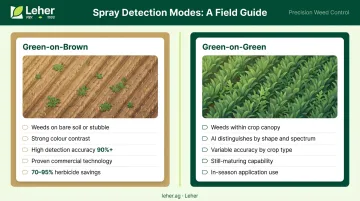
Best suited for: in-season crop management where weeds emerge within an established stand.
Practical Guidance for Farmers
- Start with green-on-brown if you're managing fallow fields or pre-sowing weed programs — it's proven, more accessible, and delivers strong savings
- Consider green-on-green capable systems if in-season precision treatment is a priority — but set realistic expectations around detection accuracy and factor in canopy conditions
- In both cases, combine with a preemergence broadcast application for best overall weed control
Key Benefits of Spot Spraying for Farmers
Herbicide Savings
The savings range is wide, and that's honest. It depends on weed pressure, system type, and operating conditions. From available trial and commercial data:
- A 2024 on-farm maize trial saved 47% herbicide versus broadcast while achieving up to 86% weed control efficacy with equal crop yields
- Iowa State soybean demonstrations across 415 acres averaged 76% herbicide savings, ranging from 43.9% to 90.6%, with USD 15.70/acre average chemical cost savings (in the US trial)
- Manufacturer benchmarks: Deere Select (77%), Greeneye (87% non-residual reduction), Ecorobotix ARA (50% to over 95%)
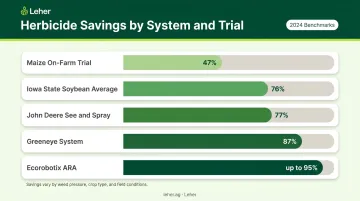
The pattern is consistent: lower weed pressure fields yield the greatest percentage savings. Higher-pressure fields still benefit, but the margin narrows.
Economic and Input Cost Impact
For Indian farmers, input costs represent a significant share of total farming expenditure. A direct reduction in herbicide spend translates immediately to margin improvement — no price risk, no yield dependence.
The strongest economic model is a two-pass approach: a full-rate preemergence broadcast application to suppress early weed flush, followed by a targeted post-emergence spot application. Using spot spraying alone in high-pressure fields is likely to underperform.
Environmental and Resistance Benefits
Fewer chemicals applied means:
- Reduced herbicide concentrations in field runoff (a 2016 Queensland sugarcane study found runoff herbicide concentrations decreased directly with reduced spray coverage)
- Lower disruption to soil microbiomes — research shows herbicides can reduce total microbial populations within 7–30 days depending on the molecule
- Less selection pressure on herbicide-resistant weed populations
The resistance benefit is real but conditional. Spot spraying reduces the area treated, which reduces the number of weed plants exposed to chemical selection — but resistance management still requires mode-of-action rotation, full labeled rates where applied, and integrated weed management practices.
Weed Scouting Data as a Byproduct
Spot spraying systems generate real-time geospatial maps of weed locations, density, and treated areas. Collecting this data manually has historically been expensive and time-consuming. Over multiple seasons, these maps allow farmers and agronomists to:
- Track weed pressure trends across fields and seasons
- Optimize spray budgets based on field-specific history
- Meet compliance and traceability requirements that FPOs and agri-supply chains increasingly require
Drone-Based Spot Spraying for Indian Farmers
Why Drones Fit India's Farming Context
India's average operational farm holding was just 1.08 hectares (about 2.67 acres) as of the 2015–16 Agriculture Census. Ground-based precision sprayers — large, expensive, and designed for wide, flat field rows — are impractical for most Indian farms.
Drones don't have this constraint. They maneuver over irregular field shapes, navigate around trees and infrastructure, reach areas inaccessible to ground equipment, and deploy rapidly without requiring field-level infrastructure investment.
The Indian government has recognized this fit. Under SMAM (Sub-Mission on Agricultural Mechanization), the government approved 2,122 drones for distribution from 2023–24 to 2025–26 as of November 2025. The Namo Drone Didi scheme provides 80% central financial assistance up to ₹8 lakh per drone package for self-help groups, and SMAM offers 40% subsidy up to ₹4 lakh for drone rental service providers.
How AI-Equipped Agricultural Drones Perform Targeted Application
The spot spraying process works in three stages:
- Scan — Drone-mounted cameras capture the crop canopy or fallow ground below
- Detect — Onboard or ground-station AI identifies weed or pest presence in real time
- Target — Spray nozzles activate only in affected zones, not across the full flight path
This distinguishes spot spraying from blanket drone application, which applies chemicals uniformly across the entire area covered — regardless of where the problem actually exists.
Leher's Model in Practice
Leher demonstrates how this translates into an accessible service for Indian farmers. With drone spraying services covering 6,500+ acres and supporting 810+ farmers in 2024 alone — across sugarcane, paddy, cotton, wheat, and vegetables — the platform shows that drone-based targeted application is operational at scale today.
The model matters as much as the technology. Farmers book a spraying session through the Leher App, a DGCA-certified pilot arrives at the farm, and payment follows only after the job is completed.
No equipment ownership, no capital outlay. That makes the service accessible to smallholder farmers who would otherwise be priced out of precision technology entirely.
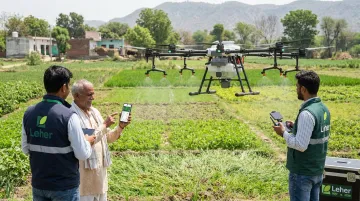
Leher's documented performance includes up to 30% reduction in pesticide use and up to 90% reduction in water consumption compared to conventional spraying — figures consistent with the efficiency gains that precision drone application delivers through reduced volumes and targeted coverage.
Frequently Asked Questions
What is spot spraying?
Spot spraying applies herbicides or pesticides only to areas where weeds or pests are actually detected — not uniformly across an entire field. Modern systems use cameras and AI to identify weed presence in real time, activating spray nozzles only where treatment is needed.
How does a spot sprayer work?
Cameras or sensors mounted on the sprayer or drone continuously scan the field. AI software classifies each area as weed, crop, or bare soil. Individual solenoid nozzles then activate within milliseconds — treating only the detected target while leaving surrounding areas untreated.
What is the difference between green-on-brown and green-on-green spraying?
Green-on-brown detects weeds against bare soil or stubble — simpler, more accurate, and the established standard for fallow and pre-sowing applications. Green-on-green identifies weeds within a growing crop canopy, requiring AI to distinguish plant types by shape and spectral signature. Most entry-level systems support green-on-brown only.
How much can spot spraying reduce pesticide use?
Field trials and commercial deployments show herbicide savings ranging from 47% to over 90%, depending on weed pressure, system type, and operational settings. Savings are greatest in fields with lower weed density, where fewer nozzles activate overall.
Can drones be used for spot spraying?
Yes. AI-equipped agricultural drones scan the field below and activate nozzles only where weeds or pests are detected. This gives them the same targeting precision as ground-based systems, with the added advantage of reaching small or irregularly shaped farms where large equipment cannot easily operate.
Is spot spraying suitable for small farms in India?
Yes — though traditional ground-based systems require significant upfront investment, drone-based spraying services change that equation. Per-acre, book-and-pay models (such as Leher's app-based service) remove equipment ownership entirely, making precision application practical for smallholder farmers across India regardless of farm size.