The state recognised this early. Telangana's Socio Economic Outlook 2023 explicitly targeted doubling farm mechanisation within 3–4 years to address chronic farm labour shortages. Agricultural drones sit at the centre of that push — and the subsidies to fund them are already active.
This guide covers every central and state-linked scheme available to Telangana farmers, who qualifies, what documents you need, and how to apply from start to finish.
Key Takeaways
- Telangana farmers can claim 40%–50% subsidies on drone purchases under SMAM, and women SHGs get up to 80% under Namo Drone Didi
- Priority categories include SC/ST farmers, women, small/marginal farmers, FPOs, SHGs, and CHC operators
- Applications are filed at agrimachinery.nic.in with physical verification by a District Agriculture Officer
- Prepare these documents before applying: Aadhaar, PAN, land records, bank passbook, and a quotation from a DGCA-approved vendor
- Only DGCA-type-certified drones qualify; post-purchase registration on the Digital Sky Platform is mandatory
Why Telangana Farmers Should Act on Drone Subsidies Now
The Pressure on Farm Economics
Telangana's paddy and cotton farmers face a compounding squeeze. Labour costs have risen steadily, while the number of available agricultural workers during peak spraying periods shrinks each season. For a small farmer managing 5–10 acres, hiring manual spray teams for multiple rounds of pesticide and micronutrient application across a kharif season is both expensive and uncertain.
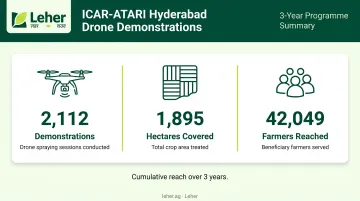
Drone spraying directly addresses this. ICAR-ATARI Hyderabad documented 2,112 drone demonstrations across 1,895 hectares in 2024-25 alone, covering insecticide, micronutrient, weedicide, and fungicidal applications — with a cumulative reach of 42,049 farmers over three years. The scale of adoption signals that the technology is no longer experimental.
Key advantages documented by ICAR for drone spraying:
- Reduces operation time and labour requirement per acre
- Uses less spray chemical and water per application
- Enables uniform coverage across uneven or flooded terrain
- Reduces direct chemical contact for the operator
Try Before You Buy
That adoption data also points to something practical: many farmers want to see drone spraying work on their own fields before committing to a purchase. Services like Leher offer on-demand drone spraying across India — farmers book through the Leher App, a trained DGCA-certified pilot arrives on the scheduled day, and payment happens only after the job is done. It's a low-risk way to assess results on your own crop before pursuing the subsidy route.
Drone Subsidy Schemes Available to Telangana Farmers
Sub-Mission on Agricultural Mechanization (SMAM)
SMAM is the primary central scheme through which most Telangana farmers apply for drone subsidies. It is administered through the state agriculture department and disbursed via Direct Benefit Transfer (DBT) directly to the applicant's Aadhaar-linked bank account.
Subsidy rates under SMAM 2025:
| Beneficiary Category | Subsidy | Cap |
|---|---|---|
| General/other individual farmers | 40% of cost | Up to ₹4 lakh |
| Small/marginal farmers | 50% of cost | Up to ₹5 lakh |
| SC/ST farmers | 50% of cost | Up to ₹5 lakh |
| Women farmers | 50% of cost | Up to ₹5 lakh |
| FPOs/cooperatives (demonstrations) | 75% grant | Verify current cap at source |
| CHCs by FPOs/rural entrepreneurs | 40% assistance | Up to ₹4 lakh |
| Agriculture graduates setting up CHCs | 50% assistance | Up to ₹5 lakh |
| ICAR institutes, KVKs, SAUs, FMTTIs | 100% grant | Verify current cap at source |
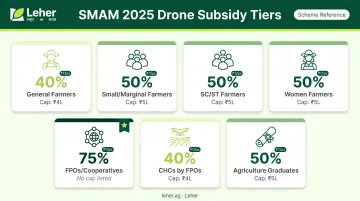
Source: SMAM 2025 Guidelines, farmech.dac.gov.in
Note: Wait-listed applications from 2024-25 are not carried forward. Fresh applications are required for the 2025-26 cycle.
Namo Drone Didi Yojana
If SMAM covers individual farmers broadly, Namo Drone Didi Yojana takes a different route — it targets women-led Self-Help Groups (SHGs) under the DAY-NRLM framework. Selection flows through SHGs within the rural livelihoods ecosystem, not through the individual farmer portal.
Key scheme parameters:
- Total outlay: ₹1,261 crore (2023-24 to 2025-26)
- Target: 15,000 selected women SHGs nationally
- Subsidy: 80% of drone and accessories cost, up to ₹8 lakh
- Training: 15-day package covering drone piloting, minor repairs, and spraying practice
- Income model: SHGs provide paid drone rental services to local farmers for fertiliser and pesticide application
For rural Telangana women already active in SHGs, the rental income model means selected groups can recover the subsidised drone cost within a single cropping season, depending on local demand.
Agriculture Infrastructure Fund (AIF)
AIF works differently from the subsidy schemes above. It is a financing tool best suited for farmers or entrepreneurs building drone-based enterprises like Custom Hiring Centres or training operations.
- Interest subvention: 3% per annum on loans up to ₹2 crore, for up to 7 years
- Credit guarantee: CGTMSE coverage up to ₹2 crore, with government paying the fee
- Eligible use: Drone purchase and Custom Hiring Centres are both listed as eligible projects
- Access: Register at the AIF beneficiary portal or approach NABARD and cooperative banks
Leher's Drone Partner Program supports AIF loan access for entrepreneurs joining their network, handling onboarding documentation alongside drone provisioning and maintenance support.
Telangana State-Level Schemes
Secondary sources mention a "40% Telangana subsidy on drones," but this refers to the central SMAM support routed through the state department — not a separate state top-up. We found no official Telangana Government Order, Agriculture Department circular, or RySS communication confirming an additional state-specific drone subsidy. Check the Telangana Department of Agriculture website for any new circulars before applying.
Who Is Eligible for Agriculture Drone Subsidy in Telangana?
Eligibility falls into four categories: individual farmers, FPOs/cooperatives/SHGs, CHC operators, and agri-entrepreneurs. Each has different documentation requirements and subsidy rates — find your category below.
Individual Farmers
To qualify under SMAM:
- Hold valid land records (patta) or a registered lease agreement
- Maintain an Aadhaar-linked bank account for DBT credit
- Prioritised categories: small/marginal farmers, SC/ST applicants, and women farmers
The SMAM guidelines refer to "small and marginal farmers" as a defined category with enhanced subsidy rates, but the specific landholding threshold definition is not stated within the SMAM document itself. Confirm current thresholds with your District Agriculture Officer before applying.
FPOs, Cooperatives, and SHGs
- Must be formally registered under relevant government acts
- Require a valid bank account in the organisation's name
- Women SHGs seeking the higher 80% subsidy must qualify under Namo Drone Didi Yojana through DAY-NRLM selection
CHC Operators and Agri-Entrepreneurs
Registered Custom Hiring Centres are eligible for subsidy support to run drone-as-a-service models. Key requirements include:
- Formal CHC registration with the relevant state agriculture department
- A business plan demonstrating service provision to local farmers
- Compliance with all DGCA operator and equipment rules (see below)
Compliance Requirements for All Applicants
Before and after purchase, every applicant must meet these conditions:
- The drone model must appear on the DGCA-approved/type-certified list
- The operator must hold or be enrolled in a DGCA-certified Remote Pilot Certificate (RPC) course
- Under Drone Rules 2021, RPC eligibility requires being 18–65 years of age and having passed Class 10 or equivalent
- The drone must be registered on the Digital Sky Platform before any operational use
Documents Required and How to Apply for Agriculture Drone Subsidy in Telangana
Documents Checklist
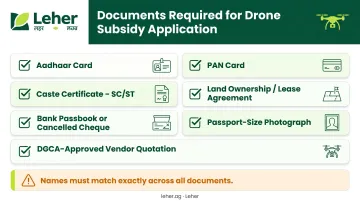
Gather these before starting your application:
- Aadhaar card (linked to your bank account)
- PAN card
- Caste certificate (for SC/ST applicants)
- Land ownership document or registered lease agreement
- Bank passbook or cancelled cheque
- Recent passport-size photograph
- Formal written quotation from a DGCA-approved drone manufacturer or vendor
Every document must show matching name, address, and Aadhaar number. Name mismatches between land records and Aadhaar are the most common rejection cause.
Application Process
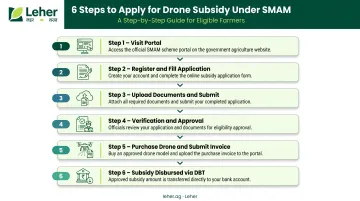
Step 1: Visit the official portal
Go to the Central Agri Mechanization DBT Portal. For Namo Drone Didi, approach your state nodal agency or DAY-NRLM block coordinator. Also check the Telangana Department of Agriculture website for state-specific application windows.
Step 2: Register and fill the application
Select the correct applicant category (individual farmer, FPO, SHG, CHC, or institution). Enter personal details, agricultural information, and link your Aadhaar. The portal generates a unique Application Reference ID on submission — save this immediately.
Step 3: Upload documents and submit
Attach digital copies of all required documents. The drone quotation must come from an empanelled, DGCA-approved vendor — not just any supplier. After submission, the application enters the district-level verification queue.
Step 4: Verification and approval
The District Agriculture Officer (DAO) or a designated field officer reviews your application. This may include a physical farm inspection. Approval notification arrives via SMS or email to your registered mobile number.
Step 5: Purchase the drone and submit invoice
After approval, purchase the DGCA-approved drone from the vendor named in your quotation. Upload the purchase invoice and drone photographs on the portal. A final field verification confirms the purchase.
Step 6: Subsidy disbursement
Once all verification is complete, the subsidy amount is credited directly to your Aadhaar-linked bank account via DBT. No official processing timeline is publicly stated for SMAM disbursements. Follow up with your DAO if there are delays. Register the drone on the Digital Sky Platform before operating it.
Tips to Ensure Your Drone Subsidy Application Is Approved
Three mistakes account for most rejections. Avoid them and your application stands a strong chance of approval.
Check document consistency before uploading. Your name, address, and Aadhaar number must be identical across your land records, bank passbook, and ID proof. A single character difference can trigger rejection.
Only quote from DGCA-empanelled vendors. Drone models that aren't type-certified — or vendors not on the government's approved list — result in automatic disqualification. Before finalising your quotation:
- Confirm the model appears on the DGCA type-certified list
- Cross-check the vendor against the empanelled list on the scheme portal
Track application windows actively. SMAM operates on annual cycles, and 2024-25 wait-listed applications were not rolled over into 2025-26. Check agrimachinery.nic.in and the Telangana Agriculture Department website regularly. Your local Agriculture Extension Officer is also a reliable source for new notifications.
Leher's team assists drone entrepreneurs in navigating subsidy paperwork and connecting with approved service partners. Reach out at [email protected] if you need guidance.
Frequently Asked Questions
How to apply for agriculture drone subsidy in Telangana?
Telangana farmers apply through the Central Agri Mechanization DBT Portal at agrimachinery.nic.in. Register under the correct applicant category, upload required documents (Aadhaar, land records, and a DGCA-approved drone quotation), then submit for verification by the District Agriculture Officer.
What is the subsidy for drones in agriculture?
Under SMAM, general farmers receive 40% subsidy up to ₹4 lakh, while small/marginal, SC/ST, and women farmers receive 50% up to ₹5 lakh. Women SHGs under Namo Drone Didi get 80% up to ₹8 lakh, FPOs can receive up to 75%, and agricultural institutions like KVKs and ICAR receive 100% grants — all contingent on purchasing a DGCA-type-certified drone.
What is the price of a 12-litre agriculture drone?
Prices for 12-litre agriculture drones vary by manufacturer and are not uniformly listed. Apply the SMAM subsidy formula to any verified invoice: general farmers receive the lower of 40% of cost or ₹4 lakh; priority categories receive the lower of 50% or ₹5 lakh. Contact DGCA-empanelled manufacturers directly for current quotes.
Who is eligible for agriculture drone subsidy in Telangana?
Eligible applicants include individual farmers (with priority for SC/ST, women, and small/marginal landholders), registered FPOs, women SHGs, CHC operators, and agricultural institutions. All applicants must hold valid land records or registration documents and purchase a DGCA-type-certified drone model.
What documents are required for drone subsidy application in Telangana?
Core documents include Aadhaar card, PAN card, land ownership or lease proof, bank passbook or cancelled cheque, caste certificate if applicable, a recent passport-size photograph, and a formal quotation from a DGCA-approved drone vendor. All names and details must match exactly across documents.
Can a farmer access drone spraying without buying a drone?
Yes. Farmers who are not ready to purchase can access drone spraying immediately through CHC operators or agri-tech platforms like Leher, which connects farmers with trained pilots via the Leher App on a book-now, pay-after-service model. This is a practical option while you explore the subsidy route for future ownership.