Introduction
Most Indian farmers still decide when to irrigate by checking the soil with their hands. When to spray by looking for visible pest damage. When to harvest by experience and intuition. These are not failures of knowledge — they're the result of farming without data.
That gap has a cost. Over-irrigation drives up electricity bills and causes nutrient leaching. Pesticides applied on a calendar schedule — rather than to actual pest pressure — waste money and let infestations go untreated. By the time disease damage is visible, yield loss has already happened.
According to India's Agriculture Census 2015-16, 86% of operational holdings are under 2 hectares — meaning the farmers who stand to gain the most from better information are also the ones with the least margin for error.
Farm monitoring systems are changing this. Using sensors, drones, and connected software, these tools give farmers real-time visibility into what's actually happening in their fields — not what they guess might be happening.
This guide covers:
- What farm monitoring systems are and why they matter now
- The main types available to Indian farmers
- The technologies behind them
- How to get started without overhauling your entire operation
Key Takeaways
- Farm monitoring uses sensors, drones, and software to track soil, weather, crop health, and pest activity in real time
- It shifts farmers from reactive problem-solving to early intervention — protecting yields before losses accumulate
- Key types: soil, weather, aerial/drone, pest, and livestock monitoring
- ICAR research on banana crops ICAR research on banana crops found IoT soil-moisture monitoring cut water use by 25–30% and nutrients by 15–20% — with no yield loss
- Getting started doesn't require a full system overhaul — tackle your biggest cost or risk first
What Is Farm Monitoring?
Farm monitoring is the use of technology — sensors, connected devices, drones, and software platforms — to continuously track and analyse data about crop health, soil conditions, weather, and overall farm operations.
Traditional observation is slow and incomplete. A farmer walking a field can only see what's visible, and can only be in one place at a time. Sensors and drones collect data continuously, across the entire farm, capturing changes that would otherwise go unnoticed until they become serious problems.
The Core Components
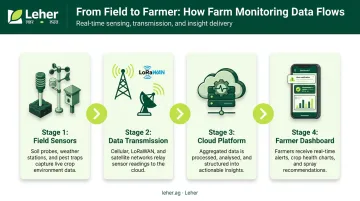
A modern farm monitoring system typically includes:
- Field sensors — measuring soil moisture, temperature, pH, weather conditions, or pest presence
- Data transmission — via cellular (4G/LTE), LoRaWAN for low-power long-range applications, or satellite in areas without mobile coverage
- A cloud platform — that processes, stores, and visualises the incoming data
- Alert and reporting tools — delivering insights directly to a farmer's smartphone
Monitoring vs. Automation
Understanding the components above raises a practical question: what's the difference between monitoring and acting on that data? Monitoring provides the data layer — it tells you what is happening on your farm. Automation takes the next step, using that data to trigger a response. A drip irrigation system, for instance, can automatically open valves when soil moisture sensors report a drop below a set threshold — no manual intervention needed.
For most Indian farmers, monitoring comes first. It builds familiarity with the data, surfaces clear problem areas, and delivers visible returns before any automation investment is made.
Why Indian Farmers Need Farm Monitoring Now
The Structural Reality
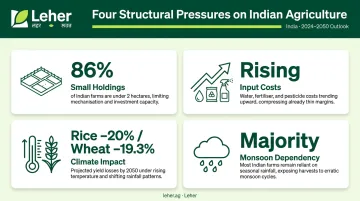
Indian agriculture operates under compounding pressures:
- 86% of holdings are under 2 hectares, leaving almost no room for yield surprises
- Input costs — water, fertiliser, pesticides — are rising consistently
- Climate variability is intensifying, with ICAR modelling projecting rainfed rice yields 20% lower by 2050 and wheat 19.3% lower by 2050 if no adaptation measures are taken
- Monsoon dependency remains high for a majority of farms
The Cost of Operating Without Data
Without monitoring, common patterns include:
- Over-irrigation from fixed schedules rather than actual soil moisture readings — traditional irrigation in India operates at only 25–35% water-use efficiency, per a Ministry-supported IIMA study
- Calendar-based pesticide spraying that misses actual pest pressure windows — applied too early or too late relative to infestation timing
- Reactive disease management — catching problems after visible damage appears, when much of the yield loss has already occurred
The cumulative effect is significant: crop losses due to weeds, pests, and diseases are estimated at 10–35% annually according to a Ministry of Agriculture Lok Sabha reply, varying by agro-climatic conditions.
The Policy Tailwind
India's Digital Agriculture Mission, approved on 2 September 2024 with a ₹2,817 crore outlay, is building exactly the infrastructure farm monitoring depends on:
India's Digital Agriculture Mission, approved on 2 September 2024 with a ₹2,817 crore outlay, is building exactly the infrastructure farm monitoring depends on:
- Krishi Decision Support System — integrating remote sensing data on crops, soil, weather, and water
- Digital Crop Survey covering farms nationwide
- Soil profile mapping across 142 million hectares
Farmers who adopt monitoring tools now will be positioned to plug directly into this national data infrastructure as it matures.
Key Types of Farm Monitoring Systems
Soil Health and Moisture Monitoring
Soil sensors placed at varying depths measure moisture, temperature, pH, and nutrient content continuously. This data answers questions that manual checking simply cannot: Is the root zone actually dry, or just the surface? Is moisture distribution uniform across different parts of the field?
Why it matters in practice:
- Overwatering causes root rot and nutrient leaching; underwatering stresses crops and suppresses yields
- Moisture threshold alerts let farmers schedule drip or sprinkler irrigation based on what the crop actually needs, not a fixed schedule
ICAR's National Research Centre for Banana documented that IoT-based soil-moisture-sensor irrigation saved 25–30% water and 15–20% nutrients in banana cultivation without compromising yield — concrete Indian evidence that sensor-guided irrigation delivers real resource savings.
Crop and Aerial Monitoring
Drones equipped with multispectral or RGB cameras can scan entire fields in a fraction of the time it would take to walk every row. They detect crop stress, canopy health, chlorophyll levels, and early signs of disease or pest damage that aren't visible at ground level.
For Indian farms — where manual field scouting is labour-intensive — aerial data gives farmers a field-wide view that was previously impossible without significant manpower.
Drone-based monitoring doesn't just identify problems — it locates them precisely. That means inputs can be applied exactly where needed, not broadcast across the entire field.
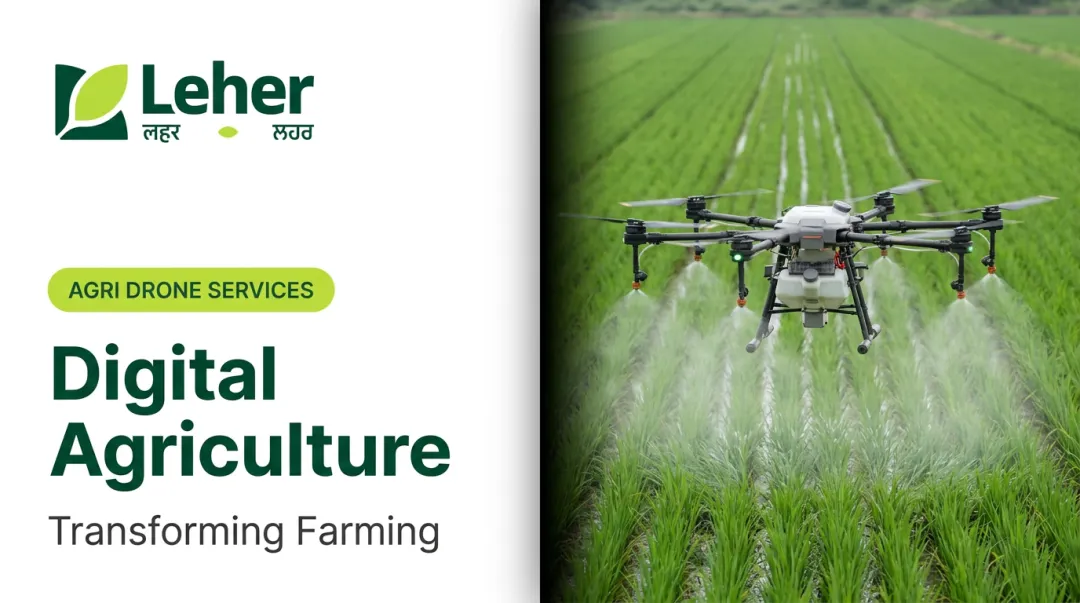
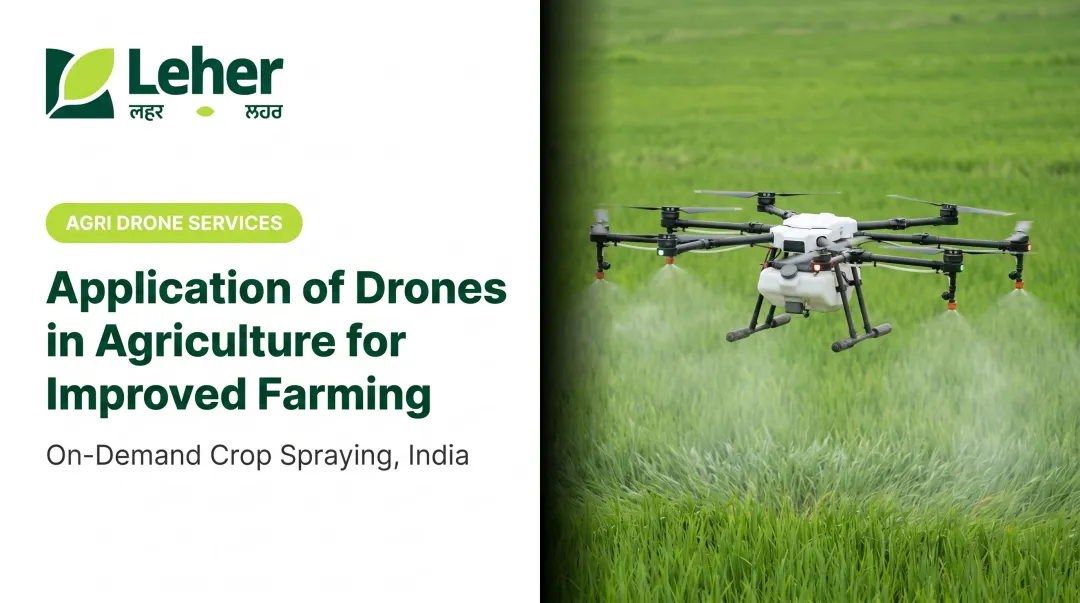
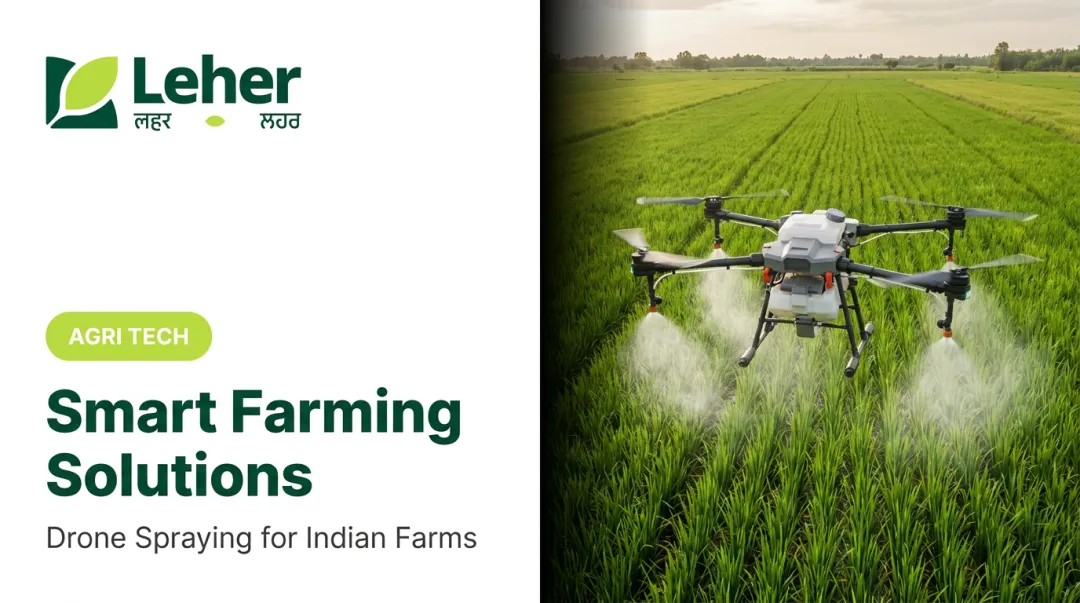
Companies like Leher combine aerial data collection with precision spraying, closing the gap between spotting a problem and treating it in a single visit. Leher's service covers up to 50 acres per day, with documented outcomes of up to 90% water savings and around 30% reduction in pesticide use compared to conventional spraying.
Weather and Environmental Monitoring
On-farm weather stations measure temperature, humidity, rainfall, wind speed, and solar radiation at the field level. This is considerably more accurate than district-level forecasts for making farm-specific decisions.
Practical applications include:
- Timing fungicide applications around humidity-temperature windows when fungal disease risk is highest
- Frost alerts for horticulture crops
- Irrigation adjustments based on actual evapotranspiration rather than estimated weather
IMD's Gramin Krishi Mausam Sewa already provides 5-day district and block-level advisories — a 2020 study cited by PIB found 98% of 3,965 surveyed farmers modified farming practices after receiving weather information, with an estimated ₹13,331 crore annual income gain in rainfed districts. On-farm weather stations take this further by providing microclimate data specific to individual fields.
Pest and Disease Monitoring
IoT-based pest monitoring uses sensor-equipped traps or cameras to count insects, identify infestation hotspots, and trigger alerts when pest pressure crosses action thresholds.
The alternative — spraying on fixed schedules — wastes inputs when pest pressure is low and misses timing when it's high. ICAR-NRIIPM's IPM modules show need-based pest management reduces pesticide usage by 72% compared to conventional farmer practices. A 2025 global meta-analysis in Communications Earth and Environment found threshold-based management reduced insecticide applications by 44% without compromising yield, a finding consistent with Indian IPM data.
Livestock Monitoring
For mixed farms with cattle or poultry, wearable sensors (ear tags, collars) track movement, body temperature, feeding patterns, and reproductive cycles. Early disease detection and heat detection in cattle directly reduces veterinary costs and improves herd productivity, compounding meaningfully over a full season.
Technologies That Power Modern Farm Monitoring
The Sensor Layer
Field sensors form the data collection foundation. Soil probes, weather stations, pest traps, and crop cameras each capture specific parameters continuously. The key is how they communicate that data back:
- Cellular (4G/LTE-M) — reliable where coverage exists; as of September 2024, more than 6,14,564 villages had 4G connectivity in India
- LoRaWAN — low-power, long-range protocol suited to large farms or areas with patchy cellular coverage
- Satellite — for genuinely remote areas without mobile infrastructure
Rural internet subscribers in India reached 398.35 million by March 2024 (TRAI), making mobile-connected monitoring increasingly practical across agricultural regions.
Cloud Platforms and Dashboards
Data from field sensors flows to cloud platforms that process, store, and visualise it. What a farmer sees on a dashboard typically includes:
- Real-time readings from each sensor
- Historical trends by season or crop cycle
- Zone-specific maps showing variation across the field
- Automated alerts when parameters cross set thresholds
Critically, modern platforms are smartphone-first — which matters in India, where most farmers access the internet via mobile devices rather than computers.
Drones as Integrated Monitoring-Action Tools
Drones function as both sensors and action platforms. A single drone flight can capture multispectral field data and then, on a follow-up run, deliver targeted inputs to exactly the areas showing stress.
This cycle of observation, analysis, and targeted action fits India's farm scale and the cost sensitivity of most operations. Leher takes this further with an on-demand model: farmers book a drone spraying session through the Leher App, a DGCA-certified pilot arrives at the field, and payment happens only after the job is done — no equipment ownership required.
How to Get Started with Farm Monitoring in India
Step 1: Start With Your Biggest Problem
Don't try to monitor everything at once. Ask: what is the most expensive or frequent source of loss on this farm?
- If water cost is the issue — start with soil moisture sensors
- If pest damage is the primary risk — begin with drone-based crop scouting
- If weather-related timing decisions are the challenge — a basic on-farm weather station delivers immediate value
One targeted intervention, done right, delivers clearer returns than spreading thin across too many areas at once.
Step 2: Match Technology to Farm Size and Connectivity
Different scales and situations suit different approaches:
| Farm Profile | Recommended Starting Point |
|---|---|
| Small farm, good cellular coverage | IoT sensor kit + smartphone alerts |
| Small farm, limited connectivity | LoRaWAN-based sensors or drone-as-a-service visits |
| Medium farm, mixed crops | Weather station + periodic drone surveys |
| Large farm or FPO | Full sensor network + contracted drone monitoring |
Step 3: Use Service-Based Models to Lower Entry Cost
Most Indian farmers don't need to buy and maintain hardware. Agri-tech companies like Leher operate on a drone-as-a-service model: farmers book spraying and monitoring visits through the Leher App, a DGCA-certified pilot arrives, and payment happens after the job is done. No upfront investment, no maintenance responsibility.
Government schemes are also pushing access over ownership. Key programs include:
- Kisan Drone grants: fund FPO demonstrations and custom hiring centres
- Namo Drone Didi scheme: targets 15,000 women-led self-help groups to provide drone rental services to farmers through 2024–26
Frequently Asked Questions
What is farm monitoring?
Farm monitoring is the use of sensors, drones, and software to track crop health, soil conditions, weather, and farm operations in real time. It gives farmers continuous field visibility rather than periodic manual observation, enabling faster and more accurate decisions.
What are the main types of farm monitoring systems?
The five key types are: soil health and moisture monitoring, aerial and crop monitoring via drones, weather and environmental monitoring, pest and disease monitoring, and livestock monitoring. Most farms start with one or two types based on their primary cost or risk.
How do drones help in farm monitoring?
Drones capture aerial imagery and multispectral data across large areas quickly, detecting crop stress, disease, and pest hotspots before they're visible from the ground. They can also deliver precision inputs — pesticides or fertilisers — to exactly the locations that need treatment during the same flight.
Is farm monitoring affordable for small Indian farmers?
Drone-as-a-service and IoT sensor kits remove the need for large upfront investment. Farmers can book monitoring on a per-acre or per-session basis, and government schemes support drone access through FPOs and women-led SHG rental programs.
What is the difference between farm monitoring and precision agriculture?
Farm monitoring is the data collection layer — observing what is happening in the field. Precision agriculture is the broader practice of using that data to apply inputs and make decisions with high accuracy. Without reliable monitoring data, precision agriculture is guesswork.
How does farm monitoring help reduce pesticide use?
Continuous monitoring identifies pest pressure early and pinpoints exactly where it exists, so treatment goes only to affected areas. This replaces blanket calendar-based spraying, cutting chemical use and cost while keeping every at-risk patch covered.