Introduction
Across Punjab, Haryana, and the Indo-Gangetic Plain, input costs are climbing, groundwater tables are dropping, and seasonal labor is harder to secure. Climate unpredictability has made timing-critical crop protection applications increasingly difficult to manage with traditional methods.
Manual backpack sprayers cover less than one acre per hour. Tractor boom sprayers compact the soil, struggle in waterlogged fields, and expose operators to direct chemical contact.
Neither method suits the fragmented landscape that defines Indian agriculture. According to the Agriculture Census 2015-16, over 86% of holdings are marginal or small, averaging just 1.08 hectares.
Drone spraying offers a practical alternative. It's not universally suited to every farm, but for the right crop and context, it delivers measurable improvements in coverage, chemical use, and operator safety.
This article breaks down how agricultural drone spraying works, what it genuinely delivers, where it falls short, and how Indian farmers and agribusiness professionals can decide whether it fits their operation.
TL;DR: Key Takeaways
- GPS-guided spray drones fly 7–10 feet above the crop canopy and cover 5–10 acres per hour
- Studies report 30–40% lower pesticide consumption and up to 90% less carrier water compared to conventional methods
- Main limitations: 10–15 litre tank capacity, 10–20 minute flight times, and high equipment purchase costs
- Drone spraying suits waterlogged terrain, fragmented plots, and time-sensitive applications; tractor sprayers hold the advantage on large, flat, accessible fields
- Drone-as-a-service models let farmers with even 1–2 acres access the technology without purchasing hardware
What Is Agriculture Drone Spraying and How Does It Work?
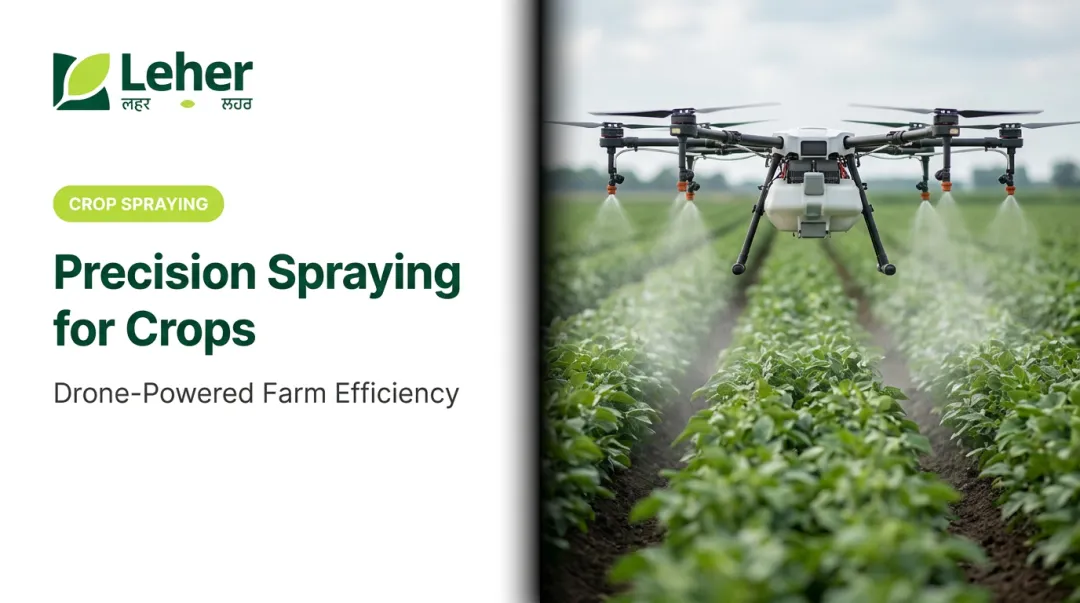
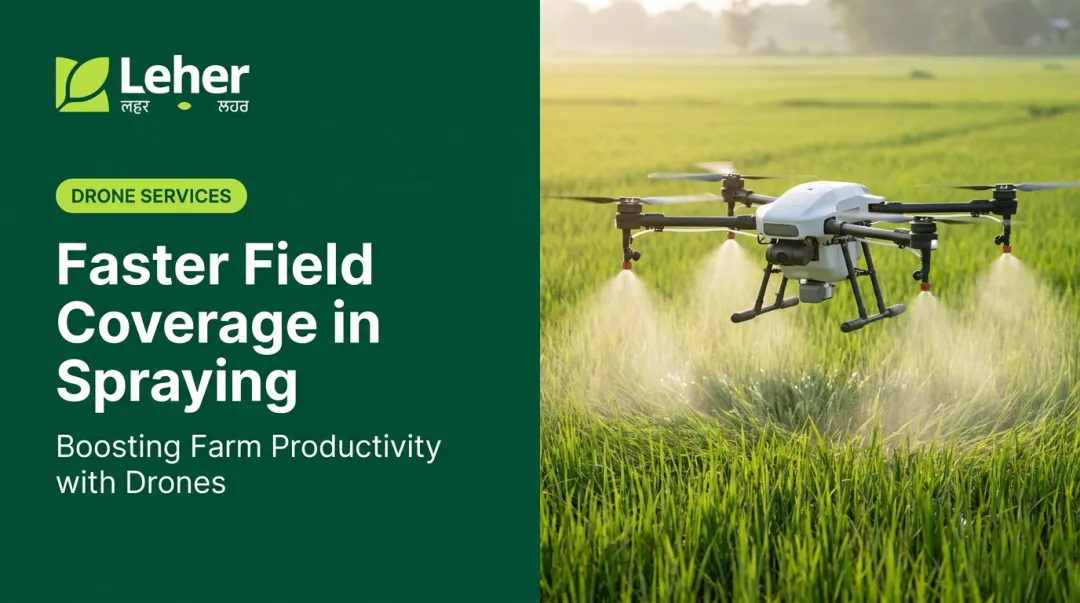
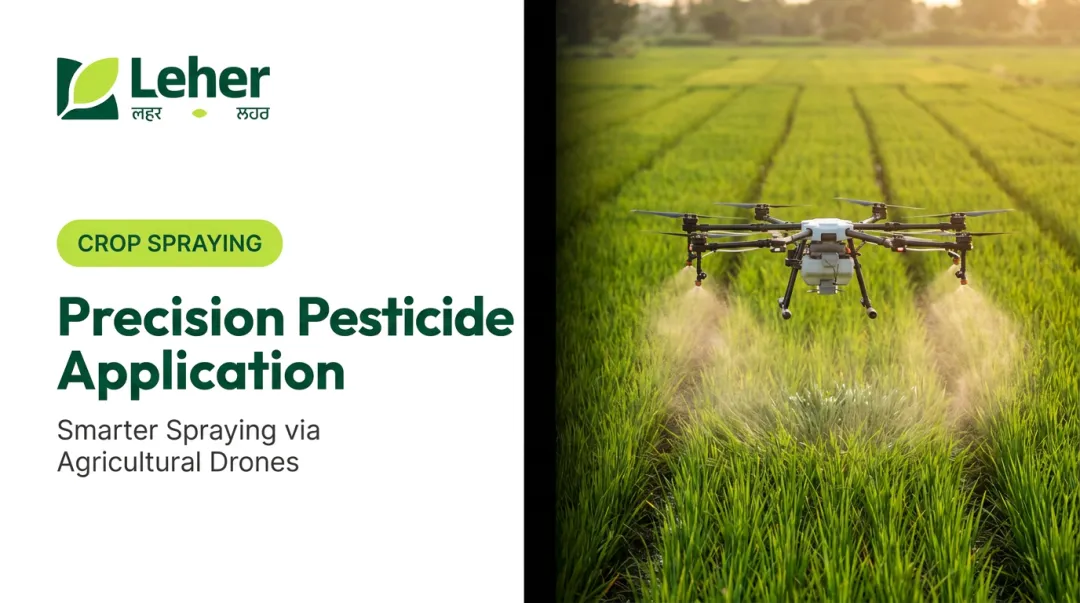
Agricultural drone spraying uses UAVs (unmanned aerial vehicles) fitted with spray tanks, pumps, nozzles, and GPS navigation to apply liquid crop inputs across a field at a defined rate and altitude. India's official SOP specifies an operating height of 2–3 metres (roughly 7–10 feet) above the crop canopy, and a spray volume of 5–10 litres per acre — far lower than conventional methods.
The Spraying Process Step by Step
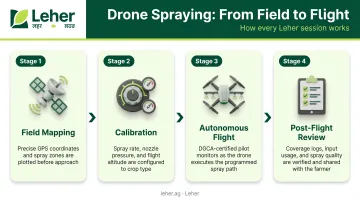
- Field mapping — The field boundary is mapped using GPS, and a spray route is auto-generated based on plot shape and obstacles
- Calibration — Dosage rate, nozzle type, and flight speed are set based on the crop, chemical formulation, and target pest or nutrient
- Autonomous flight — The drone executes the spray pass at a fixed height and speed, often with minimal operator intervention
- Post-flight review — Coverage logs and flight data are reviewed to confirm uniform application
Nozzle Types: The Key Trade-Off
Two nozzle systems dominate agricultural drones. Which one you use shapes coverage quality, drift risk, and how much maintenance you're dealing with in the field:
| Nozzle Type | How It Works | Best For |
|---|---|---|
| Hydraulic flat-fan nozzles | Pressurised liquid through a fixed orifice | Flexibility in droplet size selection; wider chemical compatibility |
| Rotary disc atomisers | Spinning disc breaks liquid into droplets; disc speed controls size | More uniform droplets, less prone to clogging, better drift management |
The practical difference comes down to control. With rotary atomisers, operators adjust droplet size by changing disc speed — higher speed produces finer droplets for better canopy penetration, while lower speed yields coarser droplets that reduce drift in open fields.
Hydraulic nozzles offer broader compatibility with different chemical formulations, but fine orifice sizes make them more prone to clogging and require more frequent maintenance checks between spray passes.
Key Benefits of Agriculture Drone Spraying
Precision Application and Input Savings
GPS-guided drones apply chemicals along pre-mapped routes at calibrated rates, avoiding over-spraying at field edges and skipping already-treated areas. The results are meaningful.
A 2025 peer-reviewed life cycle assessment found UAV spraying achieved 40% lower pesticide consumption, 70% lower water use, and 50% lower CO₂ emissions compared to conventional spraying under studied conditions. ICAR potato trials found drone spraying used just 20 litres per hectare of carrier water, versus 500–750 litres per hectare with conventional equipment.
Leher's field operations — covering 6,500+ acres and serving 810+ farmers in 2024 — consistently report approximately 30% pesticide reduction and 90% water savings, aligning with what independent research finds under comparable conditions.
Speed and Operational Efficiency
Timing matters enormously in crop protection. A fungicide applied two days late can mean the difference between managing a disease outbreak and losing a significant portion of yield.
- Spray drones: 5–10 acres per hour (ICAR-NBAIR reports approximately 7–8 minutes per acre in field demonstrations)
- Manual backpack sprayer: Under 1 acre per hour
- Tractor boom sprayer: Theoretically faster on open ground, but constrained by field access, soil conditions, and crop growth stage
For post-emergence herbicides, fungicide windows, and outbreak responses, that speed advantage is operationally significant.
No Soil Compaction or Crop Damage
Because the drone hovers above the canopy and never enters the field, it eliminates the wheel traffic that compacts topsoil and physically damages standing crop rows. Late-season applications — when fungicide on rice or cotton is most critical — are precisely when tractor access is most damaging and often impractical. Drone spraying sidesteps that trade-off entirely.
Access to Difficult Terrain
Drones operate effectively where machinery cannot:
- Waterlogged paddy fields during the kharif season
- Steep or uneven terrain in hilly states
- Narrow strips between drainage channels or bunds
- Orchards and tea gardens where row access is limited
For India's fragmented smallholdings — many bordered by other farms, roads, or water bodies — this terrain flexibility is a practical advantage.
Reduced Farmer Chemical Exposure
Backpack sprayer operators walk through chemical mist for hours at a time. Manual application is a well-documented exposure risk in Indian agriculture, with effects ranging from respiratory problems and skin conditions to acute poisoning. Drone spraying removes the operator from the spray zone entirely — the pilot stands at the field edge and monitors the flight.
The Real Challenges of Agriculture Drone Spraying
Limited Battery Life and Payload Capacity
This is the most significant operational constraint. Most multi-rotor spray drones currently available in India carry 10–15 litres per flight and have a hovering endurance of 10–20 minutes before needing a battery swap and tank refill.
For reference:
- DJI Agras T10: 8-litre tank, approximately 17 minutes hovering time
- Dhaksha DH-Agrigator E10 Plus (Indian-made): 10-litre tank, 23-minute endurance
- DJI Agras T30: 30-litre tank, but at maximum load, hovering endurance drops significantly
This means every field operation requires a planned rhythm: spare battery sets on hand, a generator or fast charger nearby, and a refill station positioned close to the field. It adds logistical overhead that solo operators need to account for in their job planning.
High Equipment Costs
Agricultural spray drones are not cheap. While exact retail prices fluctuate and should be confirmed directly with suppliers (factoring in GST, battery count, charger, warranty, and pilot costs), entry-level models suitable for agricultural use in India typically start around ₹5–7 lakh, with mid-range models in the ₹8–15 lakh range.
For a farmer with 2–5 acres, outright purchase is rarely financially viable. Drone-as-a-service providers like Leher offer a practical alternative: farmers book spraying per acre through the Leher App without owning any hardware.
Government support also helps bridge the cost gap. The NAMO Drone Didi scheme (approved for 2023–24 to 2025–26 with a ₹1,261 crore outlay) provides up to 80% subsidy on drone packages for Women Self-Help Groups, while SMAM supports ICAR/KVK demonstrations at 100% up to ₹10 lakh.
Spray Drift in Wind and Humid Conditions
Fine droplets drift. India's official SOP for drone spraying sets 15 km/h (about 9.3 mph) as the maximum permissible wind speed for operations. Above this threshold, off-target chemical movement becomes a serious risk — for neighbouring crops, water bodies, and pollinators.
Best practices to reduce drift:
- Spray during early morning or evening when wind is typically lower
- Use coarser droplet settings when conditions are borderline
- Maintain buffer zones near sensitive crops or water bodies as required by the pesticide label and SOP
- Avoid spraying in temperature inversion conditions
Regulatory and Certification Requirements
Operating a commercial agricultural spray drone in India requires navigating two separate regulatory layers:
- Aviation compliance (DGCA): Drone registration and Unique Identification Number (UIN) via the Digital Sky platform, Remote Pilot Certificate for the operator, and airspace zone verification before each job
- Pesticide compliance (PPQS/CIB&RC): Only pesticide formulations with interim approval for aerial application can be used. Media reports cite 477 approved formulations as of April 2022, with extensions granted subsequently — but operators must verify the specific product label before each application, not just assume approval
The Digital Sky platform classifies airspace into green (no prior approval needed), yellow (controlled), and red (no-fly) zones. Checking this map before every job is a regulatory requirement, not optional.
Skill Gap and Training Requirements
Safe, effective drone spraying demands a specific skill set. In rural India, the gap between available training and farmer/operator demand remains wide.
Core competencies operators need to develop include:
- GPS flight planning and pre-job airspace checks
- Nozzle calibration and droplet size management
- Chemical handling protocols and label compliance
- Data log interpretation and emergency response
Leher's DGCA-approved drone pilot training programme covers these areas through hands-on operation in real farming scenarios, alongside regulatory compliance and post-certification support. Broader adoption at scale, though, depends on this training infrastructure reaching operators in the districts where the need is greatest.
Drone Spraying vs. Traditional Methods: A Practical Comparison
Side-by-Side Comparison
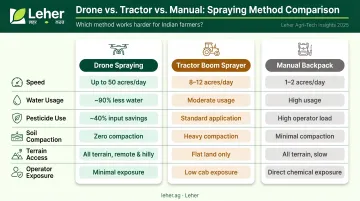
| Factor | Drone Spraying | Tractor Boom Sprayer | Manual Backpack |
|---|---|---|---|
| Speed | 5–10 acres/hour | Variable; constrained by field access | Under 1 acre/hour |
| Water usage | ~20 L/ha (SOP: 5–10 L/acre) | High (hundreds of litres/ha) | High |
| Pesticide use | 30–40% lower (study conditions) | Often excessive/uneven | Often excessive/uneven |
| Soil compaction | None | Significant during application | Minimal |
| Difficult terrain | Effective | Limited | Possible but slow |
| Operator exposure | Minimal | Moderate (cab) | High (direct contact) |
| Labor required | 1 operator | 1–2 operators + field crew | 3–5 workers |
When Traditional Methods Still Make Sense
- Very large, flat farms with reliable tractor access and no flooding risk
- Crops requiring high application volumes that drones cannot deliver in a single pass
- Operations where drone service costs outweigh the benefit of precision application
When Drone Spraying Clearly Wins
- Waterlogged or elevated terrain
- Late-season fungicide or herbicide applications in standing crops
- Small or fragmented holdings with multiple plots
- Rapid response to pest or disease outbreaks where days of delay cause crop loss
- Farms targeting export markets or certifications that require reduced chemical residue
The Cost Picture for Indian Smallholders
Drone spraying costs in India vary by crop, region, and service provider — no fixed national benchmark applies. Leher's model delivers approximately 20% lower overall farming costs compared to conventional spraying, through reduced input waste, lower water consumption, and faster field coverage. For accurate per-acre figures, farmers should request quotes from local providers based on their specific crop and acreage.
Frequently Asked Questions
What do agriculture drones actually spray?
Agricultural spray drones apply liquid pesticides, herbicides, fungicides, and foliar fertilisers, including plant growth regulators in advanced applications. Every product used must carry label approval for aerial application under India's PPQS/CIB&RC requirements before it can be used in drone operations.
How much does agriculture drone spraying cost in India?
Per-acre service costs vary by region, crop type, and provider. Buying a drone outright typically costs ₹5–15 lakh or more depending on the model, making drone-as-a-service far more accessible for most farmers. For area-specific pricing, the Leher App lets you request a quote directly from local operators.
Can small and marginal farmers use drone spraying?
Yes. Through drone-as-a-service models like Leher's, farmers with even 1–2 acres can book a spraying session through an app, pay per acre after the job is done, and access the same precision technology as large farms — without owning any equipment.
How does drone spraying reduce pesticide and water use?
GPS-guided drones apply chemicals along pre-mapped routes at calibrated rates and heights, delivering a consistent dose only where needed. This eliminates the over-spraying and uneven coverage common with manual and boom-sprayer methods, reducing both chemical waste and carrier water volume.
Do operators need a licence to spray pesticides with a drone in India?
Yes. Commercial drone operators require a Remote Pilot Certificate from DGCA and must register their drone via the Digital Sky platform under Drone Rules 2021. Each pesticide product also needs CIB&RC interim approval for aerial application before use.
What are the main limitations for large-farm operations?
The 10–15 litre tank capacity and 10–20 minute flight times mean frequent refills and battery swaps, adding logistical overhead that large tractor sprayers avoid on open, accessible fields. Larger models like the DJI T30 (30 litres) narrow this gap but are still more operationally complex than a single tractor pass.