The result: nutrients that crops can't absorb leach into groundwater, volatilise into the atmosphere, and acidify soils over time. Fertiliser spending climbs without a proportional yield benefit.
Precision nutrient management (PNM) addresses this directly. Instead of applying blanket rates across an entire field, PNM uses soil data, crop sensing, and targeted application to deliver the right nutrient, in the right quantity, at the right time and place. For Indian smallholder farmers managing tight margins and fragmented plots, this shift from guesswork to data can meaningfully improve both profitability and soil health.
Key Takeaways
- PNM replaces uniform fertiliser application with data-driven, site-specific nutrient decisions.
- The 4R framework (Right Source, Right Rate, Right Time, Right Place) guides every PNM decision.
- GPS-tagged soil testing, SPAD/NDVI sensors, and variable-rate spraying technologies like agricultural drones drive site-specific application.
- Integrated Nutrient Management (INM) combines organic and chemical inputs to reduce synthetic fertiliser dependence while sustaining soil fertility.
- Indian farmers can start with government Soil Health Cards, then add crop sensing and drone spraying services to execute PNM at scale.
What Is Precision Nutrient Management?
Precision nutrient management is the practice of supplying crops with the exact type, quantity, and placement of nutrients they require — based on soil test data, crop demand signals, and spatial variability within the field. It's the opposite of blanket application, where a uniform fertiliser rate is broadcast across an entire farm regardless of whether different zones actually need it.
Why Conventional Application Falls Short
Conventional fertiliser practice in India tends to over-rely on subsidised urea and DAP, applied at flat rates driven by habit or general recommendations rather than soil-specific need. The consequences are well-documented:
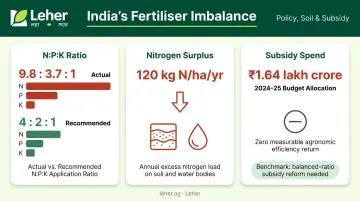
- Nitrogen surplus: FAOSTAT data reports India's cropland nitrogen surplus at around 120 kg N/ha per year — a substantial environmental load that contributes to groundwater contamination and greenhouse gas emissions.
- Wasted expenditure: The government allocated roughly ₹1.64 lakh crore to fertiliser subsidies in 2024-25. When nutrients are applied beyond crop uptake capacity, that public expenditure delivers no agronomic return.
- Soil degradation: Imbalanced fertiliser use depletes soil organic carbon and suppresses microbial activity, reducing long-term productivity.
How PNM Works Differently
Rather than treating a field as uniform, PNM divides it into management zones based on soil variability — differences in pH, organic matter, or nutrient levels across the farm. Each zone gets its own nutrient prescription, which means targeted application that maximises crop uptake and cuts waste. In practice, this translates to three measurable gains:
- Fewer inputs spent on zones that don't need them
- Lower risk of nutrient runoff and soil acidification
- Better yield consistency across variable terrain
This efficiency advantage matters most where resources are tightest. With average operational holdings having fallen to around 1.08 hectares, Indian smallholders can't absorb the cost of chronic over-application. PNM technologies — especially those delivered through service models rather than individual ownership — give farmers a direct way to cut input costs without sacrificing yield.
The 4Rs of Precision Nutrient Management
The 4R framework is the globally recognised backbone of PNM. Each "R" addresses a different dimension of nutrient efficiency, and together they ensure that fertiliser investments deliver maximum agronomic return with minimum environmental cost.
Right Source
Choosing the right fertiliser type means matching the nutrient source to both the crop's requirements and the soil's existing chemistry. Common sources each carry distinct trade-offs:
- Urea releases nitrogen rapidly and suits crops with high vegetative demand, but is prone to volatilisation in alkaline soils
- DAP provides phosphorus alongside nitrogen — useful at sowing, less relevant mid-season
- Vermicompost and farmyard manure release nutrients slowly, improving soil structure alongside nutrition
Applying a fast-release nitrogen fertiliser to already nitrogen-saturated soil, for instance, drives up cost and accelerates leaching simultaneously.
Right Rate
Applying exactly what the crop can use — no more, no less — depends on three inputs:
- Soil test results for existing nutrient levels
- Target yield expectations for the season
- Credit from any prior organic inputs (manure nitrogen, legume residue)
Under-application limits yield. Over-application creates runoff, drives soil acidification, and adds unnecessary cost. A New Delhi wheat trial illustrates the precision possible: 120 kg N/ha produced 4.87 t/ha, statistically comparable to 5.22 t/ha at 150 kg N/ha — meaning the additional 30 kg of nitrogen added cost without proportionate yield benefit.
Right Time
Crop nutrient demand is not constant. A paddy crop needs different nutrient support at tillering versus panicle initiation. Applying all nitrogen as a single basal dose misses the peak uptake windows, leaving nutrients vulnerable to leaching before the crop can absorb them.
Split application strategies — calibrated to crop growth stages — measurably improve uptake efficiency. The Rice Crop Manager tool tested in Odisha demonstrated this clearly, recommending split nitrogen applications across early vegetative, mid-tillering, and panicle initiation stages, and generating rice yield increases of 0.3–0.8 Mg/ha over farmers' conventional fertiliser practice.
Right Place
Where and how fertiliser is deposited determines how much the crop actually captures. Broadcast application distributes nutrients across the soil surface, where much of the nitrogen is exposed to volatilisation before incorporation. Placing nutrients closer to the root zone (through soil injection, deep placement, or targeted foliar application) increases contact efficiency and reduces losses.
Deep-placed urea briquettes in irrigated rice systems, for example, sharply reduce nitrogen losses compared to surface broadcast. For foliar nutrients, drone-based precision spraying delivers inputs directly onto the crop canopy with controlled, even coverage — particularly valuable where ground machinery access is difficult or where timing to a specific growth stage is critical. On-demand drone spraying services available to Indian farmers through platforms like the Leher App make this kind of targeted, growth-stage application practically accessible, even on smallholder plots.
Tools and Technologies That Enable Precision Nutrient Management
Soil Testing and Soil Health Mapping
Every PNM programme starts with knowing what's already in the soil. GPS-tagged soil sampling across different field zones reveals spatial variability in pH, organic carbon, nitrogen, phosphorus, and potassium. This data feeds into digital soil maps that form the basis of variable-rate nutrient prescriptions.
India's Soil Health Card (SHC) scheme has issued more than 22 crore cards to date. Research by NPC found that farmers who used SHC recommendations reported 8–10% lower chemical fertiliser use and 5–6% yield increases. The scheme provides a useful baseline, but the real challenge lies in converting that card into adjusted on-farm practice.
Crop Sensing Tools
Soil tests establish a baseline, but crops' nutritional status changes through the season. Sensor-based tools allow in-season corrections without waiting for lab results:
- SPAD meters measure leaf chlorophyll content as a proxy for nitrogen status. In a rice-wheat system in eastern India, SPAD-guided nitrogen management saved 33.3% N in rice and 18.8% N in wheat — without any yield penalty.
- NDVI sensors (including GreenSeeker) measure canopy reflectance to assess crop vigour and guide top-dressing decisions across larger areas.
- Drone-mounted and satellite remote sensing scale these readings to entire fields, generating spatial maps of crop stress that can inform variable-rate application decisions.
Variable-Rate Technology and Drone Spraying
Variable-rate technology (VRT) is the execution layer: once nutrient prescriptions exist, VRT equipment applies different rates as it moves across zones, rather than maintaining a constant output. Smart spreaders and sprayers can read prescription maps and adjust automatically.
For Indian conditions, where plots are small and fragmented, terrain is often irregular, and heavy ground machinery is impractical, drone-based spraying offers a more accessible route to variable-rate application.
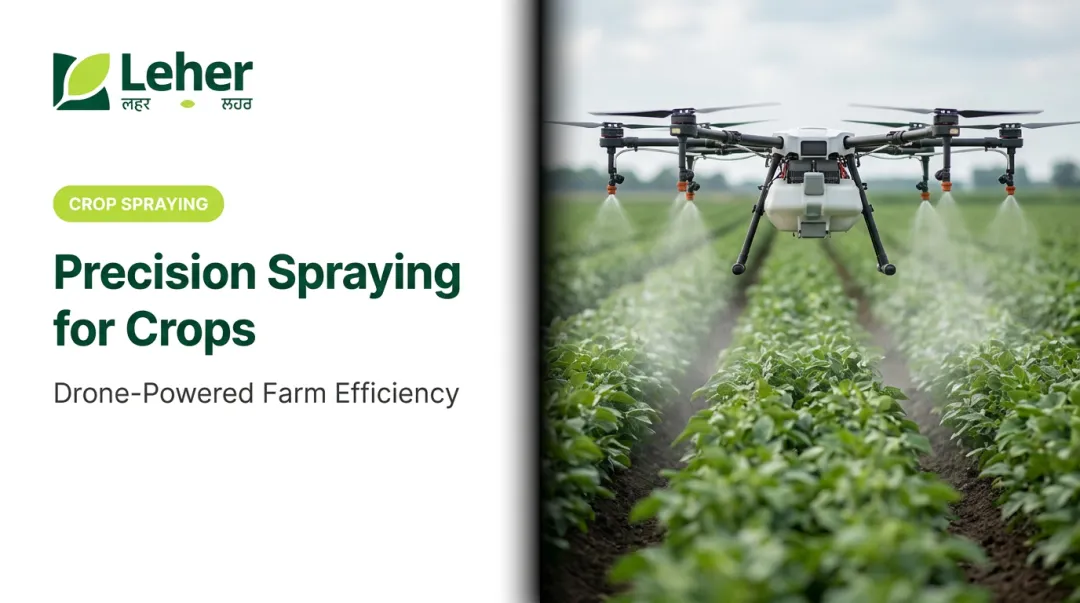
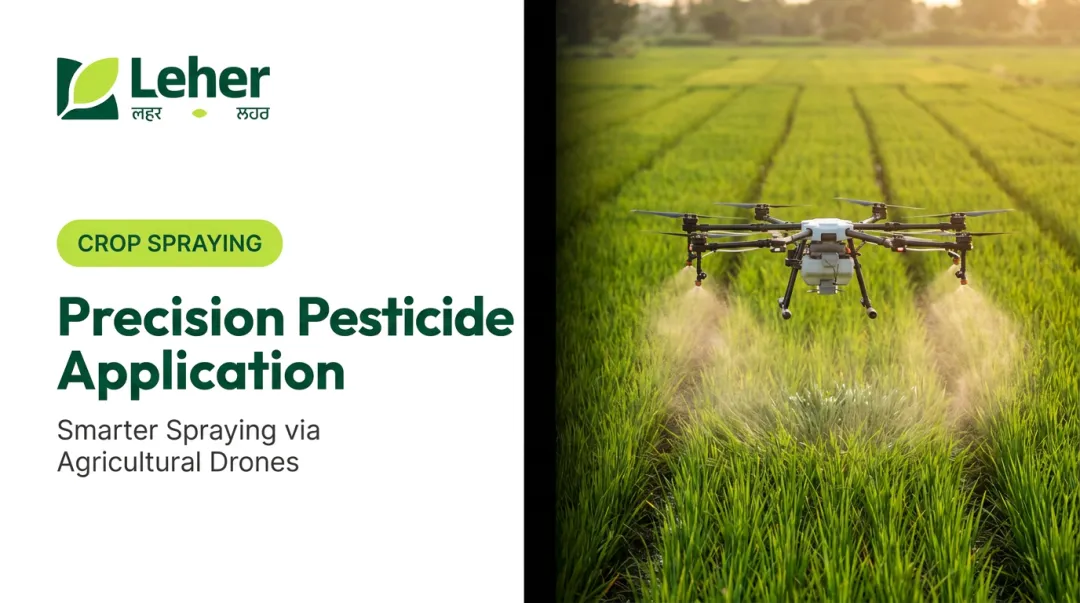
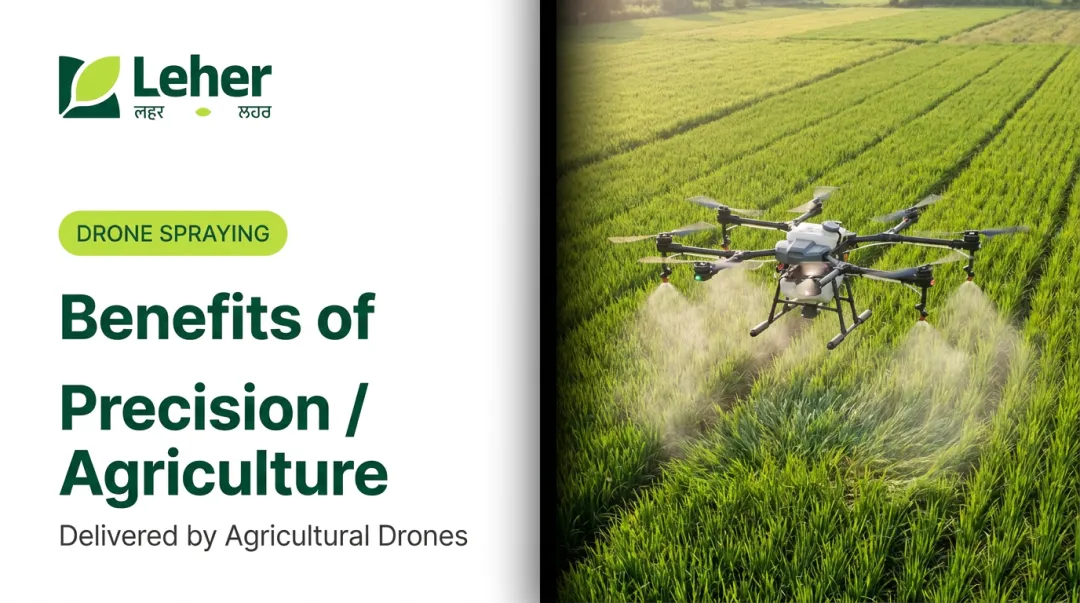
Leher's agricultural drone spraying service is built around this reality. For foliar nutrient application, key advantages include:
- Covers up to 50 acres per day, compared to roughly 3 acres with conventional manual methods
- Delivers uniform aerial coverage with approximately 90% water savings
- Achieves around 40% input savings relative to conventional approaches
- Farmers book a DGCA-certified pilot through the Leher App and pay after the job is complete — no equipment investment required

Digital Farm Management Platforms
Agronomic apps pull together soil data, weather forecasts, and crop growth models to generate nutrient plans that go beyond static recommendations. The next step is AI-driven in-season adjustment: systems that detect crop stress signals and automatically update prescriptions before a problem compounds into yield loss.
Integrated Nutrient Management: Combining Organic and Precision Inputs
Integrated Nutrient Management (INM) combines organic nutrient sources — farmyard manure, green manure, biofertilisers, crop residues — with precision-applied chemical fertilisers. The goal is to meet short-term crop nutrient demands while building long-term soil health.
INM fits naturally within the PNM framework because organic inputs are treated as calculable nutrient sources, not vague supplements. A legume residue contributes a measurable nitrogen credit. Farmyard manure has known N, P, and K values.
When these are factored into the nutrient prescription, the quantity of synthetic fertiliser required drops, reducing both cost and environmental load.
Long-term INM research consistently shows:
- Improved soil organic matter and microbial activity over chemical-only treatments
- Better water retention and reduced erosion risk
- Lower greenhouse gas emissions from soil under balanced organic-chemical combinations
- Sustained or improved yields across crop rotations
For Indian farmers already managing farmyard manure from livestock, INM is less a new input strategy than a structured way to account for what's already being applied — and reduce the synthetic fertiliser bill accordingly.
Steps to Implement Precision Nutrient Management on Your Farm
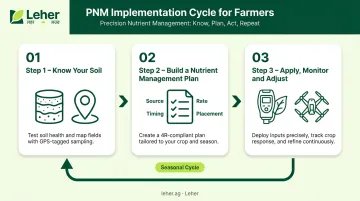
Step 1 — Know Your Soil
Begin with comprehensive soil testing across different zones of the field. A single composite sample per farm misses spatial variability that can be significant even in small holdings. Work with a certified agronomist or agri-tech service provider to:
- Collect GPS-tagged samples from representative zones
- Test for pH, organic carbon, available N, P, K, and key micronutrients
- Build a baseline nutrient map identifying deficient and surplus zones
India's Soil Health Card scheme is a practical starting point. Cards are free through local agricultural offices and provide zone-specific recommendations for fertiliser and soil amendment.
Step 2 — Build a Nutrient Management Plan
With soil test data in hand, develop a field-specific plan that specifies:
- Source: Which fertiliser types (organic, synthetic, biofertiliser) for each nutrient
- Rate: Quantities per zone, adjusted for yield targets and organic matter credits
- Timing: Basal dose at sowing, plus top-dressing schedule through the season
- Placement: Soil incorporation, deep placement, or foliar application by crop stage
Digital agri platforms and the government's SHC portal provide tools to translate test results into structured plans. For foliar nutrient applications at scale, Leher's drone spraying service delivers precision fertiliser application across paddy, wheat, cotton, sugarcane, and vegetables. Sessions are bookable directly through the Leher App.
Step 3 — Apply, Monitor, and Adjust
Once your plan is in place, execution and observation go hand in hand. Use SPAD readings or visual scouting to track crop nutritional status through the season. If nitrogen stress appears at mid-tillering, an in-season top-dress correction is far cheaper than letting yield potential erode.
Precision nutrient management is iterative. Each season's data — soil tests, yield maps, input records — sharpens the next season's prescription. At harvest, record what worked and what didn't; that log becomes your most valuable input for the following sowing cycle.
Frequently Asked Questions
What is precision nutrient management?
Precision nutrient management is a data-driven approach to supplying crops with the exact type, quantity, and placement of nutrients they need — based on soil testing, crop sensing, and spatial field variability. The goal is to maximise yield while minimising input waste and environmental impact.
What is the main concept of INM (integrated nutrient management)?
INM combines organic nutrient sources — manure, green manure, biofertilisers — with chemical fertilisers in a site-specific, balanced way. The approach sustains soil fertility over time, reduces dependence on costly synthetic inputs, and supports sustainable crop production across seasons.
What are the 4 Rs of precision agriculture?
The 4Rs stand for Right Source, Right Rate, Right Time, and Right Place — guiding farmers to apply the correct fertiliser type, at the right quantity and growth stage, in the most effective field location.
How does precision nutrient management reduce fertiliser costs?
By applying only what soil tests and crop sensors indicate is needed, PNM eliminates over-application. Farmers spend less on fertiliser while maintaining or improving yields — cutting input costs per hectare or acre.
What tools are commonly used in precision nutrient management?
Common tools include:
- Soil test kits and GPS-based soil mapping
- SPAD chlorophyll meters and NDVI sensors
- Variable-rate sprayers and spreaders (including agricultural drones)
- Digital farm management platforms that translate soil and crop data into prescription-based application plans