Introduction
Agricultural drone spraying is one of the fastest-growing business opportunities in rural India right now. According to IMARC Group, India's agriculture drones market reached ₹25,000+ crore (USD 302.3 million) in 2025 and is projected to grow at 23.84% CAGR through 2034. For rural entrepreneurs, that trajectory translates to real, bookable income.
But many aspiring drone operators make the same mistake: they research drone prices, pick one they can afford, and assume the rest will figure itself out. It won't. Startup costs vary widely depending on your niche, the drone category, DGCA compliance requirements, and whether you're flying solo or building a fleet — and underestimating licensing and recurring expenses is one of the most common reasons new drone businesses stall before earning their first rupee.
This guide breaks down realistic cost ranges across three operational tiers — solo operator, small fleet, and commercial-scale — so you can build a budget that matches your actual goals, not just your wishlist.
Key Takeaways
- Startup costs range from under ₹3 lakh (basic photography) to ₹25 lakh+ (agricultural spraying fleet)
- The biggest cost drivers are drone type, DGCA training, and insurance — not just hardware
- DGCA training for small-category drones costs ₹70,800 (including GST) at approved institutes
- Government subsidies (SMAM, Namo Drone Didi) can offset 40–100% of drone costs for eligible operators
- Solo agri-spraying operators can start with a single DGCA-certified drone
- Drone partner programs (like Leher's) offer a lower-capital entry point with equipment, training, and support bundled in
How Much Does It Cost to Start a Drone Business in India?
There's no single number. Your startup cost depends on the service you're offering, the drone category required, whether you need DGCA training, and whether you're operating as a solo pilot or building a team.
Two mistakes show up constantly among first-time drone entrepreneurs:
- Underestimating licensing and training costs — these are mandatory for commercial operations, not optional
- Treating the drone purchase as the only major expense — accessories, insurance, and software together often add 40–50% to the total launch cost
Here's a realistic breakdown by tier.
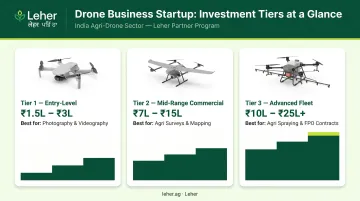
| Tier | Estimated Startup Cost | Best For |
|---|---|---|
| Tier 1: Entry-Level | ₹1.5 lakh – ₹3 lakh | Real estate photography, event videography |
| Tier 2: Mid-Range Commercial | ₹7 lakh – ₹15 lakh | Agricultural surveys, mapping, inspections |
| Tier 3: Advanced / Fleet | ₹10 lakh – ₹25 lakh+ | Full-time agri spraying, FPO contracts |
Tier 1: Entry-Level Setup (Basic Aerial Photography / Videography)
Estimated startup cost: ₹1.5 lakh – ₹3 lakh
This tier covers a consumer or prosumer drone (under 2 kg), basic camera, spare batteries, and Digital Sky Platform registration. A DJI Mini 4 Pro Fly More Combo, for example, is listed at approximately ₹1,09,000 on IndiaMART — add accessories, a carry case, and basic insurance and you're in the ₹1.5–3 lakh range.
| Item | Estimated Cost |
|---|---|
| Drone body and camera | ₹80,000–₹1,50,000 |
| Accessories (batteries, propellers, case) | ₹15,000–₹30,000 |
| UIN registration and compliance | ₹5,000–₹10,000 |
| Insurance (basic hull cover) | ₹10,000–₹25,000 annually |
Best for: Freelancers targeting real estate photography, event videography, or tourism content. Low financial risk, but limited commercial scale — and nano/micro-category rules still apply for commercial work.
Tier 2: Mid-Range Commercial Setup (Agricultural Surveys / Mapping / Inspections)
Estimated startup cost: ₹7 lakh – ₹15 lakh
This tier covers a professional mapping or survey drone (RTK-capable), DGCA pilot training, software subscriptions, and insurance. A DJI Phantom 4 RTK is listed at approximately ₹5,80,000–₹6,09,000 (including GST) on Indian e-commerce platforms.
- Drone and sensor payload: ₹5,00,000–₹10,00,000
- DGCA training (small-category multirotor at an approved RPTO): ₹70,800
- Accessories and ground equipment: ₹50,000–₹1,50,000
- Mapping software (e.g., PIX4Dfields): ~₹1,65,000/year (USD 1,990)
- Insurance: quote-based; plan for ₹20,000–₹50,000 annually
Best for: Entrepreneurs targeting agriculture survey contracts, construction mapping, or infrastructure inspection. Higher entry cost, but the per-acre or per-project revenue potential is considerably higher than Tier 1.
Tier 3: Advanced / Fleet Operations (Agricultural Spraying / Industrial)
Estimated startup cost: ₹10 lakh – ₹25 lakh+
This is the most capital-intensive tier — and the one with the strongest government subsidy support. A DGCA type-certified Made-in-India agricultural spraying drone like the Fuselage Innovation FIA QD10 (10L payload) is listed at ₹8,00,000 on UAV Marketplace.
Add training, insurance, batteries, and chargers across two units, and you're looking at ₹15–25 lakh before subsidies.
- Agri spraying drone (10L): ₹8,00,000–₹10,00,000 per unit
- Spare batteries: ₹21,709–₹58,499 per pack; plan for 3–4 packs
- Charger: ~₹24,679
- DGCA training (small-category): ₹70,800
- Insurance, AMC, registration: ₹50,000–₹1,50,000 annually
Government subsidies can reduce this cost considerably — see the FAQ for current SMAM and Namo Drone Didi rates.
Best for: Agri-entrepreneurs building a full-time drone spraying business, targeting FPO contracts, or covering hundreds of acres per season.
Key Factors That Affect Drone Business Startup Costs
Every cost line in a drone business is connected. Choosing a higher-spec niche doesn't just increase the drone price — it triggers higher training requirements, more expensive insurance, and more complex compliance. Here's what drives the biggest swings.
Type and Specifications of the Drone
The drone itself is the largest single expense, and the category determines almost everything else. A basic photography drone sits under ₹1.5 lakh. A DGCA-certified agricultural spraying drone starts near ₹8 lakh. Payload type adds to the cost further:
- Standard RGB camera: included in most prosumer drones
- Multispectral sensor (for crop mapping): significant add-on cost; no verified India retail price found — budget on a quote basis
- Spray tank + pump assembly (10L–30L): built into agri-spraying drones; drives the "small category" classification and all associated compliance requirements
Licensing, Certification, and Regulatory Compliance
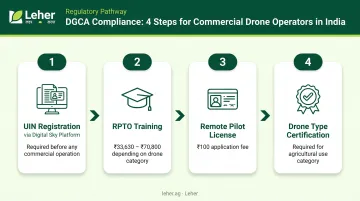
India's Drone Rules 2021 simplified the regulatory framework significantly — UAOP was abolished, fee types dropped from 72 to 4, and the Remote Pilot License fee was set at just ₹100 (valid for 10 years). But compliance is still mandatory, and training is a real cost.
Key requirements for commercial drone operators:
- Unique Identification Number (UIN) via the Digital Sky Platform — required for all commercial drones
- Remote Pilot License — requires training from a DGCA-approved RPTO (Remote Pilot Training Organisation)
- RPTO training fees: ₹33,630 (micro multirotor, 4 days) or ₹70,800 (small multirotor, 5 days) at the Indian Institute of Drones, including GST
- Drone type certification — agricultural spraying drones must be DGCA type-certified; confirm before purchasing
Non-compliance can ground your operations and cost you contracts — government and agribusiness clients now require compliance documentation before awarding work. Your drone's classification under these rules also directly affects how insurers assess your risk profile.
Insurance and Risk Coverage
Drone insurance in India covers hull damage, third-party liability, payload, and optional add-ons. Insurers including Tata AIG (partnered with TropoGo), ICICI Lombard, and New India Assurance offer RPAS-specific policies aligned with IRDAI product wording. Premiums are quote-based and depend on:
- Drone value and payload
- Use case (spraying, mapping, photography)
- Operating geography and pilot experience
- Add-ons like night operations or training flights
Budget for third-party liability and hull cover as separate line items, and request quotes from at least two insurers. Some corporate and government agribusiness clients now require proof of valid insurance before awarding contracts.
Operating and Maintenance Costs
Recurring costs are consistently underestimated. Plan for these annually:
| O&M Item | Indicative Cost (India Market) |
|---|---|
| Agri-drone battery (6S, 16000–22000mAh) | ₹21,709–₹33,999 per pack |
| High-capacity battery (30000mAh+) | ₹42,000–₹58,499 per pack |
| Charger (ULTRAPOWER UP1100) | ~₹24,679 |
| Motor/propeller spares | ₹1,400/pair (propellers), ₹18,000 (Hobbywing X9 motor) |
| Mapping software (PIX4Dfields) | ~₹1,65,000/year |
A reasonable working estimate: recurring O&M adds 15–25% to your annual operating cost on top of the initial setup. For a ₹10 lakh spraying operation, that's ₹1.5–2.5 lakh per year before insurance.
Budget vs. Premium Drone Setup: What's the Real Difference?
Choosing a cheaper drone to save upfront capital makes sense in some situations and backfires in others. Here's how the two ends of the market compare across four dimensions:
| Dimension | Budget Setup | Premium / Certified Setup |
|---|---|---|
| Performance & payload | Limited payload; basic camera; no spray capability | 10L–30L spray tank; RTK/multispectral sensor options |
| Durability & field reliability | Consumer-grade; higher repair frequency | Commercial-grade; designed for daily field use |
| Regulatory readiness | May not meet DGCA type-certification for commercial spraying | DGCA type-certified; cleared for commercial agri operations |
| Maintenance frequency | More frequent; spare parts harder to source | Manufacturer-supported; parts availability better |
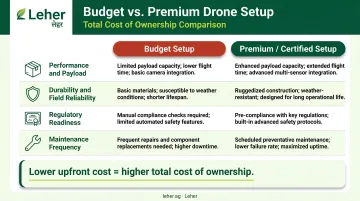
A lower upfront cost typically means a higher total cost of ownership. Three situations where this plays out:
- Frequent repairs eat into margins faster than a premium drone's price difference
- Non-certified drones lock you out of DGCA-compliant commercial spraying contracts
- Limited payload capacity pushes you toward lower-margin, smaller-scale work
If a drone can't qualify for the contracts that actually pay, the "savings" disappear quickly.
How to Estimate the Right Budget for Your Drone Business
The right budget isn't the lowest possible number. It's the one that matches your target niche, expected workload, and a realistic break-even timeline. Before you budget, answer these questions honestly:
- What specific service will I offer — spraying, mapping, photography?
- How many acres or projects per month do I have demand for, confirmed or likely?
- Does my drone category require DGCA training and type certification?
- Do I have clients lined up, or am I building demand from scratch?
Common Budgeting Mistakes to Avoid
- Focusing only on the drone purchase price and ignoring accessories, insurance, and software
- Over-specifying gear for a niche where you haven't confirmed client demand yet
- Choosing the cheapest available drone without checking DGCA compliance requirements
- Ignoring recurring costs — batteries and software alone can run ₹2–3 lakh annually for a spraying operation
A Lower-Capital Entry Point Worth Considering
Some of these mistakes are easier to avoid when the compliance and logistics infrastructure is already in place. For aspiring agricultural drone entrepreneurs who want to enter the market without bearing the full upfront cost, partnership models offer a structured alternative.
Leher's rural drone partner program lets entrepreneurs join with their own DGCA-compliant drone or acquire one through Leher. The model includes:
- AIF loan facilitation to ease equipment financing
- Drone insurance and annual maintenance contracts
- Guaranteed farming orders from day one
This means you can start generating revenue from spraying operations before you've recovered full capital outlay — a meaningful difference for first-time operators calibrating their entry risk.
Whatever your entry path, map out every cost component before committing. Your drone is a depreciating asset; your market knowledge is not.
Frequently Asked Questions
How much does it cost to start a drone business in India?
Costs range from ₹1.5–3 lakh for a basic photography setup to ₹10–25 lakh+ for a commercial agricultural spraying operation. Beyond the drone itself, DGCA training (up to ₹70,800), insurance, accessories, and software add 40–50% to the total. The niche you choose determines your total startup cost.
Is a drone business profitable in India?
Agricultural spraying and precision mapping are both profitable, with strong demand from FPOs, agribusinesses, and individual farmers. A single drone can spray an acre in under 10 minutes, and service charges typically run ₹300–700/acre — margins are strongest for certified operators with steady contract volume.
What licences do I need to start a drone business in India?
You need a Unique Identification Number (UIN) via the Digital Sky Platform, a Remote Pilot License from a DGCA-approved RPTO, and — for agricultural spraying — a DGCA type-certified drone. The licence fee is just ₹100, but training at an approved institute costs ₹33,630–₹70,800 depending on drone category.
What is the best drone for starting an agricultural drone business in India?
It depends on your service. For spraying, look for a DGCA type-certified drone with a 10L+ payload — the Made-in-India Fuselage Innovation FIA QD10 (₹8,00,000) is a verified benchmark. For mapping, RTK-capable drones like the DJI Phantom 4 RTK are used widely. DGCA classification and payload capacity are the key selection criteria, not brand alone.
Are there government subsidies for buying agricultural drones in India?
Under SMAM, eligible farmers can receive 40–50% subsidy (up to ₹4–5 lakh), FPOs up to 75%, and Women SHGs up to 80% (up to ₹8 lakh) under the Namo Drone Didi scheme. Check the agrimachinery.nic.in DBT portal and your state agriculture department for current eligibility.