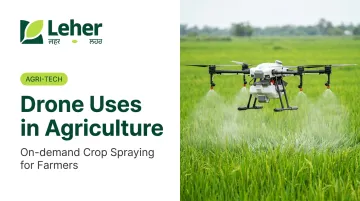
Traditional methods often involve treating entire fields uniformly, whether they need it or not. This can lead to wasted water, excess chemical use, and high labour costs. But what if you could see your farm from a new perspective? What if you could give each plant exactly what it needs, right when it needs it?
This is where agricultural drones come in. These are not toys; they are powerful tools transforming modern farming into a data-driven, precise, and sustainable practice. This article will explore what agricultural drones are, their most impactful uses, and how you can get started with this game-changing technology.
TL;DR: The Future of Farming from Above
- What they are: Agricultural drones are specialised unmanned aerial vehicles (UAVs) used for monitoring, mapping, and applying treatments to crops.
- What they do: Key uses include real-time crop health monitoring, precision spraying of pesticides and fertilisers, and detailed soil analysis for better planning.
- Why it matters: Drones lead to higher yields, significantly less water and chemical usage, lower operational costs, and improved safety for farm workers.
- How to start: The right application depends on your farm's size and goals, with service models like Leher's making it easy to start without buying a drone.
What Are Agricultural Drones?
An agricultural drone is a specialised, unmanned aerial vehicle designed specifically for farming tasks. Think of it less as a gadget and more as a flying data platform. Equipped with advanced sensors, high-resolution cameras, or dispensers, these robust tools are built to operate in demanding farm environments.
They serve two primary functions:
- Collecting data by acting as an "eye in the sky," capturing detailed imagery that reveals insights about crop health, soil conditions, and topography invisible to the naked eye.
- Taking action by using onboard tanks and nozzles to perform tasks like the precision spraying of fertilisers, pesticides, or even spreading seeds.
Instead of walking the fields for hours, a farmer can get a complete overview in minutes, enabling them to make smarter, faster decisions based on real-time information.
Why Drones Are a Game-Changer for Modern Farming
The biggest shift drones bring to agriculture is the move from guesswork to precision agriculture. Instead of treating an entire field uniformly, farmers can manage specific zones based on their unique needs. This targeted approach delivers profound benefits.
Cost-Effectiveness
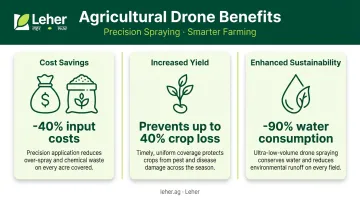
By applying inputs only where needed, waste is dramatically reduced. A study by the Association of Equipment Manufacturers (AEM) found precision methods cut fertiliser use by 8% and herbicide use by 9%. For Indian farmers, this translates directly to keeping more money in their pockets, with Leher's services often helping reduce overall input costs by up to 40%.
Increased Efficiency and Yield
Up to 40% of global crop production is lost to pests and diseases each year, according to the Food and Agriculture Organization (FAO). Drones enable early detection of crop stress, allowing for swift, targeted treatment before a problem spreads across the entire field. This proactive approach leads to healthier crops, better yields, and higher-quality produce.
Enhanced Sustainability
Precision application means fewer chemicals entering the soil and waterways, protecting the local environment. With India facing significant water stress, optimising water use is critical. Drone spraying can reduce water consumption by up to 90%, making it not just an economic benefit but a vital step towards sustainable farming.
Key Drone Uses in Agriculture
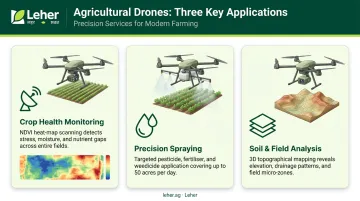
Three key drone applications are delivering the most significant impact for farmers across India today.
Use 1: Crop Health Monitoring and Scouting
This is a diagnostic application focused on identifying problems before they become critical. Drones equipped with multispectral or thermal cameras fly over a field to assess plant health across vast areas.
These advanced sensors capture data invisible to the human eye, such as how plants reflect light. Specialised software processes this data to create maps using indices like the Normalized Difference Vegetation Index (NDVI), which acts as a reliable indicator of plant health. A recent study on rice crops in Tamil Nadu found a strong correlation between drone-derived indices and actual harvest yields, proving its effectiveness.
- Best Suited For: Large-scale farms where manual scouting is impractical and for high-value crops where early disease detection is vital.
- Key Strengths: Provides a comprehensive field overview in minutes, identifying issues like pests, diseases, and irrigation problems quickly.
- Limitations: Requires specialised software and expertise to process and interpret the data from sensor imagery.
Use 2: Precision Spraying and Seeding
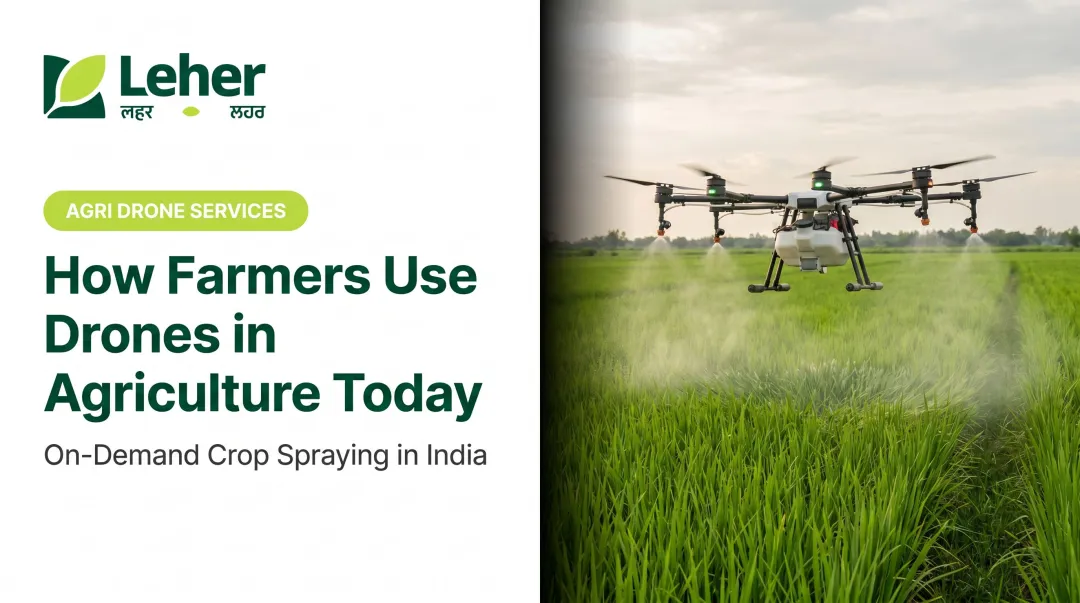
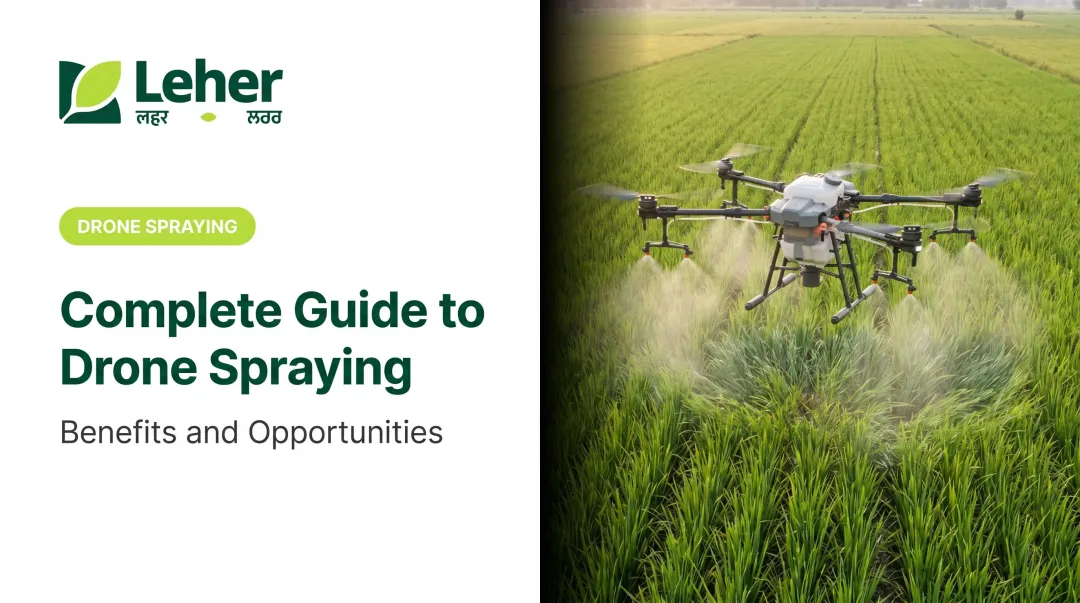
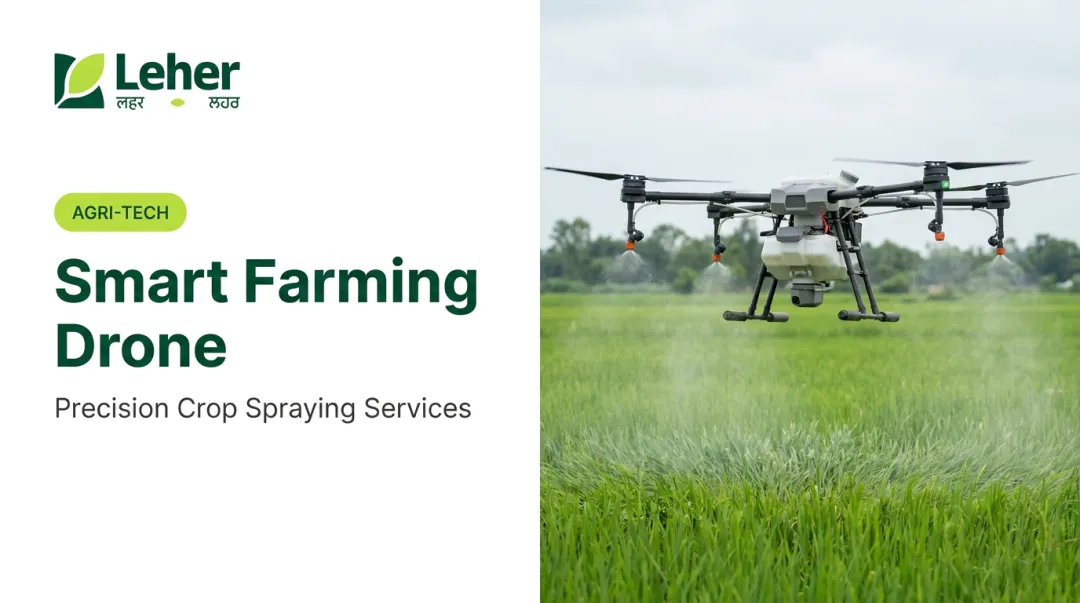
This is an action-oriented application that directly treats crops. Drones are used to apply liquids like pesticides, herbicides, and fertilisers, or even solids like seeds, in a highly targeted manner. They can fly at low altitudes and follow pre-programmed paths, ensuring uniform coverage with minimal drift.
This method is a huge improvement over traditional backpack sprayers or large tractors. It's faster, more efficient, and far safer for the operator.
- Best Suited For: Farms with varied terrain like hills that are difficult for ground machinery to access, and for spot-spraying where only specific areas need treatment.
- Key Strengths: Drastically reduces input usage. At Leher, our drone services have been shown to reduce water use by up to 90% and pesticide use by up to 30%. It's also significantly faster—one benchmark study found a drone sprayer could cover 5.5 hectares per hour compared to just 0.8 hectares per hour for a manual backpack sprayer.
- Limitations: Drones have limited payload capacity, so they may need multiple refills for very large areas. Operations are also subject to strict government regulations.
Use 3: Soil and Field Analysis (Mapping)
This is a strategic planning tool used before and after planting seasons. Drones with high-resolution cameras create detailed 3D maps of the farmland, revealing crucial information about topography, soil quality variations, and drainage patterns.
This data is foundational for other precision agriculture activities. For example, a detailed elevation map can help in designing an efficient irrigation system that conserves water and prevents waterlogging. It also allows for the creation of "management zones" for applying different rates of fertiliser based on soil needs.
- Best Suited For: Preparing new fields for planting, optimising existing irrigation systems, and creating detailed plans for variable-rate fertilisation.
- Key Strengths: Provides highly accurate elevation and contour data essential for water management. It can also help calculate plant counts and predict yields more accurately.
- Limitations: Processing the data into usable 3D models requires powerful software and technical expertise. The value is realised in long-term planning rather than immediate problem-solving.
How to Choose the Right Drone Application for Your Farm
The best drone application isn't a one-size-fits-all solution. It depends entirely on your specific goals, crop type, and operational scale.
Ask yourself these key questions:
- What is my primary goal? Are you trying to solve an urgent problem like a pest infestation? Optimise your use of resources like water and fertiliser? Or gather data for better long-term planning?
- What is my farm size and crop type? Crop monitoring provides immense value for large fields of commodity crops like wheat or paddy. Precision spraying offers huge benefits for high-value horticultural crops where input costs are high.
- What is my budget and technical capacity? This is the most important consideration. Buying a professional agricultural drone is a significant investment, often costing several lakhs of rupees, and requires a skilled, certified operator to fly it.
For most farmers, the most practical and cost-effective solution is hiring a Drone-as-a-Service (DaaS) provider. This model gives you all the benefits of precision technology without the high upfront cost, maintenance headaches, or regulatory burden.
With a service like Leher, the process is simple. You book a service through an app, a certified pilot arrives to do the job, and you only pay for the work completed.
Getting Started with Agricultural Drones: Key Considerations
Adopting drone technology is more straightforward than ever, but there are a few practical steps and hurdles to keep in mind.
Navigating Regulations
In India, drone operations are regulated by the Directorate General of Civil Aviation (DGCA). Agricultural spraying requires a certified drone, a licensed pilot with a Remote Pilot Certificate, and adherence to airspace rules on the DigitalSky platform.
Working with a compliant service provider is crucial, as they handle these legal and regulatory requirements for you.
Data Management
Collecting data with a drone is only the first step. The real value comes from turning that data into actionable insights—for example, converting a crop health map into a precise spot-spraying plan. An effective service partner doesn't just fly the drone; they help you interpret the data to make better farming decisions.
The Entrepreneurial Opportunity
For tech-savvy individuals in rural areas, the rise of agricultural drones presents a massive business opportunity. Becoming a certified drone pilot and service provider is a viable career path.
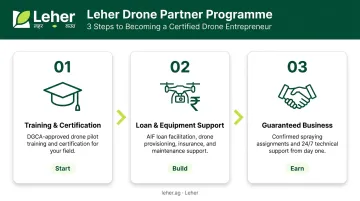
At Leher, our Drone Partner Programme is designed to foster this ecosystem. We help rural entrepreneurs get started by providing:
- Comprehensive training and certification support
- Loan facilitation for equipment and insurance
- Guaranteed business to help launch their local services
Frequently Asked Questions
What can drones be used for in farming?
Drones are primarily used for three things: monitoring crop health with advanced sensors, precision spraying of fertilisers and pesticides, and creating detailed field maps for better planning and water management.
What are the 4 types of drones?
The main physical designs are multi-rotor and fixed-wing. For farmers, it's more useful to categorize them by payload: monitoring drones carrying cameras or spraying drones equipped with tanks and nozzles.
How much does it cost to use drones for farming in India?
Costs vary, but services are typically priced per acre, which is more cost-effective for most farmers than buying a drone. For example, some farmers in Telangana paid around ₹500 per acre for spraying services in 2019.
What are the government regulations for agricultural drones in India?
The DGCA requires certified drones, licensed pilots, and adherence to no-fly zones on the DigitalSky platform. To ensure all rules are followed, it's best to partner with a fully compliant service provider like Leher.
Do drones replace the need for farm labour?
No, they transform it. Drones handle hazardous work like manual backpack spraying, but they also create new skilled jobs for pilots, technicians, and data analysts, boosting rural economies.
How does drone spraying improve crop safety and quality?
By applying chemicals in a highly targeted way, drones reduce the overall chemical load on crops and the soil. This minimises residue on the final produce, leading to healthier, safer, and higher-quality food.