Introduction
More than half of India's agricultural soils are zinc-deficient. According to a nationwide analysis of 242,827 soil samples across 615 districts published in Scientific Reports, 51.2% of Indian soils are deficient in zinc and 44.7% in boron — deficiencies that silently suppress yield, fruit set, and grain quality season after season without obvious early warning signs.
Soil application alone rarely fixes these deficiencies. In alkaline, calcareous, or waterlogged soils — common across Haryana, Punjab, Rajasthan, and the Indo-Gangetic Plain — zinc and boron applied at the root zone become chemically unavailable before plants can absorb them.
Foliar spraying sidesteps the problem entirely. Nutrients applied directly to the leaf surface bypass soil chemistry entirely, reach plant tissues within hours, and produce measurable responses during the crop stages that matter most — flowering, fruit set, and grain filling.
What follows covers the research behind foliar zinc and boron, the crop stages where timing is critical, and the practical steps that determine whether a spray delivers results or misses the window.
Key Takeaways
- 51.2% of Indian soils are zinc-deficient; 44.7% are boron-deficient — foliar correction directly addresses yield losses that soil application alone cannot fix
- Foliar application bypasses soil fixation and delivers nutrients directly to leaf tissue, with foliar zinc showing 8–19% higher utilisation efficiency than soil application
- Combined Zn+B sprays have shown yield increases exceeding 52% in soybean and 2.5x improvements in nut production in hazelnut research
- Timing determines results: flowering and fruit set are the highest-impact application windows
- Uniform canopy coverage is critical; missed patches cause uneven nutrient uptake and yield variability
What Is Foliar Application of Zinc and Boron?
Foliar application means spraying a dissolved micronutrient solution directly onto plant leaves. Nutrients enter through the cuticle and stomatal pathways rather than through roots from the soil — making delivery faster and independent of soil chemistry.
Zinc and boron foliar sprays are used across:
- Cereals — paddy and wheat, particularly for Zn correction during early vegetative stages
- Pulses and oilseeds — chickpea, soybean, groundnut, at branching and flowering stages
- Vegetables — high-value crops where quality and uniformity are commercially critical
- Orchards and tree crops — fruit set and premature nut stage in mango, hazelnut, and other fruit crops
Timing is critical. During reproductive stages — flowering, fruit set, pod fill, grain filling — crop demand for zinc and boron peaks, and this is precisely when soil supply runs short, whether due to high pH, waterlogged conditions, or the pace of uptake simply lagging behind growth.
Foliar zinc and boron application fills that gap. It does not replace a sound soil fertility program, but it steps in where soil chemistry or timing prevents roots from delivering what the crop needs, when it needs it.
Key Advantages of Foliar Zinc and Boron Application
The advantages below are grounded in field-level outcomes: yield data, tissue nutrient levels, fruit quality, and input efficiency — covering what actually changes when foliar Zn and B are applied correctly.
Advantage 1: Rapid Nutrient Delivery That Bypasses Soil Fixation
In alkaline, calcareous, or leached soils (common across Haryana, Punjab, Rajasthan, and eastern India) zinc and boron applied to the soil become chemically unavailable before roots can absorb them. Foliar spraying sidesteps this entirely.
Once absorbed through the leaf surface, zinc and boron move through the plant's vascular system to reach growing points, developing fruits, and reproductive organs: the tissues most sensitive to deficiency.
Why this matters in practice:
- Foliar-applied zinc shows 8–19% higher utilisation efficiency than soil-applied zinc, with grain zinc concentration increases of up to 55.2% for foliar vs. 29.1% for soil application, according to a 2025 global wheat meta-analysis in Nature Communications
- Visible deficiency symptoms (interveinal chlorosis, stunted new growth) can begin correcting within days of a foliar spray, compared to weeks for soil-applied corrections
- Smaller quantities are needed to achieve equivalent tissue levels, reducing input cost per hectare. For cost-sensitive smallholder farmers, this efficiency gap is a meaningful input saving.
KPIs impacted: nutrient use efficiency, days to deficiency correction, leaf tissue micronutrient levels, input cost per hectare
When it matters most: Alkaline and calcareous soils across the Indo-Gangetic Plain, and during fast-moving growth stages where waiting for soil application to take effect isn't an option.
Advantage 2: Measurable Improvements in Yield, Fruit Set, and Quality
Zinc drives auxin production, cell division, and pollen viability, while boron handles cell wall integrity, carbohydrate transport, and ovule fertilisation. Together, they underpin reproductive success — deficiency in either directly cuts fruit set, grain filling, and harvestable yield.
Foliar sprays applied at flowering or early fruit set ensure adequate concentrations reach buds and developing fruits at precisely the moment these processes occur.
What the research shows:
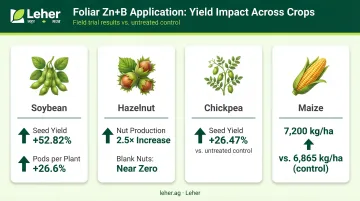
- In soybean, a combined Zn+B foliar spray at flowering increased seed yield from 3,404 to 5,202 kg/ha — a 52.82% increase — and raised pods per plant by 26.6%, with protein content rising from 26.22% to 33.37%. Combined application outperformed either nutrient applied alone.
- In European hazelnut, combined B+Zn spraying increased stabilised nut production approximately 2.5-fold, improved kernel yield percentage, and reduced blank nut incidence to near zero in some treatment programs
- In West Bengal chickpea trials, foliar Zn 0.5% + B 0.1% at branching and pre-flowering increased seed yield by 26.47% over untreated controls
- In Tamil Nadu maize, foliar 0.5% ZnSO₄ produced 7,200 kg/ha grain yield versus 6,865 kg/ha in untreated plots
KPIs impacted: yield per hectare, fruit set percentage, grain or nut weight, marketable produce percentage, seed protein content
When it matters most: Yield gains are most consistent when baseline deficiency exists, both nutrients are applied together, and timing aligns with flowering or fruit set.
Advantage 3: Stronger Stress Tolerance and Produce Quality
Zinc and boron both help plants manage oxidative stress. Zinc activates antioxidant enzymes (including Cu/Zn-superoxide dismutase) that neutralise harmful reactive oxygen species (ROS) in plant cells. Boron supports membrane integrity, protecting tissues from oxidative damage during drought, heat, or pest pressure.
Plants treated with combined B+Zn foliar sprays have shown:
- ~43% reduction in lipid peroxidation (a marker of cellular oxidative damage) in both leaf and kernel tissues compared to untreated controls, per the hazelnut research cited above
- Increased radical scavenging activity, meaning the plant handles environmental stress more effectively during critical production windows
- Improved post-harvest shelf life and kernel nutritional value, which matters for premium, processing, or export-oriented markets
Why this matters for Indian farmers: As climate variability increases, crops face more frequent heat and water stress during fruit development. Foliar Zn+B builds a biochemical buffer that helps maintain consistent yields across variable conditions, including seasons where weather doesn't cooperate.
Crops where impact is greatest: High-value horticultural crops, orchards facing heat or drought during fruit development, and any crop on nutrient-poor or acidic soils.
What Happens When Zinc and Boron Are Missing
Deficiency symptoms appear first in new, actively growing tissues — by the time they're visible, yield loss has already begun.
Zinc deficiency signs:
- Small, distorted new leaves ("little leaf" syndrome in trees)
- Interveinal chlorosis on young leaves
- Poor tillering in cereals and reduced stem elongation
- Lower pollen viability and reduced grain or fruit set
Zinc is the fourth most important yield-limiting nutrient in Indian agriculture, with approximately 72.2 million hectares of cultivated soils estimated to be zinc-deficient.
Boron creates a different but equally damaging set of problems — especially at flowering, where timing is everything.
Boron deficiency signs:
- Tip death in growing points
- Hollow or cracked stems and fruits
- Failed fruit set and poor seed development
- Rough, corky fruit surfaces
Boron deficiency is particularly damaging at flowering because soil application cannot correct it fast enough to protect the current season's crop. Once symptoms appear, the window for reproductive recovery has already closed.
Farmers often attribute persistent yield gaps to weather, variety, or pest pressure — when the actual cause is a correctable micronutrient deficiency that a well-timed foliar spray could fix.
How to Get the Most Value from Foliar Zinc and Boron Application
Timing: Match Application to Crop Stage
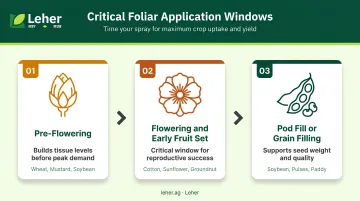
The highest-impact windows are:
- Pre-flowering — builds tissue levels before peak demand begins
- Flowering and early fruit set — the critical window for reproductive success
- Pod fill or grain filling — supports seed weight and quality in cereals and pulses
For paddy, TNAU recommends 0.5–1.5% ZnSO₄ applied at 25–30 DAT, repeated 2–3 times at 10–14 day intervals. For rice boron correction, 0.3% boric acid (3 g/litre) applied twice at 15-day intervals is the standard guidance.
Tank Mixing Zinc and Boron
Zinc and boron can be combined in the same spray — and the research supports it, with combined applications consistently outperforming single-nutrient sprays in yield and quality outcomes.
Practical mixing notes:
- Adjust spray solution to a slightly acidic pH before adding zinc to reduce precipitation risk
- Avoid phosphate-based buffers, as zinc and phosphate can react and reduce nutrient availability
- Conduct a jar test before large-scale mixing when using unfamiliar formulations
- At moderate application rates, combined sprays are as effective as separate applications while halving the number of spray passes required
Canopy Coverage: Where Precision Makes the Difference
Foliar nutrition only works where the spray reaches. Uneven coverage means uneven nutrition — particularly in dense canopies or tall crops like sugarcane and maize.
Drone-based application addresses this directly. Leher's aerial spraying service covers the full canopy from above, reaching dense foliage that ground equipment often misses. A trained pilot handles the full session, covering up to 50 acres per day — a 10-acre farm is done in under an hour, with no crop damage from foot traffic or equipment weight.

Farmers book a session through the Leher App, the pilot arrives, completes the spray, and payment is collected only after the job is done. For zinc and boron applications timed to flowering or grain fill, that same-day booking removes the wait for available equipment or labour during a window that cannot be missed.
Conclusion
Foliar zinc and boron application works because it aligns nutrient delivery with plant demand — during the stages when reproductive tissues need these nutrients most, and in soils where root uptake alone can't meet that demand in time.
Across crop types, correcting Zn and B deficiency at the right stage produces measurable gains in yield, fruit set, grain quality, and crop resilience. Hazelnut and soybean trials document those gains in fruit set and seed quality; chickpea and maize data from Indian field conditions confirm the same pattern holds here.
Foliar Zn+B should be a planned, recurring element of the crop nutrition calendar — timed to growth stage, mixed correctly, and applied with uniform coverage. For farmers on alkaline or calcareous soils across the Indo-Gangetic Plain, it is one of the highest-return interventions available per season. The limiting factor is rarely the nutrient itself; it's consistent, even coverage at the right time — precisely where drone-based spraying delivers the most reliable results.
Frequently Asked Questions
What is a zinc and boron foliar spray and what is it used for?
It is a water-dissolved micronutrient solution sprayed directly onto plant leaves, supplying zinc and boron through leaf absorption rather than root uptake. It is used to correct deficiencies, support flowering and fruit set, and improve yield and produce quality — particularly where soil pH or soil type limits root availability.
Can zinc and boron be mixed together in a foliar spray?
Yes — combined Zn+B sprays are effective and supported by multiple research trials. Adjust the solution to a slightly acidic pH before adding zinc to reduce precipitation risk, and avoid phosphate-based buffers. Combined sprays at moderate rates perform comparably to separate applications while cutting the number of spray passes.
What are the functions of zinc and boron in plants?
Zinc supports cell division, auxin synthesis, protein synthesis, and pollen viability. Boron is essential for cell wall formation, pollen tube development, fertilisation, carbohydrate transport, and membrane stability. Both nutrients are directly tied to reproductive growth and yield formation.
When is the best time to apply zinc and boron foliar spray?
Flowering and early fruit set are the highest-impact windows, when reproductive tissues have peak nutrient demand. A pre-flowering spray builds adequate tissue levels beforehand — especially important in crops with a short or concentrated flowering window.
What are the signs of zinc or boron deficiency in crops?
Zinc deficiency shows as small, distorted new leaves, interveinal chlorosis on young tissue, stunted shoots, and "little leaf" in trees. Boron deficiency presents as tip death in growing points, hollow or cracked stems and fruits, failed fruit set, and rough or corky fruit surfaces. Both appear first in actively growing tissues.
Can foliar application of zinc and boron replace soil application entirely?
No — foliar application corrects active deficiencies faster and supports critical growth stages more effectively, but it does not rebuild long-term soil nutrient reserves. The best approach combines both: soil application to address baseline deficiency, and foliar sprays to top up at key growth windows.