Smart farming solutions offer a different equation. By combining drones, IoT sensors, AI monitoring, and automation, farmers can produce more food while using fewer resources — not as a distant promise, but as a practical reality deployable today, even on a one-hectare plot.
By the end of this article, you will understand what smart farming actually means, which technologies deliver the most impact for Indian conditions, and how to take a first, low-risk step into precision agriculture — regardless of farm size.
Key Takeaways
- Smart farming uses data and technology to make farming decisions faster and more accurate
- Drone spraying cuts water use by up to 90% and pesticide use by up to 30%
- IoT-based irrigation delivers water savings of over 40% compared to conventional flood methods
- AI tools detect crop disease before symptoms appear, giving farmers days of lead time to act
- Pay-per-use drone spraying services let farmers access precision technology without owning any equipment
What Is Smart Farming?
Smart farming is the use of real-time data — collected by sensors, drones, satellites, and connected devices — to monitor, manage, and optimise agricultural operations. The FAO describes it as applying timely data, technological support, and precision interventions to improve decision-making and productivity. The aim: grow more food, use fewer inputs, and reduce environmental harm.
From GPS Tractors to Connected Farms
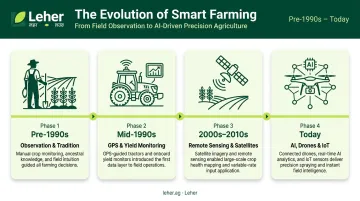
The journey from traditional farming to smart farming happened in distinct phases:
- Pre-1990s: Decisions based on observation, tradition, and seasonal patterns
- Mid-1990s: Precision agriculture emerged — GPS-guided tractors, yield monitors (introduced around 1993), and satellite-connected farm equipment (GreenStar, 1996)
- 2000s–2010s: Remote sensing and variable-rate application became mainstream on large commercial farms
- Today: IoT, AI, and drones create a fully connected farm where real-time data informs every decision automatically
Smart Farming vs. Precision Agriculture vs. Digital Farming
These three terms overlap constantly and confuse even experienced practitioners. The table below draws the line clearly:
| Term | Scope | Focus |
|---|---|---|
| Digital Farming | Broadest | All data-driven tools in agriculture |
| Smart Farming | Mid-level | Using data to optimise whole-farm decisions |
| Precision Agriculture | Narrowest | Field-level accuracy (variable-rate inputs, GPS guidance) |
Precision agriculture is a subset of smart farming, which is itself a subset of the broader digital farming umbrella.
For Indian farmers, this distinction matters practically: you do not need every technology in the chain to benefit. A smallholder in Punjab who books a drone spraying session is already practising smart farming — without owning a single sensor.
Key Smart Farming Technologies for Indian Farms
Smart farming is an ecosystem of tools, not a single product. The right combination depends on your crop, farm size, and budget. Here are the four technologies with the most direct relevance to Indian conditions.
Drone-Powered Precision Spraying
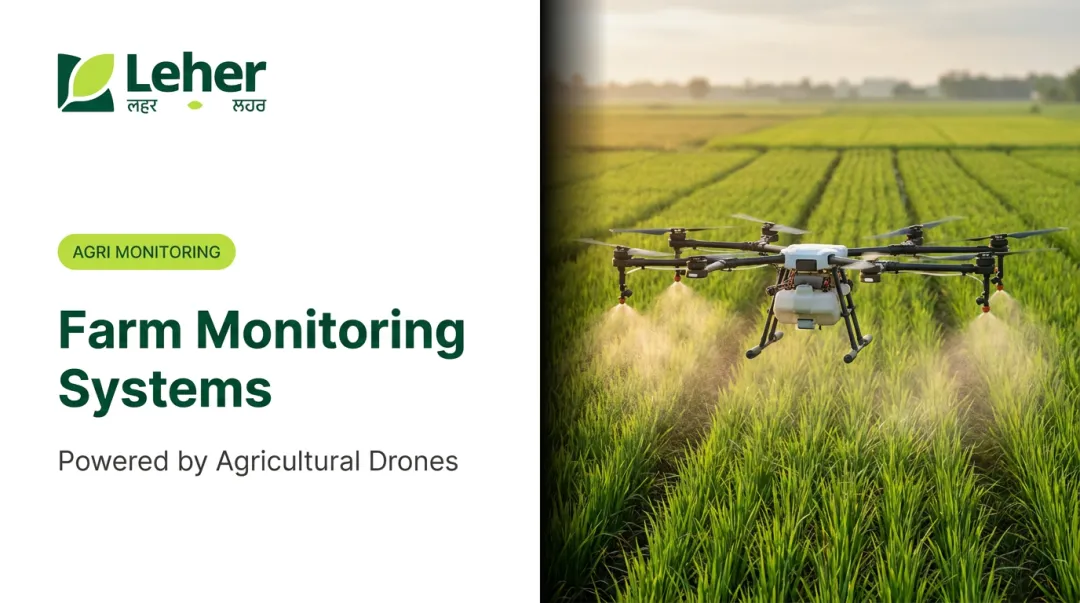
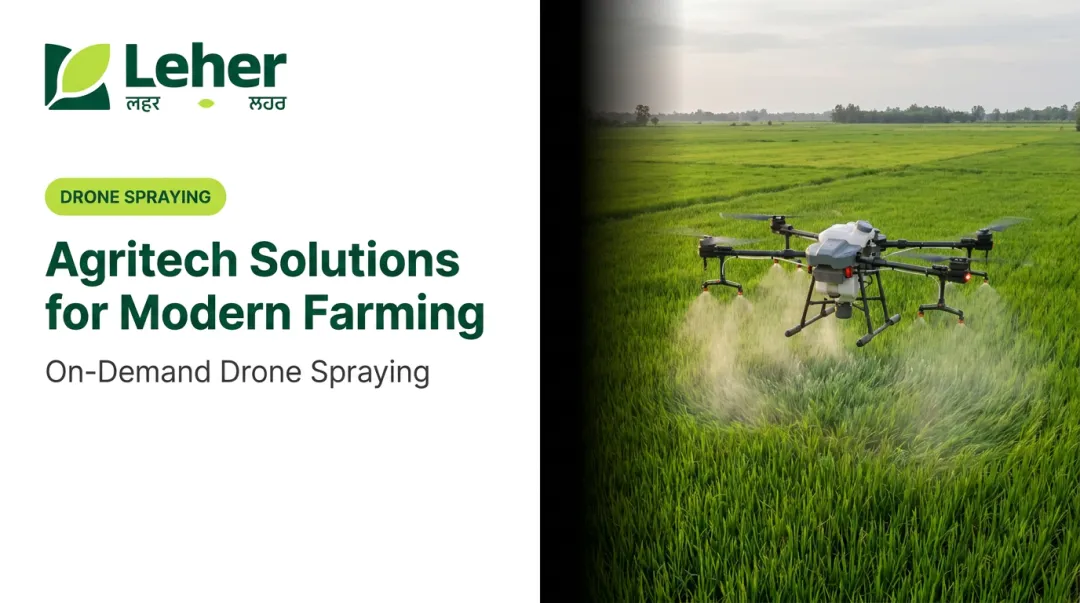
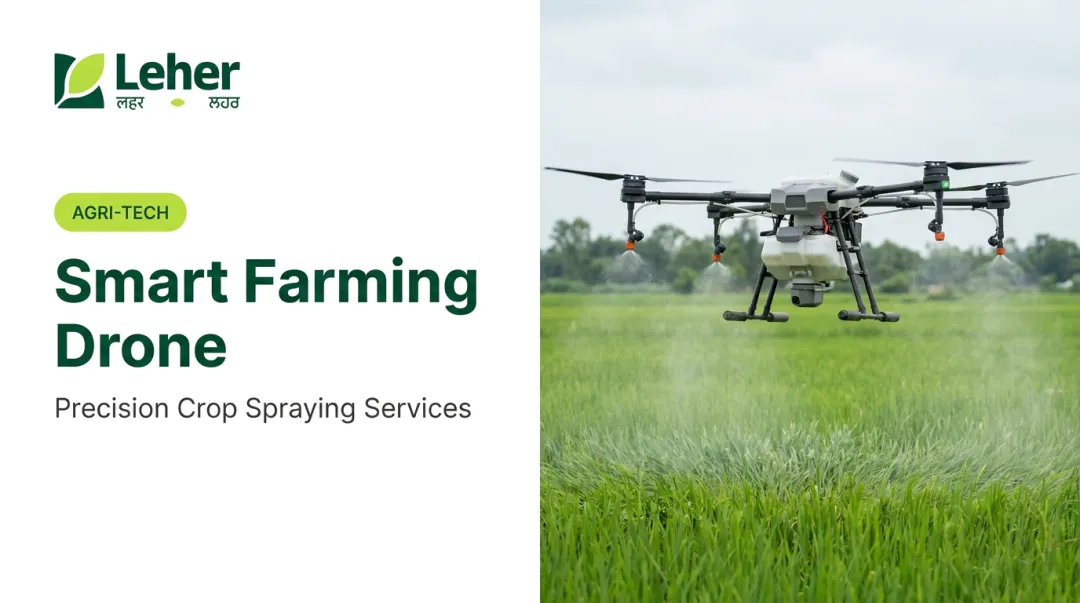
Agricultural drones apply pesticides, herbicides, and foliar fertilisers with a precision that ground equipment simply cannot match. A 2024 soybean study conducted in Parbhani, Maharashtra (published in Science of the Total Environment) found that drone spraying used just 25 litres per hectare of water versus 520–660 litres per hectare for conventional boom and knapsack sprayers. That gap — roughly 95% less water per hectare — reshapes input economics at the field level.
Beyond water, drones bring three practical advantages for Indian terrain:
- Access: Waterlogged paddy fields, hilly tea estates, and fragmented smallholder plots are all navigable by drone, where tractors and boom sprayers cannot operate
- Speed: Drone spraying covers around 5 minutes per acre, compared to 8 hours per hectare for manual knapsack application
- Safety: Farmers avoid direct exposure to agrochemicals during application
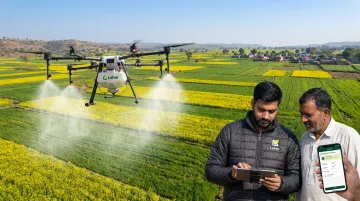
Leher's drone spraying service illustrates this in practice. Operating across crops including sugarcane, paddy, cotton, wheat, tea, and rubber, Leher served 6,500+ acres and 810+ farmers in 2024 using DGCA-certified pilots dispatched via the Leher App. Their drones cover up to 50 acres per day — with no equipment ownership required from the farmer.
Smart Irrigation and IoT Soil Sensors
Most Indian farmers still use flood or furrow irrigation, which delivers water at 40–70% application efficiency at best. IoT soil moisture sensors change this by measuring actual soil conditions and triggering irrigation only when crops need it — not according to a fixed schedule.
A 2024 precision irrigation review found that IoT-based irrigation strategies reduced water consumption by 40.29% in alternate wetting and drying rice cultivation. In Punjab and Haryana — where groundwater extraction already exceeds 135% of natural replenishment — that reduction carries real urgency.
Micro-irrigation data from India reinforces the case. Groundnut cultivation in Gujarat showed 88.62% water savings under micro-irrigation, and Punjab adopters recorded fertiliser savings of 12.89–37.51% and pest-management chemical savings of 17.71–48.23%.
AI-Powered Crop Monitoring and Disease Detection
Crop diseases spread for days or weeks before they show visible symptoms. A 2024 UAV hyperspectral imaging study detected wheat stripe rust at just 7 days post-inoculation — still in the asymptomatic phase — with 78.1% accuracy. For a farmer, that is the difference between a targeted fungicide spray and a complete crop failure.
AI monitoring tools are becoming mobile-first in India. Farmers photograph crops with a smartphone and receive instant diagnosis and treatment recommendations — no technical knowledge required.
India's digital agriculture infrastructure is scaling rapidly to support these tools:
- The National Pest Surveillance System now covers 66 crops and over 432 pest types
- The Digital Agriculture Mission has created over 7.63 crore Farmer IDs, building the data foundation for AI tools to reach smallholders at scale
Farm Automation and Robotics
India's overall agricultural mechanisation stands at 45%, with weeding (33%) and harvesting (34%) still heavily manual. Automation — from mechanised seeders to robotic weeders to automated milking — directly addresses labour shortages that worsen every season.
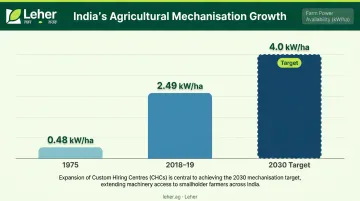
Full robotics remain out of reach for most smallholders, but partial automation through custom hiring centres is already viable for mid-sized farms. India's farm power trajectory shows where this is heading:
- Farm power availability: 0.48 kW/ha in 1975 → 2.49 kW/ha in 2018–19
- Government target: 4.0 kW/ha by 2030
- Custom hiring centre access is expanding this reach to farms that cannot afford equipment outright
Benefits of Smart Farming for Indian Farmers
Higher Yields, Lower Inputs
Real-time data allows targeted interventions instead of blanket treatment. Cotton cultivation in Gujarat recorded a 21.72% yield increase under micro-irrigation, with simultaneous input reductions. Smart farming delivers productivity and sustainability together — not as a trade-off, but as a combined outcome.
Water Conservation at Scale
Leher's drone spraying data shows up to 90% reduction in water use compared to conventional spraying methods. Pair that with IoT-driven irrigation savings of 40%+, and a farm in a water-stressed district can meaningfully extend the life of its groundwater access.
Reduced Chemical Use
Drone spraying targets affected areas precisely rather than blanketing entire fields. Leher reports up to 30% pesticide reduction through precision application — which also means lower chemical expenditure per crop cycle, not just environmental benefit. Reduced runoff and healthier soil biology follow naturally, with input cost savings building further across each season.
Direct Cost Savings
Leher's service model reports around 40% input savings across pesticides, fertilisers, and water, translating to 20% lower overall farming costs. For a smallholder operating on thin margins, that reduction makes previously unaffordable inputs or crop diversification realistic.
Long-Term Soil and Climate Resilience
Data-driven farming reduces soil degradation from over-irrigation and chemical overuse. Key long-term outcomes include:
- Lower greenhouse gas emissions from agriculture, supporting India's climate commitments
- Reduced soil compaction and chemical buildup from precision application
- Preserved groundwater levels through sustained irrigation efficiency
- Protected arable land productivity for future crop cycles
Smart Farming in India: Challenges and Opportunities
Real Barriers Worth Acknowledging
Smart farming adoption in India faces three honest obstacles:
- Cost: Hardware like sensors and drones carries upfront investment that most smallholders cannot absorb individually
- Connectivity: India had 434.27 million rural internet subscribers as of December 2025 — significant, but coverage remains uneven in remote agricultural districts
- Digital literacy: Many smallholder farmers are unfamiliar with app-based tools, creating an adoption gap that requires hands-on demonstration, not just marketing
Service-based models — where a farmer pays per acre sprayed without owning anything — directly address the first and third barriers.
Policy Tailwinds
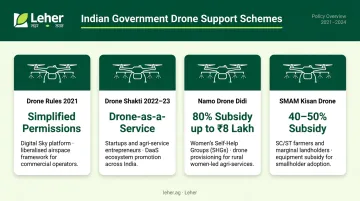
Government support for agricultural drones is substantial — and backed by real budget allocations:
- Drone Rules 2021: Liberalised operating permissions, reduced paperwork, created the Digital Sky platform
- Drone Shakti (Budget 2022–23): Promoted Drone-as-a-Service for agricultural applications
- Namo Drone Didi: ₹1,261 crore outlay targeting 14,500 women Self-Help Groups, with 80% assistance up to ₹8 lakh per SHG for drone acquisition
- SMAM Kisan Drone: Subsidies ranging from 40–100% of drone cost depending on farmer category (SC/ST, women, and small/marginal farmers eligible for 50% up to ₹5 lakh)
As of February 2026, India had 38,500+ registered drones and 39,890 DGCA-certified remote pilots — numbers that reflect a regulatory and training infrastructure now capable of supporting nationwide scale.
The Rural Entrepreneur Opportunity
That policy infrastructure is opening a door beyond the farm itself. Drone operators are becoming a new category of rural entrepreneur — trained technicians who serve clusters of farmers as a business. Leher is actively building this network, with 100+ active drone partners currently and a target of 1,000 rural drone entrepreneurs by 2030. A single certified operator covering multiple farms can realistically serve 30–50 acres per day — enough to build a full-time livelihood in districts where formal employment options are limited.
How to Get Started with Smart Farming
Step 1: Identify Your Biggest Problem First
Before choosing any technology, name the problem you want to solve:
- Pest damage eating into yields? → AI monitoring or drone spraying
- High water bills and depleting groundwater? → IoT soil sensors or smart irrigation
- Labour shortages at harvest or sowing? → Mechanisation and automation
- Broad input cost pressure? → Precision spraying services
The right entry point is the one that solves your most expensive problem fastest.
Step 2: Start with a Service, Not a Purchase
The fastest path into smart farming for most Indian farmers is hiring a service provider for one crop cycle. No capital investment. No learning curve. Just measurable results to evaluate.
Leher works this way by design. Book a drone spraying session through the Leher App in three clicks, a DGCA-certified pilot arrives at your farm, sprays your crop, and you pay only after the job is done. No platform fee, no equipment to buy, no technical knowledge required — just one crop cycle to see what precision spraying delivers on your own fields.
Step 3: Build on What Works
Once you see results from that first session, the next steps tend to follow naturally. Farmers who start with drone spraying often move to more frequent bookings, then explore IoT irrigation, then AI crop monitoring — building a more efficient, lower-cost operation over time. When choosing a long-term partner, look for local presence, transparent per-acre pricing, and a pay-per-service model so you're never locked into equipment you don't need.
Frequently Asked Questions
What is a smart farming solution?
A smart farming solution is any technology-driven tool or service — such as IoT sensors, AI crop monitoring, or drone spraying — that helps farmers make data-based decisions. The goal is to improve yield, reduce input use, and increase sustainability without requiring expert knowledge from the farmer.
How is smart farming different from traditional farming?
Traditional farming relies on experience, fixed schedules, and manual observation. Smart farming uses real-time data and precision tools to respond to actual field conditions — so irrigation runs when soil is dry, not on a calendar, and spraying targets affected plants, not entire fields.
How does drone spraying benefit Indian farmers specifically?
Drone spraying covers terrain that ground equipment cannot access, applies chemicals with precision that reduces water use by up to 90% and pesticide use by up to 30%, and protects farmers from direct chemical exposure. For India's fragmented, diverse farmlands, terrain flexibility and reduced chemical exposure address two of the most pressing day-to-day concerns farmers face.
What are the main challenges of adopting smart farming in India?
High upfront hardware costs, inconsistent rural internet connectivity, and limited familiarity with digital tools are the three main barriers. Service-based models that require no farmer investment, combined with government drone subsidies, are bringing all three within reach.
Is smart farming only suitable for large farms?
No. Service-based models like drone-as-a-service make precision technology accessible to any farm size. A farmer with one hectare can book a drone spraying session the same way a farmer with 100 hectares can — the technology scales down as easily as it scales up.
What government support is available for smart farming in India?
India's DGCA Drone Rules 2021 simplified operating permissions. The Namo Drone Didi scheme offers an 80% subsidy up to ₹8 lakh for women's SHGs, while SMAM Kisan Drone subsidies cover 40–50% of drone costs for SC/ST farmers, women, and small/marginal landholders.