Against this backdrop, Drone Didi Yojana stands out as something more than a welfare program. By placing commercial-grade agricultural drones in the hands of women-led Self-Help Groups (SHGs), the scheme simultaneously addresses farm-level efficiency, chemical safety, and rural women's economic independence. With a ₹1,261 crore budget and a target of 15,000 drones deployed across India, it is one of the most ambitious agri-tech interventions India has attempted at the grassroots level.
Key Takeaways
- 15,000 agricultural drones go to women-led SHGs with an 80% government subsidy (up to ₹8 lakh per SHG)
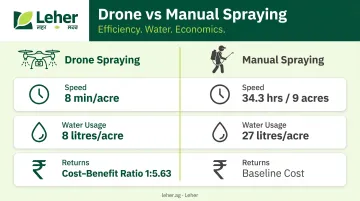
- Drones cover 1 acre in roughly 8 minutes, using just 8 litres of water — versus 27 litres by hand
- Each participating SHG is targeted to earn a minimum of ₹1 lakh additional income per year through drone rental services
- Implemented under DAY-NRLM across three central departments, with Lead Fertilizer Companies managing ground-level delivery
- Rollout is ongoing: 1,094 drones distributed by early 2024, with the programme running through 2025–26
What Is the Drone Didi Yojana?
The Union Cabinet approved the Central Sector Scheme on 29 November 2023, allocating ₹1,261 crore for the period 2023-24 to 2025-26. The scheme operates under the Deendayal Antyodaya Yojana – National Rural Livelihoods Mission (DAY-NRLM) framework and is formally named Namo Drone Didi.
The Dual Mandate
The scheme has two parallel objectives that reinforce each other:
- Precision agriculture delivery — put drone technology directly into farming clusters through SHG-operated rental services
- Sustainable rural livelihoods — help participating SHGs earn at least ₹1 lakh additional annual income, directly feeding into the broader Lakhpati Didi goal
Who Runs It
Three central departments share implementation responsibility:
- DA&FW (Department of Agriculture & Farmers' Welfare) — policy and technical oversight
- DoRD (Department of Rural Development) — SHG selection and livelihoods integration
- DoF (Department of Fertilizers) — coordinates Lead Fertilizer Companies (LFCs)
Two field-level institutions handle direct implementation:
- LFCs (Lead Fertilizer Companies) — bridge drone suppliers and SHGs by managing procurement, maintenance, and nano fertilizer promotion
- KVKs (Krishi Vigyan Kendras) — run technical demonstrations and farmer awareness programs at the village level
For farmers and SHGs looking to access the scheme, these are the primary on-ground contact points.
How the Scheme Works: Subsidies, Training, and Equipment
Financial Structure
The financial structure covers most costs upfront, keeping out-of-pocket expenses low for SHGs:
| Component | Detail |
|---|---|
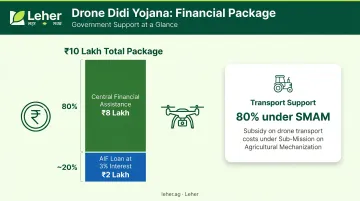
| Central Financial Assistance | 80% of drone package cost, capped at ₹8 lakh per SHG |
| Balance financing | Remaining ~₹2 lakh available as AIF loan at 3% interest |
| Total package value | Approximately ₹10 lakh per SHG |
| Transport support | 80% financial assistance under SMAM for multi-utility vehicles |
Training Program
One SHG member completes a 15-day training program:
- Days 1–5: Mandatory drone pilot training at a DGCA-authorised Remote Pilot Training Organisation, leading to a Remote Pilot Certificate (RPC)
- Days 6–15: Agricultural application training covering precision spraying techniques, nutrient and pesticide application, crop monitoring, and field mapping
A second SHG member or family member receives 5-day assistant training covering electrical fittings, mechanical repair, battery management, and minor maintenance — so the SHG is not dependent on external technicians for day-to-day operations.
What Each SHG Receives
The drone package is a complete operational kit:
- Commercial-grade agricultural drone with spray assembly
- One standard battery set plus four additional battery sets
- Chargers and accessories
- pH meters, moisture meters, anemometer, and camera
Once the SHG is operational with this kit, all activity feeds into the Namo Drone Didi portal (namodronedidi.da.gov.in), which tracks drone usage, service delivery, and maintenance needs in real time.
Agricultural Transformation: What Changes on the Ground
Speed and Water Efficiency
A Tamil Nadu paddy field trial conducted in December 2024 at Needamangalam documented a drone spraying 9 acres in 1.2 hours — 8 minutes per acre — while conventional manual spraying took 34.3 hours for the same area. Water consumption was 72 litres for 9 acres (approximately 8 litres per acre) versus 240 litres manually.
One trained SHG can realistically service 2,000–2,500 acres per year. For smallholder farmers who previously could not afford either the time or the labour for timely crop protection, that kind of throughput is transformative.
ICAR-NBAIR demonstrations across Karnataka and Tamil Nadu corroborated the 7–8 minutes per acre benchmark, and a Kharif 2022 rice trial in Hyderabad reported an incremental cost-benefit ratio of 1:5.63 for UAV-assisted pesticide application — meaning every rupee spent on drone application returned ₹5.63 in value.
Safety: The Hidden Benefit
Drone spraying eliminates direct human exposure to pesticides during application — a change that matters enormously in Indian farming conditions. NCRB data for 2023 recorded 7,743 deaths from accidental intake of insecticides and pesticides nationally. For many farming families, removing the applicator from direct chemical contact is the most consequential outcome of the scheme — more immediate than any efficiency metric.
Market Context
These on-the-ground gains are landing at a moment of rapid commercial expansion. According to IMARC, India's agricultural drone market was valued at USD 302.3 million in 2025 and is projected to reach USD 2,185.5 million by 2034, with a CAGR near 24%. Mordor Intelligence projects a similar growth trajectory through 2031.
Drone Didi Yojana is accelerating grassroots adoption precisely as the commercial market scales. The result: a growing base of trained rural operators feeding directly into an industry that needs qualified pilots at volume.
Women's Empowerment and Rural Job Creation
From Laborer to Technical Entrepreneur
The scheme's most structural impact is on women's economic position in rural India. A Drone Didi holds a DGCA-certified Remote Pilot Certificate, owns a commercial drone business, and charges farmers for a technical service. That transition from agricultural laborer to credentialed entrepreneur has no precedent at this scale in Indian rural policy.
The scheme targets at least ₹1 lakh additional annual income per SHG, with consistent operations across 2,000–2,500 acres per year as the benchmark for achieving it.
The Community Multiplier Effect
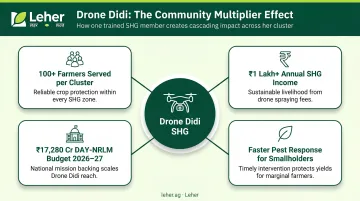
Each SHG typically serves 100+ local farmers in its cluster. This creates:
- An embedded, affordable drone spraying network with no capital requirement from the farmer
- Shorter turnaround times for pest and disease response (critical for smallholders where delays cost yields)
- A local agricultural supply chain anchor that keeps service costs accessible
Budget 2026-27 Reinforcement
The Union Budget 2026-27 increased the DAY-NRLM allocation to ₹17,280 crore, up from ₹14,400 crore in the revised estimate for 2025-26. The Budget Speech also announced Self-Help Entrepreneur (SHE) Marts — community-owned retail outlets giving women SHGs, including Drone Didis, structured access to formal markets and financing. This policy continuity signals that the government intends to build commercial sustainability into the SHG model beyond the initial subsidy window.
How Indian Farmers Can Access Drone Services Today
Through the Government Scheme
Farmers in identified clusters can access Drone Didi services by contacting:
- Their local Krishi Vigyan Kendra (KVK)
- Their State Rural Livelihood Mission (SRLM) office
The service is delivered on a rental basis — no capital investment from the farmer. The official portal (namodronedidi.da.gov.in) provides scheme information and updates on coverage.
The Current Coverage Gap
As of early 2024, 1,094 drones had been distributed — 500 under the Namo Drone Didi scheme and the rest by LFCs using internal resources. The remaining allocation of roughly 14,500 drones is being deployed through 2025-26, with large state allocations including Uttar Pradesh (2,236), Maharashtra (1,612), and Rajasthan (1,070).
Many farmers will not have scheme coverage in the near term.
Private Providers as a Complementary Pathway
Farmers who need drone spraying now, rather than waiting for scheme rollout, can access the same technology through certified private operators. Companies like Leher provide on-demand agricultural drone spraying services bookable through the Leher App, with DGCA-certified pilots arriving at the farm and payment made only after the job is completed.
Leher's documented results mirror the scheme's own targets:
- ~90% water savings per spraying session
- ~30% reduction in pesticide use
- ~40% savings on farm inputs
- Crops covered: paddy, sugarcane, cotton, wheat, and vegetables
- 30,000+ acres sprayed and 2,100+ farmers served
For farmers in regions not yet covered by Drone Didi SHGs, private services like Leher offer an immediate alternative — no scheme enrollment required, no season lost.
Frequently Asked Questions
What is the Drone Didi Scheme?
It is a Central Sector Scheme approved by the Union Cabinet on 29 November 2023, with a ₹1,261 crore budget to provide agricultural drones to 15,000 women-led SHGs under DAY-NRLM. Each SHG receives an 80% subsidy (up to ₹8 lakh) and is trained to offer drone spraying services to local farmers.
What is the price of one agricultural drone under the scheme?
The total drone package costs approximately ₹10 lakh per SHG. The government covers up to ₹8 lakh (80%) as a subsidy, and the remaining ~₹2 lakh can be borrowed at 3% interest through the Agriculture Infrastructure Fund (AIF).
How do I apply for a drone under Drone Didi Yojana?
Individual women cannot apply directly — only women-led SHGs registered under DAY-NRLM are eligible. State-level committees select participating SHGs based on location and operational readiness. Interested women should join or form an SHG and contact their local SRLM or KVK office.
Who is eligible for Drone Didi Yojana?
Women-led Self-Help Groups registered under DAY-NRLM are eligible. State-level committees select participating SHGs based on location within identified agricultural clusters and the group's operational readiness.
What agricultural tasks can Drone Didis perform?
Drone Didis offer liquid pesticide spraying, liquid fertilizer application (including urea and nano fertilizers), crop health monitoring, and field mapping — all delivered as a rental service at a per-acre rate to local farmers.
How much income can a Drone Didi earn annually?
The scheme targets a minimum of ₹1 lakh additional income per SHG annually, based on covering 2,000–2,500 acres per year. Individual pilots who stay active through peak farming seasons typically earn above that benchmark.