
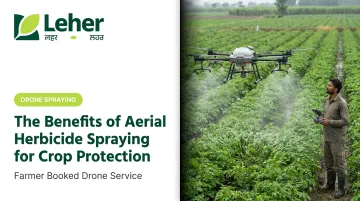
Herbicide application is standard practice, but how you apply it changes everything. Manual backpack sprayers are slow, inconsistent, and put the farmer in direct contact with chemicals for hours at a time. Aerial drone spraying changes that calculus in ways that show up directly in cost, coverage, and crop health.
This article breaks down the measurable advantages of aerial herbicide spraying — why it works better than manual methods, when it matters most, and what farmers risk by skipping or delaying treatment.
Key Takeaways
- Leher drone teams can spray 1 acre in about 5 minutes and cover up to 50 acres per day
- GPS-guided spraying helps reduce herbicide waste while maintaining even field coverage
- Fast spraying matters because many weed-control windows close 15–45 days after sowing
- Remote operation reduces chemical exposure compared with backpack spraying
- Uniform coverage limits missed patches, reduces re-treatments, and supports better weed control
What Is Aerial Herbicide Spraying?
Aerial herbicide spraying applies herbicide formulations from an airborne platform, from manned aircraft to agricultural drones, to control weeds across crop fields at scale.
Farmers typically use it at two crop stages:
- Pre-planting: Clearing weed growth before seeding, especially in fields where tillage would disturb soil structure
- Post-emergence: Protecting crops from competing vegetation without the soil compaction or crop damage that heavy ground equipment causes
Compared with manual spraying, the biggest advantage is consistency. A drone maintains a fixed height above the canopy, travels at a calibrated speed, and applies spray at a set volume per acre across every pass.
That repeatability is hard to match with a worker walking at a variable pace with a pressurised backpack tank.
India has official SOPs for drone-based pesticide application, including 250–350 micron droplet size, 20–25 litres per hectare spray volume, and 3–6 metre swath width. More than 477 pesticide formulations have interim approval for drone spraying, but each product still needs Central Insecticides Board & Registration Committee (CIB&RC) label compliance before commercial use.
Key Advantages of Aerial Herbicide Spraying for Crop Protection
The advantages below are operational and measurable, not theoretical. Each one affects cost, yield, or safety in ways that show up at the end of a season.
Advantage 1: Precision Application That Reduces Herbicide Waste
Drone sprayers fly at a consistent height above the crop canopy and deliver herbicide at a calibrated rate per acre. Compare that to manual backpack sprayers, where walking speed, tank pressure, and operator fatigue all affect how much product actually reaches each square metre of field.
GPS-guided flight paths prevent rows from being skipped or double-sprayed. The result: more uniform coverage at lower total chemical volume.
Research on direct-seeded rice in India found that 70% of the recommended herbicide dose applied via drone achieved 94–95% weed control efficiency ; higher-dose manual applications caused phytotoxicity. Less product, better result, no crop damage.
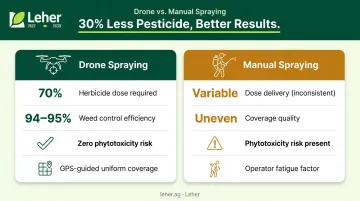
Leher's drone spraying operations report about 30% less pesticide usage compared to conventional methods, in line with its reported input-saving benchmark.
Why this matters in practice:
- Lower herbicide volume per acre reduces input cost directly
- Less residual chemical in soil lowers herbicide-resistance pressure, such as documented Phalaris minor resistance in Indian wheat
- Phytotoxicity from over-application drops when droplet size and coverage density stay consistent
KPIs affected: Herbicide cost per acre, spray overlap/skip rate, weed control efficacy, crop phytotoxicity incidence
When this advantage matters most: Fields with variable weed pressure, herbicide-sensitive crops, and operations where input cost management is critical, especially for smallholder farmers working on tight margins.
Advantage 2: Speed and Timeliness During Critical Application Windows
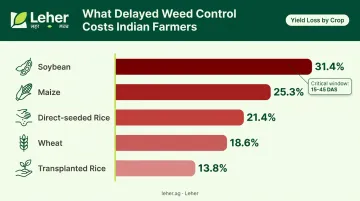
Weed control has a clock on it. For soybean, the critical crop-weed competition period is roughly 15–45 days after sowing. Miss that window and weeds can turn into yield losses that cannot be recovered later. Soybean weed losses in India average 31.4%, maize 25.3%, and direct-seeded rice 21.4% when control is inadequate or delayed.
In 2024 field demonstrations, ICAR-NBAIR recorded agri-drone crop-protection efficiency of 7–8 minutes per acre. Leher's operational benchmark for general field crops is 5 minutes per acre, reaching up to 50 acres per day with a single operator.
A manual spraying team cannot match that throughput. In post-monsoon waterlogged paddy fields, workers often cannot access the field at all.
Practical consequences of speed advantage:
- Treated fields stay ahead of early weed competition compared with untreated or late-treated plots
- Large or multi-plot operations that would take a manual team several days can be completed in a single aerial session
- Post-monsoon soil conditions that make ground equipment impractical don't affect drone operations
KPIs affected: Acres treated per hour, percentage of fields treated within optimal window, yield per acre in treated vs. untreated plots
When this advantage matters most: Kharif planting seasons with narrow application windows; waterlogged or terraced fields inaccessible to ground equipment; outbreak scenarios requiring treatment across large areas within 48–72 hours.
Advantage 3: Farmer Safety and Labour Efficiency
Manual herbicide spraying via backpack or knapsack sprayer puts farmers in sustained direct contact with chemicals: inhaling spray mist, absorbing product through skin, and working long hours in the field with limited protection.
WHO identifies agricultural pesticide applicators as among the groups most at risk from direct chemical exposure.
Globally, an estimated 385 million unintentional acute pesticide poisonings occur annually, with roughly 44% involving farmers. Studies on knapsack sprayer operators show dermal exposure is concentrated in the hands, arms, and face during mixing and application.
Drone spraying reduces this exposure by design. The operator controls the drone remotely from a safe distance; no one walks through the spray zone. Leher specifically highlights "No Human Exposure" as a core safety feature of its drone spraying model.
Safety is only one part of the labour equation in Indian farming:
- Plant-protection worker wages have risen from ₹397.75/day in 2022 to ₹434.81/day in 2024 for male workers (Labour Bureau data), with female rates rising proportionally
- A single drone operator can cover 50 acres per day, replacing several days of manual spraying labour
- Peak-season labour availability is increasingly unreliable; drone operations reduce that dependency
KPIs affected: Worker chemical exposure incidents, labour hours per acre, cost of labour per treatment cycle, spray uniformity, re-treatment rate
When this advantage matters most: Operations using higher-toxicity herbicides; farms where manual labour is unreliable; and larger farms where supervisory oversight of manual spraying across multiple plots is impractical.
What Happens When Aerial Herbicide Spraying Is Skipped or Delayed
Poor or late herbicide application shows up quickly in yield loss across India's major crops.
| Crop | Average yield loss from weeds | Notes |
|---|---|---|
| Soybean | 31.4% | Critical competition period: 15–45 DAS |
| Maize | 25.3% | Losses compound quickly in dense stands |
| Direct-seeded rice | 21.4% | Wet conditions amplify access problems |
| Wheat | 18.6% | Phalaris minor resistance already documented |
| Transplanted rice | 13.8% | Lower but still material |
Beyond single-season losses, delayed or inadequate treatment creates compounding problems:
- Resistance development: Undertreated weed patches expose surviving plants to sub-lethal herbicide doses — the fastest route to selecting resistant biotypes. India already has documented herbicide-resistant weeds in wheat and other crops.
- Seedbank buildup: Weeds that complete their life cycle seed the next season's problem. Missing one application window contributes to future weed pressure.
- Labour bottlenecks: If manual spraying teams are unavailable during the critical window, the field goes untreated. Drone-based services, booked on demand via platforms like the Leher App, reduce this bottleneck.
How to Get the Most Value from Aerial Herbicide Spraying
Aerial spraying delivers its full value when used as part of a structured crop protection plan , rather than as a last-minute response after visible crop damage.
For consistent results:
- Time applications early: Identify the crop-weed competition period for your crop, then spray before weeds gain a competitive edge.
- Track field-level outcomes: Compare weed suppression, crop health, and cost per acre after each treatment to improve future timing.
- Choose certified operators: DGCA-certified pilots help manage compliance, calibration, and narrow weather windows.
- Plan beyond one spray: Pair aerial herbicide application with crop rotation, seed selection, and resistance monitoring.
Leher's "Book | Spray | Pay" model through the Leher App makes the process straightforward: a farmer books a session, a DGCA-certified pilot arrives, sprays the field, and payment follows after completion.
For FPOs and large-farm operators managing multiple plots, coordinated scheduling across trained drone pilots can cover more acres in tight spray windows than a single ground crew.
Conclusion
Aerial herbicide spraying, particularly through precision drone technology, delivers measurable improvements in the metrics that matter: lower input costs, faster coverage, better weed control, and reduced health risk for the people doing the work.
These aren't one-time gains. Fields treated on schedule with accurate coverage require fewer re-treatments, support healthier crop stands, and accumulate yield advantages season after season. The compounding effect of consistent, timely weed control makes the strongest case for aerial application, beyond the technology itself.
For Indian farmers navigating tight margins, fragmented holdings, and rising labour costs, drone-based aerial herbicide spraying is no longer a future upgrade. It is a practical operational shift that pays for itself through inputs saved, labour avoided, and yield protected.
With app-booked services such as Leher, farmers can access trained drone pilots without buying a drone, keeping the benefit tied to acres sprayed rather than equipment owned.
Frequently Asked Questions
What is aerial spraying used for?
Aerial spraying applies herbicides, pesticides, or fungicides from drones or aircraft to control weeds, pests, and crop diseases. In India, agricultural drones make timed spraying practical for smaller and mid-sized farms.
How much does aerial herbicide drone spraying cost in India?
No official standard per-acre rate is published. Pricing varies by acreage, crop, chemical, travel distance, local labour, and whether you book through a service provider, FPO, or custom-hiring centre. Leher can provide location-specific pricing after reviewing the field details.
Can Roundup (glyphosate) be applied by drone in India?
Glyphosate use in India is restricted and regulated by PPQS/CIB&RC. Drone spraying is allowed only when the product label permits that application method, and state restrictions may also apply. Verify the current label before spraying.
Is aerial herbicide spraying safe for crops and nearby areas?
Yes, when pilots use the right height, droplet size, wind window, and buffer zones. Indian crop-specific SOPs specify 250–350 micron droplets and a 100-metre buffer from water bodies and residential areas.
Which crops benefit most from aerial herbicide spraying?
Paddy, soybean, maize, and wheat often benefit because weed pressure can reduce yields quickly during early growth. Waterlogged, terraced, or hard-to-enter fields are also strong candidates for drone spraying.
How does drone spraying compare to backpack sprayers for efficiency?
One trained drone operator can cover up to 50 acres per day, often around 5 minutes per acre. Compared with backpack spraying, drones improve uniformity, reduce direct chemical exposure, and avoid fatigue on uneven terrain.