Introduction
For millions of Indian farmers, the morning routine begins the same way: fill the knapsack, strap it on, and walk the field for hours under the sun. Manual spraying has been the backbone of crop protection across India for decades — and it is failing farmers on multiple fronts.
The costs go far beyond the ₹1,390 price tag of a basic knapsack sprayer. The losses are real and measurable — and they compound season after season:
- Chronic back pain and musculoskeletal strain from hours of carrying loaded equipment
- Direct chemical exposure with minimal protection
- Patchy, uneven coverage that leaves crops vulnerable
- Wasted inputs from over-application and runoff
- Lost time during narrow pest windows when speed is everything
This article lays out exactly where manual spraying falls short, what the data says about its limitations, and what modern alternatives — from battery-operated sprayers to agricultural drones — can realistically offer Indian farmers today.
Key Takeaways
- Manual knapsack sprayers cover roughly 0.08 hectares per hour — drones cover 4 hectares per hour
- Operators face dermal, ocular, and inhalation exposure to pesticides during every spraying session
- Inconsistent manual pressure leads to uneven coverage, wasting chemicals and reducing effectiveness
- Drone spraying uses 25–27 litres per hectare versus 490–625 litres per hectare for knapsack sprayers
- On-demand drone spraying services make this technology accessible to any farmer — no equipment purchase required
How Manual Spraying Works Across Indian Farms
Manual spraying — predominantly with knapsack backpack sprayers — remains the dominant crop protection method among India's smallholders. The reason is straightforward: 89.4% of Indian agricultural households own less than 2 hectares, making low-cost equipment the practical default. Agriculture Census data counts over 31.4 million operational holdings using hand-operated sprayers.
The Three Main Knapsack Types
| Type | How It Works | Primary Limitation |
|---|---|---|
| Manual pump | Operator pumps lever continuously | Pressure drops constantly |
| Battery-operated | Electric motor maintains pressure | Still requires walking entire field |
| Petrol-engine | Engine-driven pump | Heavier to carry, fuel cost |
Tractor-mounted boom sprayers step in for medium and large farms, offering wider coverage and higher tank capacity. But they come with hard limits: they cannot operate in waterlogged paddy fields, cannot navigate closely planted sugarcane rows, and their weight causes soil compaction that damages root health over time.
These equipment constraints become a safety problem in certain crops. Walking through tall sugarcane risks physical injury. Cotton thorns create a hazard for unprotected operators. In paddy fields, every step through standing water and young plants damages the crop — a cost that compounds across the entire growing season.
The Major Disadvantages of Manual Spraying
Physical Strain and Operator Fatigue
Carrying a filled 16-litre knapsack sprayer for several hours is physically gruelling. An ergonomic study from Junagadh Agricultural University measured heart rates of 97.44 beats per minute and oxygen consumption of 0.43 L/min among battery-operated knapsack sprayer operators — placing the task firmly in the medium-to-heavy physical workload category.
The practical consequence: as fatigue accumulates through a session, spray application quality degrades. Operators slow down, pump less consistently, and miss areas they would have caught earlier. That means less effective crop protection on top of the labour already spent.
Limited Coverage Speed and Efficiency
The speed gap between manual and drone spraying is structural — and the numbers make it hard to ignore.
- Knapsack sprayer: 0.082 hectares per hour (groundnut field trial, Gujarat)
- Agricultural drone: 4 hectares per hour (same field conditions)
- Soybean trial comparison: Knapsack required 8 hours per hectare; drone completed the same area in 0.33 hours
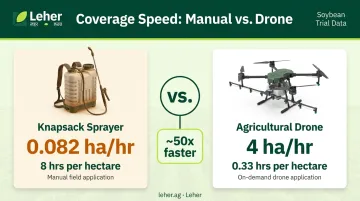
For a farmer managing a 5-acre cotton field during a pest outbreak, that difference is the gap between controlling the problem and losing the season. Leher's drone spraying service can cover up to 50 acres per day with a single trained operator — roughly 8 times the productivity of traditional methods.
Small tank capacity adds another layer of inefficiency. A 16-litre knapsack runs dry quickly in field conditions where Indian trials document application volumes of 490 to 625 litres per hectare. Operators spend a significant portion of each session walking back to refill — time that never goes toward the crop.
Inconsistent Pressure and Uneven Coverage
Manual pumping creates an inherent pressure problem. As liquid is dispensed, each pump stroke delivers less consistent pressure. Agricultural application technology research confirms that these pressure variations directly reduce spray pattern consistency, so some areas receive too much chemical while others receive too little.
This uneven distribution has two costs:
- Over-applied zones: Excess chemical that does not improve crop protection but increases input costs
- Under-applied zones: Inadequate coverage that leaves crops vulnerable, often requiring repeat treatment
Coverage of leaf undersides (where many fungal infections and insect pests actually reside) is particularly difficult. The fixed nozzle angle combined with fatigue makes consistent underside coverage nearly impossible across a full session.
Direct Chemical Exposure and Health Risks
Manual sprayer operators face chemical exposure through three pathways during every session:
- Dermal contact — skin absorption through hands, arms, and any exposed skin
- Ocular exposure — splashes during mixing, filling, and spraying
- Inhalation — breathing pesticide vapour and fine mist, especially in warm, still conditions
Research measuring dermal pesticide exposure among farmers in Telangana confirmed this is a real, quantifiable risk. Globally, a systematic review published in PMC estimates 385 million acute unintentional pesticide poisonings and approximately 11,000 deaths annually worldwide. Warm conditions amplify skin absorption, and Indian summers mean most spraying sessions happen in exactly those conditions.
Drone spraying eliminates operator chemical exposure entirely. The pilot operates the drone remotely, never entering the spray zone.
The Real Costs of Manual Spraying
The ₹1,390 purchase price of a basic knapsack sprayer looks attractive. The full-season cost is a different picture.
Water Consumption
| Method | Water per Hectare |
|---|---|
| Knapsack sprayer | 490–625 litres |
| Government drone SOP | 20–25 litres |
| Drone (groundnut trial) | ~27 litres |
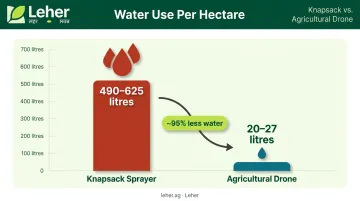
This is not just an environmental concern. In water-scarce regions, every litre applied to a field has to come from somewhere — a borewell, a canal allocation, or a tanker. At 490+ litres per hectare versus 25 litres, the difference in water cost across a full season on multiple acres is substantial.
Environmental Damage
Chemical runoff from over-application reaches local water bodies, disrupts soil microbiomes, and harms local pollinators.
Manual spraying's tendency to over-apply — driven by pressure variability and the instinct to err on the side of more — increases chemical runoff and pollinator exposure with each pass.
Over seasons, this compounds. Degraded soil microbiomes produce lower yields, meaning farmers apply more inputs to compensate — a cycle that erodes both land productivity and profit margins.
Water isn't the only resource at stake. A 2024 review on pesticide pollution in India links pesticide contamination to approximately 25% of global soil degradation and 30% of biodiversity loss in agricultural landscapes.
Modern Alternatives to Manual Spraying
Battery-Operated and Engine-Powered Knapsack Sprayers
These are genuine improvements over manual pumping. Consistent motorised pressure reduces the application variability problem, and the operator's arms are freed from continuous pumping. For small plots or spot treatments, they are practical and cost-effective.
The limitations remain real:
- Operator still walks the entire field
- Chemical exposure pathways are unchanged
- Coverage speed is still a fraction of mechanised options
- Tank capacity and refill requirements are the same
Tractor-Mounted Boom Sprayers
For large, open, flat fields — wheat in Haryana, for example — boom sprayers offer genuine efficiency. Wide spray booms, large tank capacity, and tractor speed combine to cover ground quickly.
The terrain and long-term limitations are significant, however:
- Waterlogged paddy fields are inaccessible to tractor equipment
- Dense sugarcane rows cannot accommodate a boom sprayer
- Repeated tractor passes compact soil, damaging root structure and reducing water infiltration over successive seasons
Agricultural Drone Spraying
Drones address the structural problems of manual spraying directly:
- No operator chemical exposure — pilot operates remotely, outside the spray zone
- Speed — 4+ hectares per hour in verified field trials
- Precision — consistent flight height and GPS-controlled nozzles deliver uniform droplet coverage
- Terrain access — waterlogged paddy, dense sugarcane, hillside plantations — none of these restrict aerial application
- Water efficiency — 25–27 litres per hectare versus 490–625 litres for knapsack sprayers
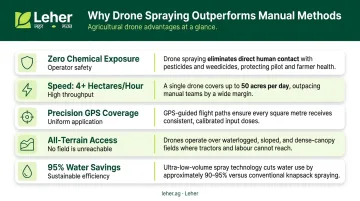
Leher's on-demand drone spraying service makes this accessible without capital investment. A farmer books through the Leher App, a DGCA-certified pilot arrives at the farm, and payment is collected only after the job is completed. There is no equipment to purchase, no maintenance to manage, and no pilot training needed.
Is Drone Spraying Right for Your Farm?
Not every farm needs to replace its knapsack sprayer immediately. A practical decision comes down to three questions:
1. What is your farm size? For plots under half an acre, manual or battery-operated sprayers still make sense. For farms of a few acres or more — where pest windows are time-sensitive — drones deliver meaningful efficiency gains that translate directly to better crop protection and lower input costs.
2. What is your terrain? Hilly, waterlogged, or densely planted fields make drone spraying the clear practical choice. Sugarcane and paddy farmers regularly deal with conditions where manual spraying is both slow and physically hazardous.
3. Is labour a constraint? Agricultural labour availability in many Indian regions is tightening. A single drone operator covering 50 acres per day replaces multiple manual labourers, without the health risks, fatigue-related quality decline, or chemical exposure those workers would face.
If drone spraying fits your situation, choosing the right provider matters. Here's what to check:
What to Look for in a Drone Spraying Provider
- DGCA-certified pilots with valid drone flying licences
- Registered drones with appropriate type certification
- SOP-compliant nozzle setup and droplet size control
- Clear per-acre pricing with no hidden charges
- Weather monitoring and buffer-zone compliance protocols
Leher's model — on-demand booking through the app, certified pilots, payment after completion — is designed specifically for farmers who want to try drone spraying without committing to equipment ownership. The company has sprayed over 30,000 acres and served 2,100+ farmers across crops including sugarcane, paddy, cotton, wheat, vegetables, tea, and rubber plantations.
Manual spraying will remain the practical reality for many farmers this season, and that comes down to budget and access — not a lack of options. For farmers facing large fields, difficult terrain, labour shortages, or time-sensitive pest events, drone spraying is no longer distant technology. It is available on demand, per acre, through an app.
Frequently Asked Questions
How many litres of water does it take to spray a hectare?
Knapsack sprayers typically apply 490–625 litres per hectare in Indian field conditions. Agricultural drones, per government SOP and field trials, apply 20–27 litres per hectare. That is roughly a 95% reduction in water use — a meaningful input cost saving, particularly for farmers in water-scarce regions.
What are the risks of spraying?
Manual spraying carries three main risks: operator health exposure (dermal, ocular, and inhalation contact with pesticides); crop damage from uneven application that leaves zones under-protected or over-dosed; and environmental harm through chemical runoff into water sources and damage to soil microbiomes and pollinators.
What are the main disadvantages of manual spraying for large farms?
The three biggest problems at scale are slow coverage speed (around 0.08 hectares per hour), high labour cost and physical strain across large areas, and inconsistent spray quality from variable manual pressure — none of which are viable for anything beyond small plots.
How does drone spraying reduce pesticide use compared to manual spraying?
Drones use precision nozzles, consistent flight height, and GPS-controlled application to deliver uniform coverage with minimal drift or over-application. Research published in Plant Archives reports drone pesticide utilisation efficiency reaching up to 85%, compared to far lower efficiency with knapsack sprayers, where pressure variability and operator fatigue cause frequent over and under-application.
Can small farmers in India afford drone spraying?
Buying a drone outright costs around ₹4–5 lakh, but Leher's service model lets farmers book spraying at a per-acre fee with zero upfront investment. Once labour savings and reduced input costs are factored in, the per-acre cost of drone spraying often matches or beats manual spraying across a full season.