This is the core problem with uniform application, and it affects farms of every size. Between 40% and 68% of applied nitrogen fertiliser is lost to the environment in many developing regions, not because farmers apply too much overall, but because application doesn't match where the need actually exists.
Variable Rate Technology (VRT) solves this by letting farmers apply the right input, at the right rate, in the right location. This article covers what VRT is, how it works, the main types, its key benefits, and — critically — how Indian farmers can access these benefits today without buying expensive equipment.
Key Takeaways
- VRT adjusts input rates (seeds, fertilisers, water, pesticides) based on where within a field they're actually needed
- Two core approaches: map-based (pre-built prescription maps + GPS) and sensor-based (real-time adjustment)
- Main applications: variable rate seeding, fertilisation, irrigation, and precision spraying
- Variable rate fertilisation delivers up to 8.37% higher maize yields; variable rate irrigation cuts water use by up to 21%
- For Indian farmers, drone-based precision spraying is the most practical way to start with VRT today
What Is Variable Rate Technology and Why Does It Matter?
VRT is a precision agriculture method that allows farmers to vary the rate of agricultural inputs — seeds, fertilisers, water, pesticides — across different zones of a single field, based on actual spatial variability in soil conditions, crop health, and topography.
Rather than treating a field as one uniform block, VRT treats it as a mosaic of zones, each with different needs and different optimal input rates.
VRT's Role in Precision Farming
VRT sits at the centre of precision agriculture alongside GPS mapping, remote sensing, and data analytics. These tools work together: remote sensing identifies variability, data analytics converts it into actionable prescriptions, and VRT-equipped machinery executes the application.
Without VRT, the data collected by all those sensors and satellites doesn't translate into changed outcomes at the field level.
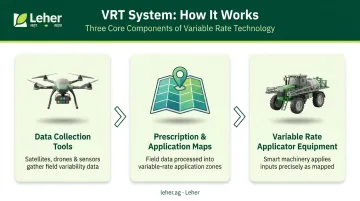
The Three Components Every VRT System Needs
Any functional VRT system requires:
- Data collection tools — soil sensors, satellite or drone imagery, GPS receivers, yield monitors
- Prescription or application maps — digital field maps that define the input rate for each GPS-defined zone
- Variable rate applicator equipment — machinery that reads those maps (or real-time sensor data) and automatically adjusts rates as it moves through the field
These systems are scaling fast. The global precision farming market is projected to reach USD 24.09 billion by 2030 at a 13.1% CAGR, and India is tracking this shift closely — the country's precision agriculture sector is projected to grow at over 12% CAGR through 2030, driven by government-backed drone adoption schemes, rising input costs, and increasing smallholder access to agri-tech tools. For Indian farmers already contending with fragmented landholdings and resource constraints, VRT's ability to cut inputs precisely where needed is less a luxury and more a practical necessity.
How Variable Rate Technology Works: Map-Based vs. Sensor-Based
There are two fundamentally different ways to implement VRT. Understanding the distinction helps farmers choose the right approach for their situation.
Map-Based VRT
This approach requires pre-season data collection — soil sampling, electrical conductivity mapping, satellite imagery, and yield history — to build a prescription map. That map divides the field into zones and assigns a specific input rate to each one.
Before field operations begin, the prescription map is uploaded to the applicator equipment. As the machine moves through the field, GPS positioning tells it exactly where it is, and the equipment automatically adjusts the application rate to match the prescription for that zone.
Best suited for: fertiliser applications, seeding, and situations where field conditions are well-understood in advance.
Sensor-Based VRT
Instead of pre-built maps, this approach uses real-time sensors mounted on the equipment itself — optical crop sensors, soil moisture probes, near-infrared spectroscopy. As the machine travels across the field, the sensors measure conditions on the go and trigger immediate rate adjustments without any prior mapping.
Best suited for: irrigation management, in-season nitrogen top-dressing, and spraying.
Side-by-Side Comparison
| Factor | Map-Based VRT | Sensor-Based VRT |
|---|---|---|
| Data requirements | Pre-season soil sampling, imagery | Real-time field measurements |
| Timing | Before the season | During field operations |
| Equipment complexity | Higher (requires mapping tools) | Moderate (sensors on applicator) |
| Best for | Fertiliser, seeding | Irrigation, spraying |
| Flexibility | Fixed to the prescription | Adjusts instantly to conditions |
The Role of Drone and Satellite Imagery
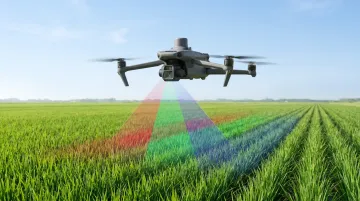
Multispectral imagery — captured by drones or satellites — has made prescription map creation significantly faster and cheaper than traditional soil sample grids alone. Vegetation indices like NDVI highlight zones of varying crop health across a field. Agronomists use this visual evidence to draw zone boundaries and assign input rates with greater confidence.
This is where drones connect directly to VRT. Beyond their role as applicators, drones serve as data collection platforms that feed the prescription mapping process:
- Capture high-resolution multispectral imagery in a single field pass
- Generate NDVI and other vegetation index maps within hours
- Identify stress zones, nutrient deficiencies, and uneven growth patterns
- Feed zone boundary data directly into prescription map software
Types of Variable Rate Technology in Farming
Variable Rate Seeding
VRT allows farmers to adjust seed population rates by zone. In high-fertility areas where soil can support denser stands, planting rates increase. In poorer zones, rates drop to prevent intra-crop competition for limited nutrients and moisture.
The result is more uniform crop emergence across the field and less wasted seed in zones where higher populations don't translate to higher yields. Iowa State University Extension notes that variable rate seeding works best in fields where plant density and yield response are meaningfully related — making field-specific data essential before implementation.
Variable Rate Fertilisation
Nutrient levels vary considerably even within small fields. VRT-guided fertilisation applies nitrogen, phosphorus, and potassium at zone-specific rates derived from soil test data or satellite-based nutrient maps.
The research outcomes are consistent:
- A USDA-ARS study found variable rate nitrogen application used 4% to 7% less total nitrogen with no significant yield difference versus uniform application
- A 2024 field study on summer maize showed VRT fertilisation produced 7,275 kg/ha versus 6,713 kg/ha under uniform rates — an 8.37% yield increase
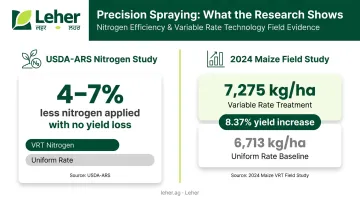
Less input, higher output: that trade-off makes variable rate fertilisation one of the strongest economic cases for VRT adoption.
Variable Rate Irrigation
Variable rate irrigation (VRI) systems use soil moisture sensors and topographic elevation data to vary water application across a field. Low-lying areas that retain moisture receive less; elevated, sandy patches that drain quickly receive more.
A 2023 study on forage crops found VRI saved 7.64% to 21.25% of water while increasing crop water productivity by up to 7.63%. For Indian agriculture — where irrigation water-use efficiency sits at only 25% to 35% — the potential gains from variable rate irrigation are substantial.
Variable Rate Spraying and Pest Management
Uniform pesticide spraying hits the whole field regardless of where pests or weeds actually are. Variable rate spraying targets only the affected zones — reducing total chemical usage, protecting unaffected crop areas, and cutting the risk of chemical runoff.
USDA-ARS research on intelligent spraying systems found pesticide use reductions of 46% to 68% compared to conventional sprayers. Drone-based precision spraying extends this principle into India's farming context.
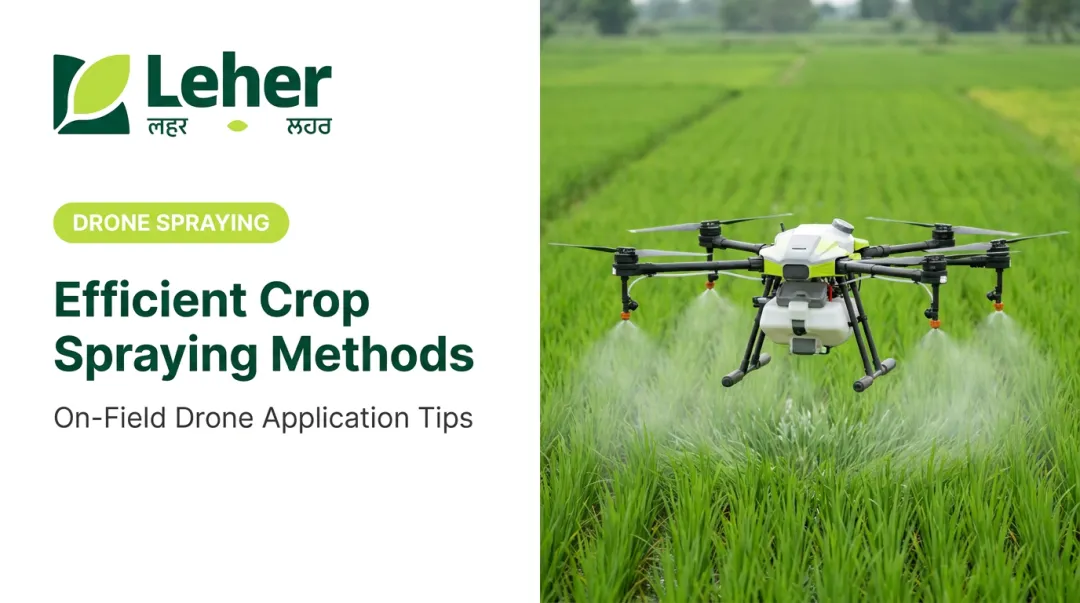
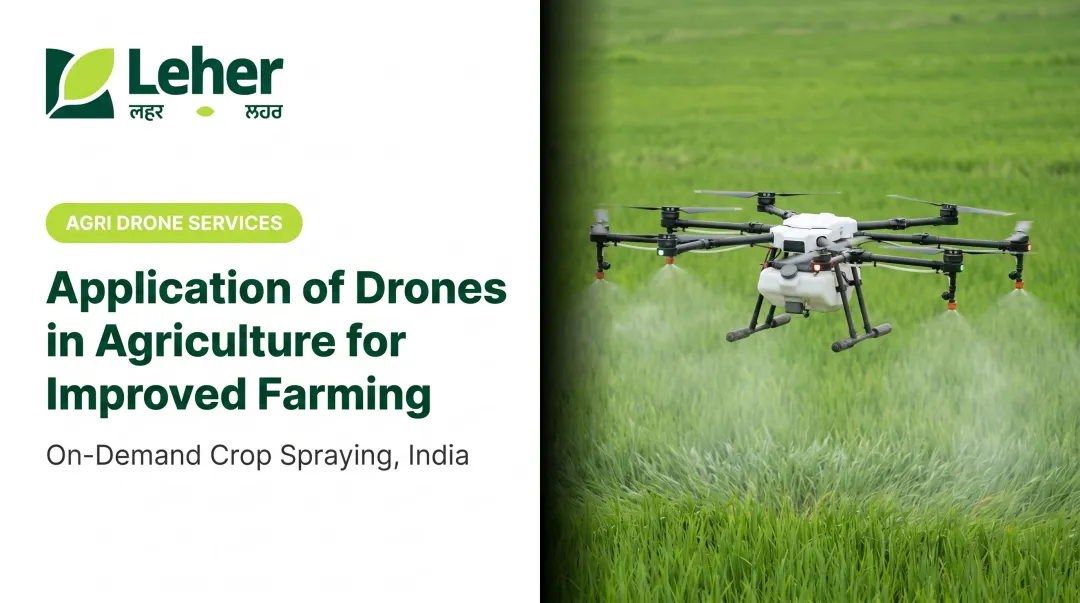
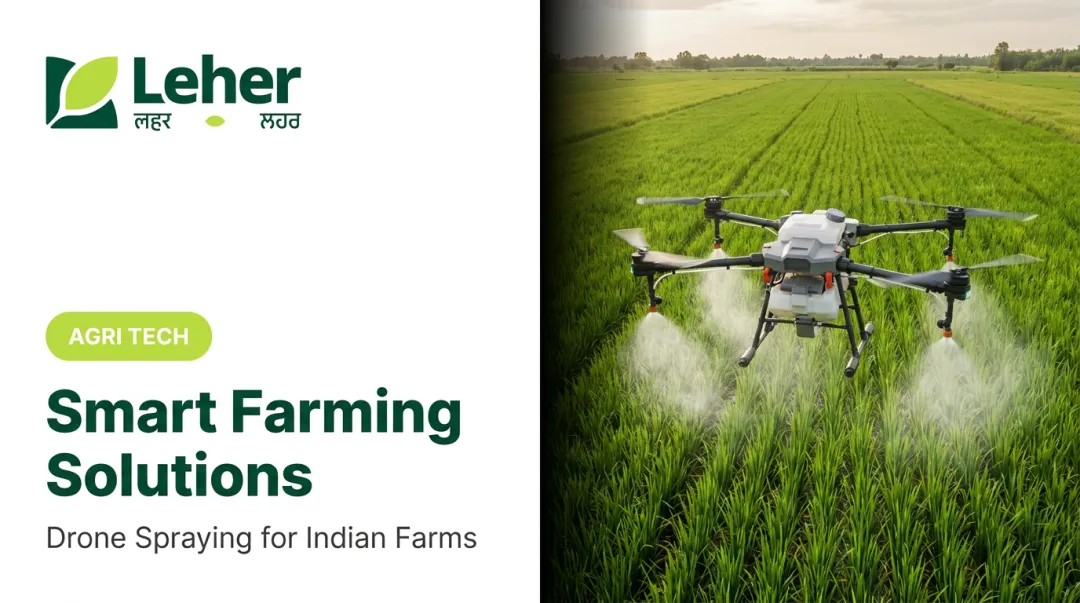
Leher's drone-powered precision spraying service applies variable rate principles directly: targeted aerial application reduces pesticide use by around 30% and water consumption by up to 90% compared to conventional methods. The service covers sugarcane, paddy, cotton, wheat, vegetables, tea, and rubber plantations — bookable through the Leher App with no equipment purchase required.
In 2024 alone, Leher served over 810 farmers across 6,500+ acres, demonstrating that precision spraying at scale is already happening across Indian farms.
Key Benefits of Variable Rate Technology for Farmers
Higher Yields and Better Return on Investment
VRT's core value is matching inputs to actual field needs. Over-applied zones stop wasting inputs; under-served zones get what they need to perform.
Research on variable rate fertilisation shows 8.37% more grain per hectare compared to uniform application. That gain — achieved without increasing input costs — means more rupees recovered on every acre planted.
Environmental Sustainability
When inputs are applied uniformly at rates suited to the field's best zones, the lower-performing areas receive more than they can absorb. That excess fertiliser doesn't disappear — it leaches into groundwater or runs off into local waterways.
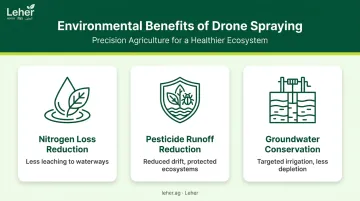
VRT reduces this problem at the source by limiting application to what each zone actually needs:
- Less nitrogen loss to waterways and the atmosphere
- Reduced pesticide drift and runoff into surrounding ecosystems
- Lower groundwater depletion from more targeted irrigation
Soil Health Preservation
Chronic over-application of fertilisers disrupts soil pH and damages microbial communities that underpin long-term soil productivity. The FAO has noted that improper nitrogen use damages air, water, and soil quality over time.
VRT reduces over-application risk by design, protecting the microbial activity that healthy soil depends on. Fewer field passes in correctly zoned areas also limit soil compaction — a secondary benefit that compounds over successive seasons.
Is Variable Rate Technology Suitable for Indian Farmers?
This is where the practical question matters most. VRT works agronomically — the evidence is clear. But does it work economically and logistically for Indian farming conditions?
The Structural Challenge
India's farm structure creates real barriers to traditional VRT adoption:
- Average operational holding size is just 1.08 hectares
- 86.08% of operational holdings are small or marginal
- 89.4% of agricultural households own less than 2 hectares
Purchasing a GPS-guided variable rate applicator, commissioning soil mapping, and maintaining the data infrastructure is not viable for most Indian farmers. The economics simply don't work at that scale.
The Turning Point: Service-Based Access
VRT becomes viable for Indian farmers not through ownership, but through service access. Rather than buying precision equipment, farmers access its benefits on a per-session, pay-as-you-go basis.
India's policy environment is actively supporting this shift:
- Farmer Producer Organisations (FPOs) are eligible for grants covering up to 75% of drone costs under the Kisan Drone scheme
- The NaMo Drone Didi scheme approved 15,000 drones for women's self-help groups
- The Digital Agriculture Mission was approved with a total outlay of ₹2,817 crore, creating infrastructure for data-driven farming
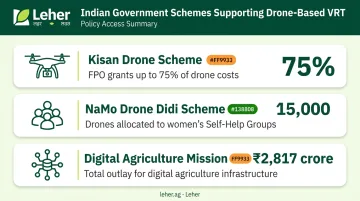
These programmes are building the supply side of service-based VRT access across rural India.
The Drone Entry Point
That government infrastructure has a direct on-ground equivalent in drone spraying services. Drone-based precision spraying is the most practical entry point for farmers who want VRT benefits without capital investment. A farmer books a session through the Leher App, a DGCA-certified pilot arrives, performs the spray, and the farmer pays only after the job is complete.
Leher's mission targets 5+ million farmers with drone-powered precision spraying by 2030, supported by a growing network of rural drone entrepreneurs across India. With 100+ drone partners already operating on the platform and a target of 1,000 rural drone partners by 2030, the delivery infrastructure is expanding alongside farmer demand.
For a smallholder farming 1–2 hectares, this model means accessing precision application technology that would otherwise cost lakhs — without owning a single piece of equipment.
Frequently Asked Questions
What is variable rate technology?
VRT is a precision agriculture method that enables farmers to apply inputs — seeds, fertilisers, water, and pesticides — at variable rates across different zones of a field. Rates are determined by spatial variability in soil and crop conditions, rather than a single uniform rate applied across the whole area.
What are the main types of variable rate technology used in farming?
The four primary types are variable rate seeding, variable rate fertilisation, variable rate irrigation, and variable rate spraying or pesticide application. Each targets a different input category, using spatial data to set zone-specific application rates.
What is the difference between map-based and sensor-based VRT?
Map-based VRT uses pre-generated prescription maps loaded into equipment before field operations begin. Sensor-based VRT uses real-time sensors mounted on the equipment to measure field conditions on the go and adjust input rates instantly, without any prior mapping.
How does VRT help reduce input costs for farmers?
VRT prevents over-application in low-need zones while ensuring adequate supply where conditions demand it. The result is lower total consumption of fertilisers, seeds, water, and chemicals — often alongside improved overall yields.
Is variable rate technology suitable for small-scale farmers in India?
Traditional VRT equipment requires capital investment that most smallholders can't justify given average holding sizes below 1.1 hectares. Service-based models — particularly drone precision spraying booked on a per-session basis — make VRT benefits accessible without any equipment ownership.
How do drones support variable rate technology in agriculture?
Drones support VRT in two ways. First, they capture multispectral aerial imagery to build prescription maps that identify zones of varying crop health. Second, they act as precision applicators — delivering targeted pesticide, fertiliser, or weedicide sprays matched to zone-specific data, rather than blanket-treating the entire field. In India, on-demand drone spraying services make this approach viable even for smallholder farmers without equipment ownership.