

Introduction
Many Indian farmers face a frustrating pattern: crops show yellowing leaves, poor flowering, or stunted growth even after regular soil fertilisation. The problem usually isn't the amount of fertiliser applied — it's the delivery method.
Foliar fertilisation offers a faster, more targeted route. When soil conditions block root absorption — high pH, waterlogging, salinity, or compacted soils — spraying nutrients directly onto leaves bypasses these constraints entirely. With over 6.74 million hectares of salt-affected soils across India documented by ICAR-CSSRI, this isn't a niche concern. It's a widespread reality.
This guide gives Indian farmers a practical foundation for using foliar fertilisation effectively — from choosing the right nutrients to avoiding the mistakes that cost yield.
Key Takeaways
- Foliar fertilizer delivers nutrients through the leaf, not the root: faster uptake and more targeted than soil application
- It works best for micronutrient correction and critical growth-stage support, not as a soil fertilizer replacement
- Apply early morning or late evening when temperatures are below 22°C and stomata are open
- Match nutrients to growth stage: nitrogen and zinc for vegetative phases, potassium and boron for flowering, calcium for fruit quality
- Soil and tissue testing should guide every foliar program — never guess which nutrient to apply
What Is Foliar Fertiliser and How Does It Work?
What Is Foliar Fertilizer and How Does It Work?
Foliar fertilization means applying a liquid nutrient solution directly onto plant leaves. Instead of waiting for roots to extract nutrients from the soil, the plant absorbs them through the leaf surface — via the cuticle, stomata, and in some crops, trichomes (fine leaf hairs).
The Three-Stage Absorption Process
- Contact — The spray solution lands on the leaf surface and rests on the cuticle
- Penetration — Nutrients move through microscopic pores in the waxy cuticle and enter through open stomata
- Translocation — Absorbed nutrients are transported to actively growing plant organs where demand is highest
Research published by the American Society for Horticultural Science found that tomato seedlings absorbed 75% of foliar-applied urea within 12 hours and 99% within 24 hours — showing just how fast leaves take up soluble nutrients when conditions are right.
Why Foliar Feeding Can't Replace Soil Fertilisation
Foliar fertilization is a complement to soil fertilization, not a replacement. Both the University of Connecticut Extension and Missouri Extension explicitly state that foliar feeding should supplement — not substitute — a sound soil fertility programme. Roots must still supply the bulk of a plant's nutritional requirements.
Foliar feeding excels in two specific situations:
- Correcting acute deficiencies quickly when soil conditions block root uptake
- Delivering targeted nutrients at precise crop growth stages where timing matters
Attempting to supply large amounts of macronutrients (N, P, K) through leaves alone is impractical. High concentrations increase the risk of leaf burn, and the leaf simply cannot process the volumes a field crop requires over a full season.
Key Benefits of Foliar Fertilisation for Crop Health
Faster Nutrient Delivery
Foliar-applied nutrients can be absorbed and translocated within hours — as the urea absorption data above confirms. A review by Lovatt (published in HortTechnology) found that properly timed foliar fertilisation can be 5 to 30 times more efficient than soil fertilisation, depending on the nutrient, crop, and soil conditions. This makes foliar feeding particularly valuable when a deficiency needs correcting before the next growth stage arrives.
Targeted Correction Where Soil Fails
Indian soils present real barriers to root uptake. High pH makes iron insoluble. Waterlogged soils block oxygen-dependent nutrient absorption. Saline and alkaline soils are widespread across Rajasthan, Punjab, Haryana, and coastal states. When the soil itself is the problem, foliar feeding routes around it.
Support at Critical Crop Stages
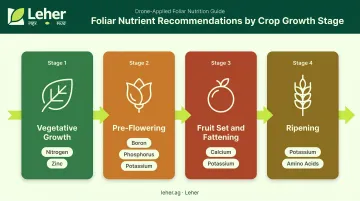
Foliar fertiliser can be timed to align with the plant's peak demand windows:
- Vegetative growth — nitrogen and zinc for strong canopy development
- Pre-flowering — boron, phosphorus, and potassium for flower formation
- Fruit set and fattening — calcium and potassium for cell development and quality
- Ripening — potassium and amino acids for grain fill and sugar accumulation
Reduced Input Waste
Because foliar fertilisers work in small, concentrated doses — particularly for micronutrients — farmers can often achieve the same correction using less product. A study on alkaline-soil potato found that foliar boron at 0.5 kg/ha produced maximum boron recovery of 25.62%, outperforming soil dressing at twice the dose (1 kg/ha). For micronutrients, the efficiency gain is real and measurable.
Stronger Plant Resilience
Those efficiency gains extend into plant health outcomes. Research from Frontiers in Plant Science on rainfed lentils in eastern India found that foliar sprays of boron (0.2%), zinc (0.5%), and iron (0.5%) helped plants cope with drought and heat stress — with boron + iron combinations increasing seed yield by 35–38% under late-sown conditions.
Signs Your Crops Need Foliar Fertiliser and When to Use It
Visual Deficiency Symptoms to Watch For
| Symptom | Likely Deficiency |
|---|---|
| Yellowing between leaf veins, green veins remain | Iron (Fe) |
| Pale green leaves, reduced tillering, narrow leaves | Nitrogen (N) |
| Drooping, slow leaf development | Potassium (K) |
| Small, deformed, or crinkled new leaves | Calcium (Ca) |
| Poor flowering, weak stems | Magnesium (Mg) or Boron (B) |
IRRI confirms that nitrogen-deficient rice leaves become narrow, small, erect, and lemon-yellow, with significantly reduced tillering. Paddy farmers across Tamil Nadu and other monsoon-dependent regions will recognise this pattern in crops under seasonal stress.
Soil Conditions That Trigger Foliar Needs
Root absorption becomes unreliable when:
- pH is above 7.5 — iron, zinc, and manganese become chemically locked up
- Soil is waterlogged — root respiration is impaired, nutrient uptake stops
- Drought conditions — dry soil prevents nutrient movement to roots
- High salinity — salt competes with nutrient ions at root membranes
- Cool soil temperatures — enzymatic activity and root function slow down
Key Growth Windows for Indian Crops
- Rice/Paddy: Spray 1% urea + 2% MAP + 1% KCl at panicle initiation, then again 10 days later to support grain filling (Tamil Nadu agriculture guidance)
- Sugarcane: Apply foliar boosters at 45, 60, and 75 days after planting to support canopy development during rapid elongation
- Wheat: Target tillering and booting stages with nitrogen and micronutrient support
- Vegetables: Apply calcium at very early fruit development to prevent blossom-end rot in tomatoes and peppers
When NOT to Apply
- Midday heat (above 30°C) — rapid evaporation reduces absorption and risks leaf scorch
- Before or during rain — solution washes off before it can be absorbed
- Strong wind — causes uneven coverage and drift
- Severely stressed plants — application can worsen damage rather than help
Key Nutrients in Foliar Fertilisers and What They Do
Macronutrients Used in Foliar Applications
Nitrogen (N) drives chlorophyll production and vegetative growth. Urea is the most efficient foliar nitrogen source; ammonium sulphate is also effective. Missouri Extension recommends foliar nitrogen rates of 1–10 lb/acre (~1.1–11.2 kg/ha), but concentration must be carefully controlled — high-nitrogen solutions cause leaf burn quickly.
Phosphorus (P) supports root and shoot energy transfer (ATP synthesis) and is most effective when applied early in crop development — ideally at the seedling or early vegetative stage.
Potassium (K) is critical for water regulation, stress resistance, strong flowering, and fruit quality. For foliar delivery, potassium sulphate or potassium nitrate at 4 lb/acre (~4.5 kg/ha) are the recommended forms. Note: potassium thiosulfate can be phytotoxic and should never be applied above 32°C.
Calcium (Ca) is relatively immobile within the plant — it doesn't redistribute easily from older leaves to developing fruit. This is why foliar calcium applications must target the right stage: very young fruit in tomatoes and peppers, before blossom-end rot can develop. Missouri Extension lists calcium nitrate at 10–15 lb/acre (~11–17 kg/ha) and calcium chloride at 5–8 lb/acre (~5.6–9 kg/ha) as foliar rates. (Indian farmers should cross-reference these rates with ICAR or local KVK guidance for region-specific calibration.)
Micronutrients That Make a Big Difference
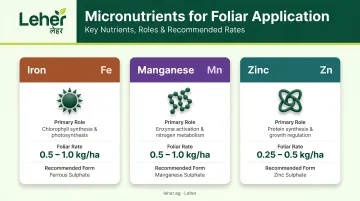
Iron (Fe), Zinc (Zn), and Manganese (Mn):
| Nutrient | Role | Foliar Rate | Form |
|---|---|---|---|
| Iron | Chlorophyll synthesis, photosynthesis | 1–2 lb/acre (~1.1–2.2 kg/ha) | FeSO₄ |
| Manganese | Oxidation-reduction, photosynthesis | 1–2 lb/acre (~1.1–2.2 kg/ha) | MnSO₄ |
| Zinc | Protein synthesis, IAA production | 0.25 lb/acre (~0.28 kg/ha) | ZnSO₄ |
One important note for farmers using glyphosate herbicides: research confirms that glyphosate can form complexes with zinc and manganese, potentially reducing their availability to the plant. This makes foliar micronutrient applications particularly important following herbicide use in susceptible crops. Beyond these three, two more micronutrients deserve close attention for flowering and fruiting crops.
Boron (B) is essential for cell wall formation, pollen viability, and fruit set — directly addressing poor flowering and fruiting issues. MSU Extension recommends 0.1–0.3 lb/acre actual boron (~0.11–0.34 kg/ha), applied across multiple small doses. Boron has an exceptionally narrow window between deficiency and toxicity; sensitive crops like beans and peas can be injured even at moderate rates.
Copper (Cu) supports pollen formation, photosynthesis, and fertilisation. It is best applied before reproductive growth stages. Like boron, copper has a narrow deficiency-to-toxicity range and requires precise dosing.
Best Practices for Applying Foliar Fertiliser
Timing and Weather Conditions
Spray early morning or late evening when temperatures are below 22°C (72°F). At these times, stomata are open, evaporation is low, and leaf surfaces retain moisture longer — all of which improve absorption. Missouri Extension identifies approximately 22°C as the optimal temperature for foliar applications.
Avoid application:
- Within 2 hours of rain
- When wind exceeds 10–15 km/h
- During peak afternoon heat
Application Technique and Coverage
- Use a fine mist, not large droplets — finer particles create more surface contact per unit volume
- Spray both the top and underside of leaves; stomatal density is often higher on the underside
- Add a surfactant or horticultural adjuvant to improve adhesion and prevent the solution from beading off waxy leaf surfaces — adjuvants improve spreading, weathering resistance, and penetration through waxy surfaces
At farm scale, even coverage across the full canopy determines how well the nutrient is absorbed. Leher's drone-based foliar spraying delivers uniform fine-mist coverage using approximately 90% less water than conventional ground sprayers, at up to 50 acres per day.
For a smallholder with 2–5 acres, that means the entire farm is sprayed in 10–25 minutes. Sessions are booked through the Leher App, with a DGCA-certified pilot arriving on-demand — no equipment to manage, no manual labour.
Concentration and Testing
- Always dilute to the lower end of the recommended range — weaker is safer
- Test on a small patch before full-field application, especially with a new product
- Apply frequently in small doses rather than infrequent large concentrations — this is especially important for boron and other leachable micronutrients
- Chelated micronutrient forms (EDTA-chelated iron, zinc, manganese) can improve uptake through waxy leaf surfaces by preventing the nutrient from reacting with other ions before absorption
Common Mistakes to Avoid
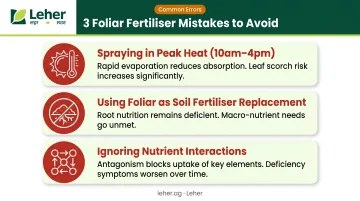
Three errors account for most foliar fertiliser failures in Indian field conditions:
- Spraying during peak heat (10 a.m.–4 p.m.): Rapid evaporation dries the solution before leaves can absorb it, wasting inputs and risking scorch. Early morning application is non-negotiable.
- Using foliar feeding as a substitute for soil fertilisation: Foliar applications address acute deficiencies and support specific growth stages — they cannot build soil nutrient reserves or supply a full season's macronutrient demand. Over-reliance causes progressive depletion that shows up only when yields start falling.
- Ignoring nutrient interactions: Excess phosphorus suppresses zinc uptake; high nitrogen reduces copper availability. Mulder's Chart of nutrient antagonisms illustrates why applying more of one nutrient can create new deficiencies elsewhere. Base every foliar application on soil and tissue test results, not assumptions.
Frequently Asked Questions
What is the best foliar fertiliser?
The right choice depends on the crop, growth stage, and confirmed deficiency. Chelated forms of zinc, iron, and manganese work best for micronutrient correction, while a balanced liquid fertiliser covering macronutrients and key micronutrients suits general plant health. Soil and tissue testing remove the guesswork.
Which fertiliser is good for flowering and fruiting?
Potassium and phosphorus are the primary macronutrients for flowering and fruit development; boron is the key micronutrient for flower formation and fruit set. Foliar sprays of potassium sulphate or potassium nitrate applied during pre-flowering deliver fast-acting support, particularly for paddy, sugarcane, and vegetable crops.
What is the best time of day to apply foliar fertiliser?
Early morning or late evening, when temperatures are below 22°C. Stomata are open, evaporation is minimal, and leaf surfaces stay moist longer. Midday application in Indian summer conditions is a waste of inputs at best, a cause of leaf scorch at worst.
Can foliar fertiliser replace soil fertiliser?
No. Foliar fertilisation is a complement to soil fertilisation. It corrects acute deficiencies and provides targeted stage-specific support, but cannot build long-term soil nutrient levels or support root health. A healthy soil fertility programme remains the foundation.
How often should I apply foliar fertiliser?
Generally every 2–4 weeks during active growth, though this varies by nutrient and crop stage. For boron specifically, MSU Extension recommends multiple small sprays across the season rather than one large application. Always follow product label guidance and observe how crops respond between applications.
What are common signs that crops need foliar fertilisation?
Watch for these warning signs:
- Yellowing between leaf veins with green veins remaining (iron deficiency)
- Pale green leaves with poor tillering (nitrogen)
- Drooping leaves and poor flowering (potassium or magnesium)
- Small, deformed new growth (calcium)
Acting promptly with the correct foliar spray can prevent yield loss.