The central challenge is clear: how can you cover your fields quickly and effectively without compromising on precision or profitability? This article explores how modern technology, particularly agricultural drones, is transforming crop spraying from a multi-day ordeal into a task completed in mere hours, boosting efficiency and protecting your bottom line.
TL;DR: Key Takeaways
- Traditional methods are slow: Manual knapsack spraying is labour-intensive and covers very little ground, while tractors cause soil compaction and crop damage.
- Drones are exceptionally fast: A single drone can cover a hectare in under 15 minutes, a task that takes a manual sprayer nearly seven hours.
- Precision saves resources: Drone technology drastically reduces water and chemical usage by targeting the crop canopy directly.
- Faster coverage means higher yields: Quick response to threats protects crop health, and timely nutrient application boosts growth.
- Service models make it easy: Farmers can access drone technology through service providers like Leher, avoiding high upfront costs and regulatory hassles.
The Hidden Costs of Slow Spraying: Why Traditional Methods Are Holding You Back
Many farmers rely on traditional spraying methods out of habit, but these familiar tools come with significant hidden costs in time, resources, and potential yield. Sticking with outdated practices can quietly erode your farm's profitability season after season.
Manual Knapsack Spraying
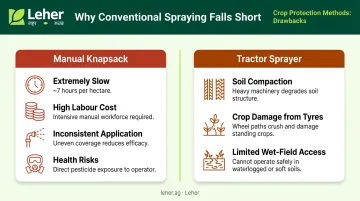
The knapsack sprayer is a common sight on Indian farms, but it is also a major bottleneck. This method is incredibly labour-intensive and extremely slow. A 2024 study on sprayer performance found that a manual knapsack sprayer covers just 0.145 hectares per hour, meaning a single hectare takes nearly seven hours to complete.
This slow pace creates several problems:
- Labour Shortages: Finding enough workers during critical spraying windows is a growing challenge. A study in Karnataka found over 91% of farmers had to hire labour from other regions during peak seasons, driving up costs and causing delays.
- Inconsistent Application: Manual application often results in uneven coverage, with some areas receiving too much chemical and others too little, leading to wasted inputs and ineffective pest control.
- Health Risks: The physical toll on labourers is immense. An Indian study revealed that many workers operate with minimal safety gear, with 35% of those surveyed spraying barefoot, leading to direct chemical exposure.
Tractor-Mounted Boom Sprayers
Tractors offer a significant speed advantage over manual methods, with studies showing they can cover over 2 hectares per hour. However, this speed comes at a high price. The weight and movement of heavy machinery introduce significant challenges that can undermine crop health and reduce profitability.
Key challenges include:
- Soil Compaction: Heavy tractor wheels compress the soil, restricting root growth, reducing water absorption, and ultimately harming crop development.
- Crop Damage: In standing crops like sugarcane, cotton, or dense paddy, tire tracks can trample and destroy a significant portion of the plants, directly reducing your final yield.
- Limited Accessibility: Tractors are useless in wet or flooded fields, a common scenario for paddy cultivation. They also struggle with uneven or sloped terrain, leaving parts of your field unsprayed and unprotected.
Beyond direct crop damage, the time lost to refilling massive water tanks and navigating field boundaries further erodes the tractor's efficiency. These compounding issues make it a costly and often damaging compromise.
How Drone Technology Revolutionises Spraying Speed
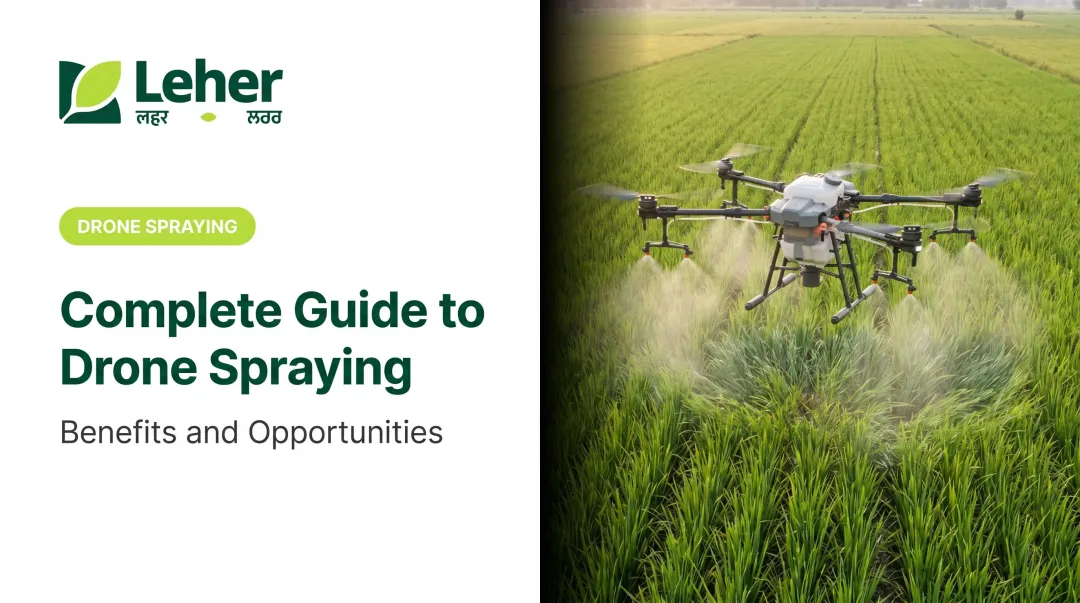
Agricultural drones fundamentally change the equation for field coverage. By operating from the air, they are completely unaffected by ground conditions like wet soil, uneven terrain, or crop height. This allows them to cover vast areas at a speed traditional methods simply cannot match.
According to a report by the Indian Council of Agricultural Research (ICAR), a drone can spray a hectare of potatoes in less than 15 minutes. Compare that to the nearly seven hours required for manual spraying.
Commercial service providers report even faster speeds, with one drone treating 3 to 4 acres in just 15-20 minutes. For a farmer, this means a task that once took an entire day can now be finished before lunch.
Key Features Driving Unmatched Efficiency
This incredible speed isn't just about flying fast. It's the result of a combination of intelligent technologies working together.
- Plans optimal flight paths using digital maps, flying autonomously to cover the entire field efficiently and without overlaps.
- Deploys multiple drones as a coordinated "swarm" to cover hundreds of acres in a single day for large farms or FPO contracts.
- Uses efficient centrifugal nozzles to create a fine mist that penetrates the crop canopy and sticks to leaves, reducing chemical waste.
- Operates in conditions unsuitable for tractors, such as on wet soil or dewy mornings, extending the available hours for spraying.
Beyond Speed: The Precision Advantage of Modern Spraying Tech
While the speed of drone spraying is impressive, the technology’s true power lies in its precision. Faster coverage is only one part of the story; using fewer resources to achieve better results is where drone technology makes the biggest impact.
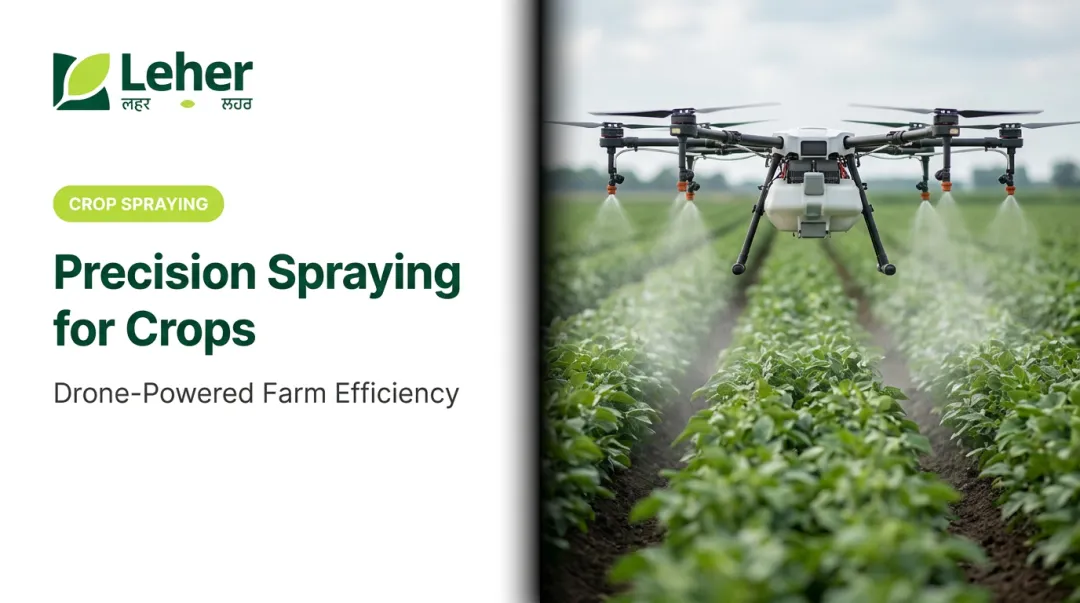
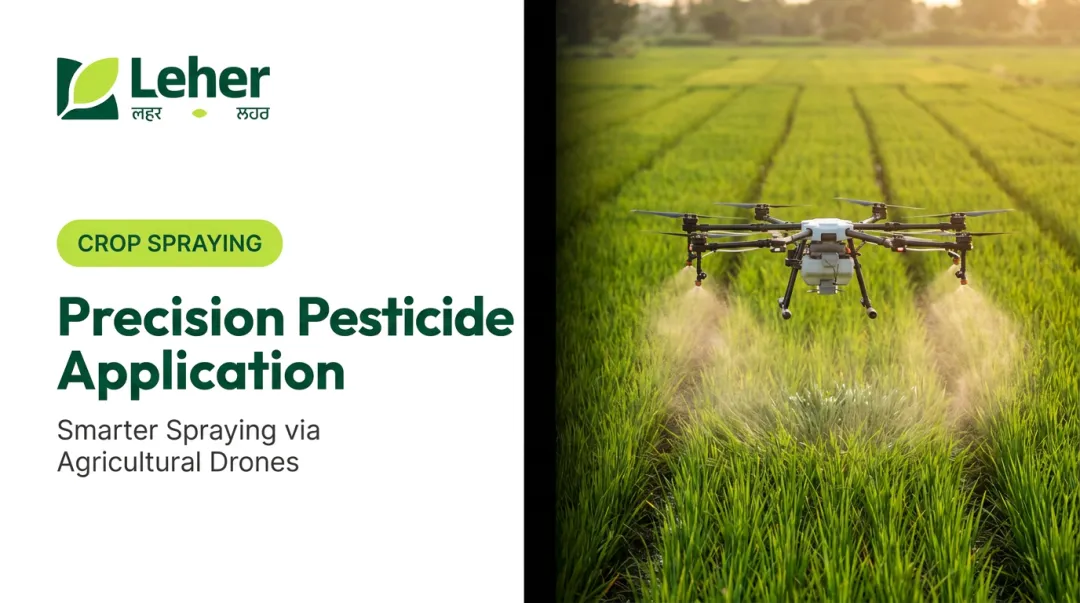
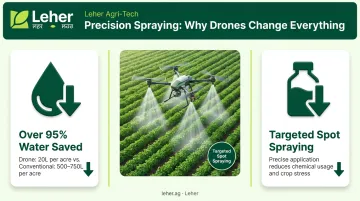
Drones fly at a consistent, low altitude, targeting only the plant canopy. This method dramatically reduces chemical waste and water use compared to ground-based sprayers that often drench the soil.
An ICAR report highlighted this efficiency, noting that drone spraying for potatoes used just 20 litres of water per hectare. This contrasts sharply with the 500-750 litres for conventional methods—a water saving of over 95%.
For farmers using Leher's services, this precision directly translates into helping them reduce pesticide use and save enormous amounts of water.
This precision also enables targeted techniques like spot spraying. If a pest outbreak is confined to one section of a field, a drone can be programmed to treat only that area. This approach saves significant time, chemicals, and money compared to blanket-spraying the entire field.
The Ripple Effect: Benefits of Faster Field Coverage
Spraying your fields in hours instead of days delivers a ripple effect of benefits for your entire farming operation, from crop health to your final profit margin.
Enhanced Crop Health and Higher Yields
Pests and fungal diseases can spread with alarming speed. A delay of even a few days in applying fungicides or pesticides can lead to irreversible damage.
- Respond to threats immediately, identifying a problem in the morning and spraying the affected area by the afternoon to stop outbreaks.
- Apply vital inputs with perfect timing, ensuring foliar nutrients and growth promoters are used at the optimal stage for maximum impact.
Improved Resource Management and Profitability
Faster operations are more efficient operations, leading to significant financial savings.
- Reduce labour costs, as one drone operator can cover the same area as a large team of manual sprayers in a fraction of the time.
- Lower input expenses through precision application, which saves significant amounts of chemicals and water.
- Save on fuel and maintenance by replacing heavy tractors with efficient, battery-powered drones.
Getting Started with Drone Spraying: A Practical Guide for Farmers
Adopting drone technology might seem complex, but it's more accessible than ever. The first step is to assess your farm's needs—consider your total acreage, crop types, and terrain. For most farmers in India, the most practical and cost-effective way to use this technology is not by buying a drone, but by partnering with a professional service provider.
Partnering with a Drone Service Provider like Leher
Hiring a service like Leher eliminates the major hurdles of drone ownership: high capital investment, complex pilot training, navigating regulations, and handling maintenance.
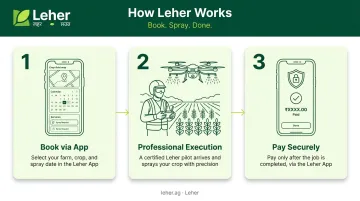
Here’s how the Leher process works:
- Book the service via the Leher App by selecting your specific crop and acreage in just a few clicks.
- Get professional execution from a trained, DGCA-certified pilot who arrives with all equipment, finalises the spray plan, and completes the job with precision.
- Pay securely after the service is completed to your satisfaction, directly through the app.
This service model gives you all the benefits of drone technology without the headaches of ownership, helping you transform spraying operations from days to hours.
Contact Leher today to schedule a consultation and see how drone spraying can work for your farm.
Frequently Asked Questions
How much faster is drone spraying than manual spraying?
Drone spraying is dramatically faster. A drone can cover a hectare in under 15 minutes, while the same area can take a manual labourer with a knapsack sprayer nearly seven hours to complete. This makes drone spraying more than 25 times faster.
Are agricultural drones effective for all crop types?
Drones are effective for a wide range of crops like paddy, sugarcane, and cotton. While canopy density can be a factor, they are ideal for conditions where ground machinery cannot operate, ensuring broad suitability.
What is the cost of drone spraying services for a small farm?
Costs are typically calculated on a per-acre basis. When you factor in the significant savings on labour, water, and chemicals, the final cost of drone spraying is highly competitive with traditional methods and often results in overall savings.
How do drones ensure even spray coverage across the entire field?
Drones follow pre-programmed flight paths at a consistent altitude to ensure uniform coverage. Advanced nozzles create a fine mist, resulting in a precise application that is often more even than manual or tractor spraying.
Do I need any special permits to use a drone spraying service on my farm?
No, you don't need any permits. A professional service provider like Leher handles all licensing and compliance. Our pilots are DGCA-certified and our drones are government-approved, ensuring a completely hassle-free process for you.