Introduction
Global agriculture is under pressure from multiple directions at once. According to the FAO, food production must rise by 70% by 2050 to feed a projected 9.1 billion people — yet arable land is expected to expand by only 5% over the same period. In India, where the average farm holding is under 1.4 hectares and over half of cropland depends on monsoon rainfall, rural labor is migrating to cities, input costs are climbing, and erratic seasons are making year-to-year planning increasingly unreliable.
Traditional farming methods — blanket pesticide spraying, flood irrigation, manual scouting — were never designed for these conditions. The gap between what these methods can deliver and what the coming decades demand is widening fast.
Modern agricultural technology — satellite crop monitoring, IoT soil sensors, precision drone spraying — is giving farmers measurable tools to cut water use, reduce input waste, and cover more ground per day.
This blog covers the key agritech solutions reshaping farming today, why India's smallholder landscape makes adoption both urgent and achievable, and what precision drone technology looks like when it actually reaches the field.
Key Takeaways
- Agritech applies AI, IoT, drones, and data analytics to make farming more productive and resource-efficient
- Key solutions span precision farming, smart irrigation, crop health monitoring, and farm management software
- 86.2% of Indian farmers operate small or marginal holdings — making affordable, service-based agritech models essential
- Drone spraying covers up to 50 acres/day vs. 3 acres manually — with ~40% input savings
- Pay-per-service models remove the biggest barrier to adoption — no upfront equipment cost for farmers
What Is Agritech and Why Does Modern Farming Need It?
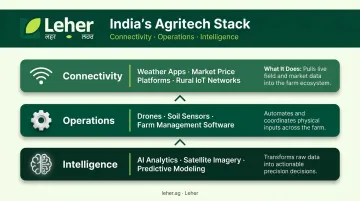
Agritech covers the full range of tools that help farmers grow more with less — mobile weather apps, GPS-guided machinery, AI-powered crop diagnostics, and everything in between. It's less a single technology than a layered system built around one goal: making farming more reliable and efficient.
That system breaks down into three working layers:
| Layer | Examples | What It Does |
|---|---|---|
| Connectivity | Weather apps, market price platforms, rural IoT networks | Links farmers to information and markets |
| Operations | Drones, soil sensors, farm management software | Improves how inputs are applied and tracked |
| Intelligence | AI analytics, satellite imagery, predictive modeling | Turns data into decisions |
The Core Problem Agritech Solves
The FAO puts the challenge in clear terms: 80% of production growth in developing countries must come from yield improvements and higher cropping intensity — not from expanding farmland. For India, where arable land per farmer has been shrinking for decades, that constraint is already a daily reality.
Add shrinking rural labor pools, groundwater depletion, and erratic monsoons, and the pressure intensifies. Farming needs to produce more from the same land, with fewer hands and less water. Agritech provides the tools to do that — not as a future possibility, but as working infrastructure available to farmers today.
Key Agritech Solutions Transforming Agriculture Today
Precision Farming
Precision farming uses GPS, sensors, and real-time field data to apply water, fertilizer, and pesticides exactly where they're needed — rather than uniformly across an entire field. The goal is to eliminate waste while maintaining or improving crop outcomes.
The input savings are well-documented. USDA research found precision technologies on corn farms saved $13–$25 per acre, while USDA ARS data shows precision agriculture can reduce fertilizer application by up to 40%. Across a full season, those savings stack up fast on thin operating margins.
For Indian farmers dealing with thin margins, reducing input waste by even 20–30% can be the difference between a profitable harvest and a breakeven one.
AI and Crop Health Monitoring
FAO estimates that up to 40% of global food crops are lost annually to plant pests. Most of that loss is preventable if farmers can detect problems early enough to act.
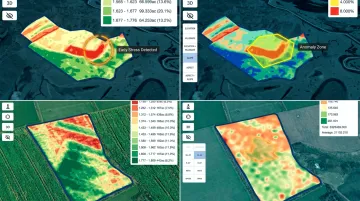
AI-powered platforms and satellite or drone imagery make early detection practical. Instead of a farmer noticing wilting leaves during a weekly walk-through, AI systems flag anomalies in crop color or density before visible damage appears.
That shift — from reactive to proactive — matters enormously. Treating a small patch costs a fraction of what a field-wide outbreak demands, in both inputs and lost yield.
IoT and Smart Sensors
Soil moisture sensors, connected weather stations, and field monitoring devices give farmers real-time visibility into what's actually happening underground and in the canopy — not just what they can see on the surface.
The water savings evidence is strong. A 2023 peer-reviewed review on soil water sensors found average water-use reductions of 38% versus traditional scheduling and 16% versus evapotranspiration-based scheduling. These systems are also now affordable at the smallholder scale, with MIT D-Lab and others documenting progress in low-cost sensor design specifically for smallholder contexts.
Farm Management Software
Paper records and memory-based decision-making are standard across much of rural India. Digital farm management platforms change that. They help farmers track inputs, expenses, task schedules, and compliance documentation in one place.
When farmers have clear records of what was sprayed, when, and at what cost, they can make sharper decisions next season and meet documentation requirements from buyers or FPOs. That kind of audit trail also unlocks access to formal credit and certification programs that paper-based farms routinely miss out on.
Market Access and Fintech Platforms
Post-harvest and market access losses are a major drag on farmer income. India's Ministry of Food Processing Industries estimated total harvest and post-harvest losses at approximately ₹1,52,790 crore based on 2020–21 data. Agritech platforms that connect farmers directly to buyers, provide real-time price data, and offer digital insurance or lending services directly reduce that gap.
Initiatives like PMFBY have expanded crop insurance reach — non-loanee farmer coverage reached 55% of total coverage in 2023–24 — but digital fintech integration still has significant room to grow for smallholders.
Drone Technology: The Precision Farming Breakthrough
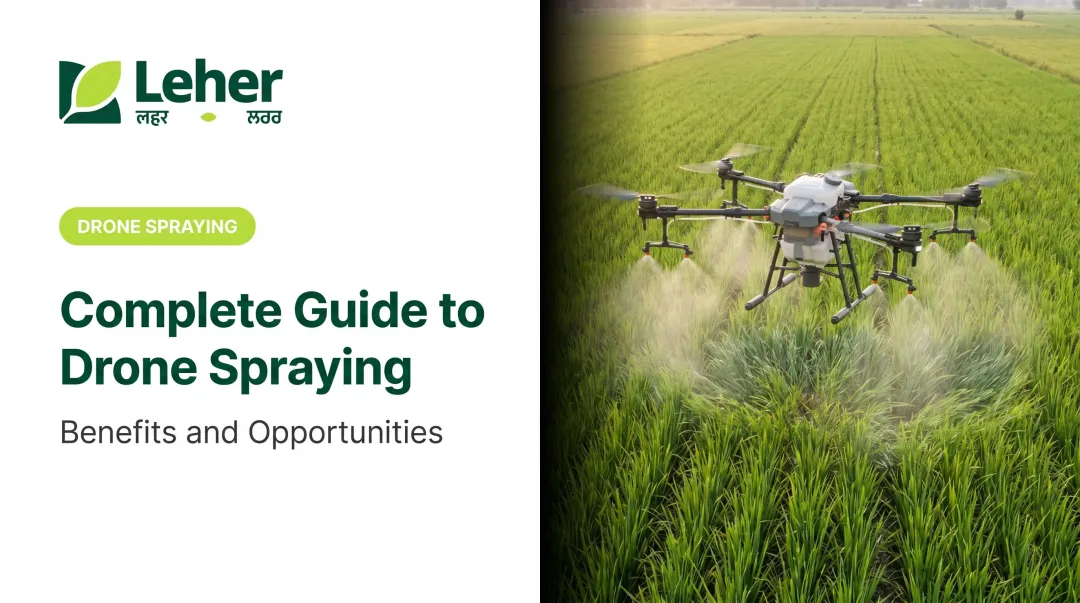
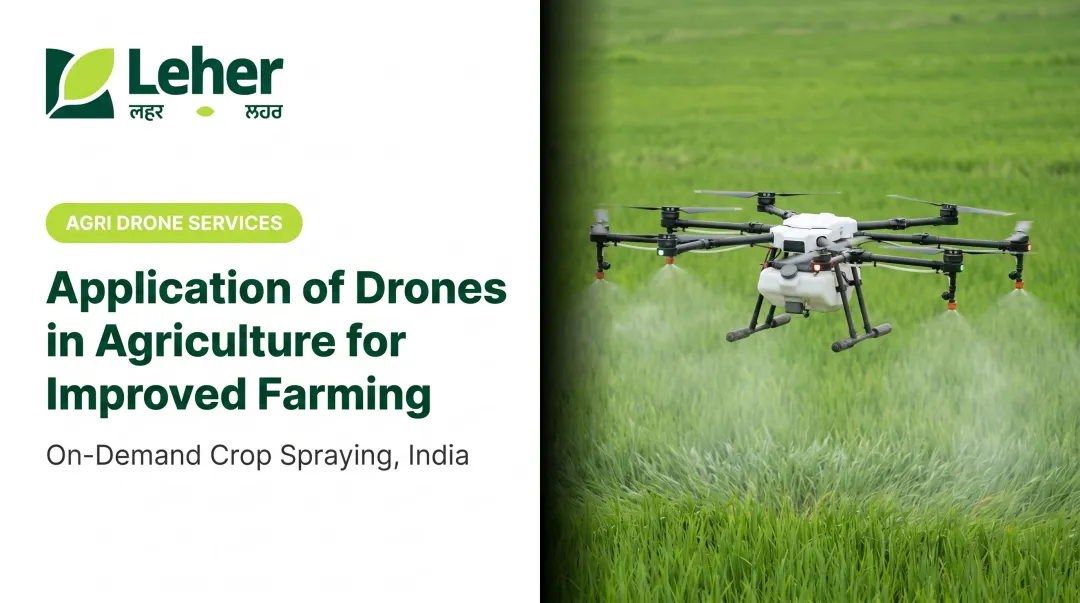
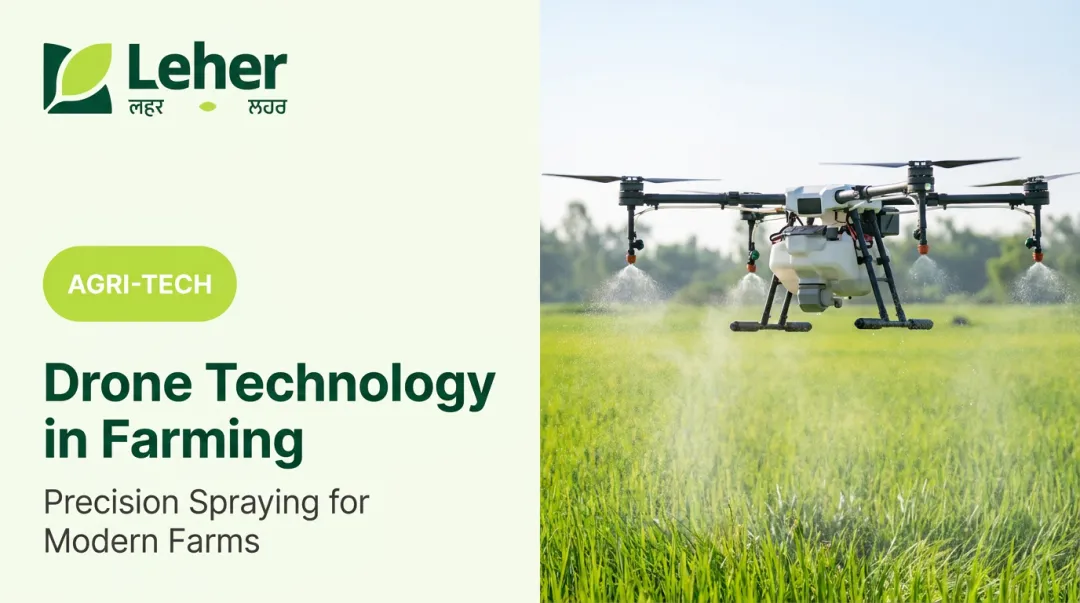
Agricultural drones are equipped with precision spraying systems and GPS guidance that enables targeted, even distribution of inputs across a field. They operate at low altitude, applying pesticides, foliar fertilizers, or weedicides in fine, controlled droplets — reaching the canopy more effectively than ground-based boom sprayers in dense or irregular crop configurations.
Coverage Speed Changes Everything
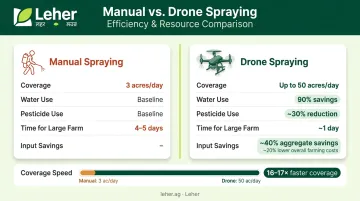
The efficiency gap between drone spraying and manual methods is stark. Manual spraying covers roughly 3 acres per day. Leher's drone spraying service achieves up to 50 acres per day — approximately 16–17 times greater daily coverage — with a single certified operator. At around 5 minutes per acre, a farmer with a 10-acre holding can have an entire crop treated in under an hour.
This matters most during narrow treatment windows, when pest or disease pressure requires rapid, field-wide response. A manual crew that takes 4–5 days to cover a large farm may be arriving too late.
Input Efficiency Gains
Precision delivery means chemicals go where they're needed, not where gravity and wind carry them. Leher's drone spraying service reports approximately 90% water savings and around 30% pesticide reduction compared to conventional ground spraying, contributing to ~40% aggregate input savings and ~20% lower overall farming costs.
Independent research backs this directional picture: a 2025 peer-reviewed review found 30% chemical-waste reduction and 25% water saving from drone spraying — figures that align closely with what Leher's field operations consistently report.
Real-World Scale in India
In 2024, Leher served 6,500+ acres and supported 810+ farmers across India, covering crops including sugarcane, paddy, cotton, wheat, and vegetables. In plantation agriculture specifically, Leher has sprayed over 700 hectares of tea (with around 75% less residue per kg of tea) and over 1,000 hectares of rubber (with up to 50% savings per hectare per round).
At this scale, drone agritech moves well beyond proof-of-concept — it's active infrastructure for Indian farming.
Rural Employment as a Co-Benefit
Beyond the farms being sprayed, drone agritech creates livelihoods. Leher's Drone Partner Program recruits rural entrepreneurs as certified drone operators — handling their DGCA training, AIF loan facilitation, drone insurance, and 24/7 technical support. The company currently has 100+ drone partners and is targeting 1,000 rural drone entrepreneurs by 2030. Each partner represents a new rural business, not just a job.
Agritech in India: Opportunities, Challenges, and the Road Ahead
The Smallholder Reality
India's Agriculture Census 2015–16 found that 86.2% of operational holdings are small or marginal, with marginal holdings alone accounting for 68.5%. This shapes how agritech must be designed and delivered at scale.
An individual farmer with 1–2 acres cannot justify purchasing a ₹5–10 lakh drone. But they can pay per acre for a drone spraying service booked through a mobile app and delivered by a local trained operator. The service model — rather than the ownership model — is what makes precision agriculture accessible at India's scale.
Government Tailwinds
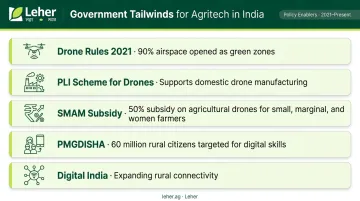
India's policy environment is actively supporting agritech adoption:
- Drone Rules 2021 opened nearly 90% of Indian airspace as green zones for drones up to 400 feet
- PLI scheme for drones (notified September 2021) supports domestic drone manufacturing
- SMAM subsidy provides 50% subsidy on agricultural drones for small, marginal, and women farmers
- PMGDISHA targets 60 million rural citizens for digital skills development
- Digital India initiatives continue to expand rural connectivity infrastructure
Adoption Barriers
The opportunity is real, but so are the friction points:
- Digital literacy gaps leave many farmers unfamiliar with app-based platforms
- Patchy internet in remote agricultural areas limits real-time data tools
- Equipment ownership costs remain out of reach for most smallholders
- Limited direct exposure to proven results breeds reasonable skepticism
None of these are permanent. Service models like Leher's "Book | Spray | Pay" app structure sidestep the equipment cost barrier entirely. Ground-level results matter too — Leher served 810+ farmers across 6,500+ acres in 2024 alone, and that kind of documented, neighbor-visible impact shifts skepticism faster than any awareness campaign.
Market Outlook
Those barriers don't diminish the market — they define where the work is. Invest India estimates the Indian agritech opportunity at USD 24 billion by 2025, with current market penetration at just 1%. For companies building homegrown precision agriculture solutions, that 99% untapped share is both the challenge and the mandate.
How to Evaluate and Adopt the Right Agritech Solution
Not every agritech tool fits every farm. A rubber plantation in Kerala has different needs than a wheat farm in Punjab or a smallholder paddy operation in Odisha. Before evaluating solutions, map your actual pain points:
- Where are you losing money — input overuse, pest damage, post-harvest losses, labor costs?
- What's your farm scale and crop type?
- Do you need to own technology or just access it as a service?
What to Look For in a Provider
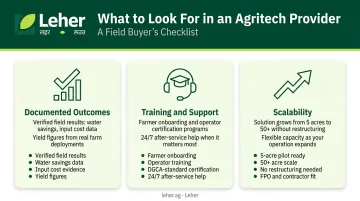
When shortlisting providers, evaluate on three criteria:
- Documented outcomes. Ask for verified field results — water savings, input cost reductions, yield data from actual operations. These carry far more weight than marketing claims.
- Training and ongoing support. Technology without support fails quickly, especially in rural contexts. Look for farmer onboarding, operator training, and responsive after-service help. Leher, for instance, pairs DGCA-certified pilot training with 24/7 partner support and app-based service tracking.
- Scalability. Start small if needed, but confirm the solution can grow with your operation — 5 acres this season should not require a completely different arrangement at 50 acres next year.
Frequently Asked Questions
What is the meaning of agritech solutions?
Agritech solutions are technologies — including AI, IoT, drones, satellites, and data platforms — applied across the agricultural value chain to improve productivity, reduce input waste, and connect farmers to markets. They address challenges from field-level crop health to post-harvest logistics.
How are drones used in modern farming?
Agricultural drones handle precision spraying of pesticides, foliar fertilizers, and weedicides, and can cover up to 50 acres per day — a fraction of the time manual application requires. Many are also equipped for field mapping and crop health surveillance via multi-spectral imaging.
What are the benefits of precision farming for smallholder farmers in India?
Precision farming helps smallholders reduce wasteful spending on water, chemicals, and labor — inputs that represent a disproportionately high share of costs on small holdings. It also provides access to data-driven crop advisory that was previously available only to large commercial operations.
How does agritech help reduce water and pesticide use?
Targeted delivery technologies — drone spraying and IoT-based smart irrigation — apply inputs only where and when needed, eliminating the overuse inherent in blanket application. Drone spraying alone can cut water use by up to 90% and reduce pesticide consumption by up to 30% compared to conventional methods.
What challenges do Indian farmers face in adopting agritech?
The main barriers are limited digital literacy, high equipment costs, patchy rural internet, and low awareness of available solutions. Service-based models where farmers pay per session rather than owning equipment are the most practical response to these constraints.
Is agritech affordable for small and marginal farmers?
Many agritech models are specifically designed for smallholder access. Drone-as-a-service offerings like Leher's pay-after-completion model and FPO-coordinated spraying contracts remove the need for large capital investment, making precision agriculture financially accessible even on 1–2 acre holdings.