Introduction
Indian agriculture is under real pressure. Average farm holdings have shrunk to 1.08 hectares as of 2015-16, input costs keep climbing, and yields stay unpredictable season after season.
Conventional farming makes this worse by treating entire fields as uniform units — applying water, pesticides, and fertilisers in blanket doses regardless of what different zones actually need.
Precision agriculture addresses this directly — but the term gets used far more often than it gets explained.
This article explains what precision agriculture actually means on the ground, what measurable advantages it delivers for Indian farmers, and what continued reliance on conventional methods is costing them.
Key Takeaways
- Precision agriculture applies inputs — water, fertilisers, pesticides — only where and when crops need them, replacing blanket field treatment with site-specific, data-driven management
- Key outcomes: lower input costs, more consistent yields, and reduced soil and water degradation
- Conventional irrigation wastes 65–75% of water applied — drone spraying cuts water use by up to 90%
- Farmers also see up to 40% savings on inputs and roughly 20% reduction in overall spraying costs
- Drone-based precision spraying is the most accessible entry point for Indian smallholder farmers today — no equipment ownership needed
What Is Precision Agriculture?
Precision agriculture is a farm management approach that uses real-time data and technology to decide when, where, and how much of any input to apply — rather than treating an entire field the same way.
The core idea is simple: fields are not uniform. Soil moisture varies from one corner to another. Pest pressure builds in specific patches before spreading. Nutrient deficiencies concentrate in certain zones. Blanket applications can't respond to this variability — they just average it out, which means over-applying in some areas and under-applying in others.
Precision agriculture corrects this by collecting and acting on field-level data. Technologies involved include:
- GPS and satellite mapping for spatial field data
- Sensors and drones for real-time crop and soil monitoring
- NDVI imaging to detect crop health variation before it's visible to the naked eye
- Variable-rate application systems that adjust input doses zone by zone
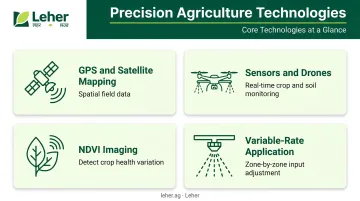
The UNDP defines precision agriculture as focused on the precise use of seeds, water, fertilizers, and pesticides through mobile phones, satellites, UAVs, and on-site sensors — a definition that fits Indian smallholder conditions well.
In practice, it applies across crop protection, irrigation, soil mapping, and yield monitoring — spanning field crops, horticulture, and plantation crops. The goal is reducing input waste and protecting farm margins through decisions grounded in actual field data.
Key Advantages of Precision Agriculture
Each advantage below translates directly into field-level outcomes: lower costs, better yields, and a farm that stays productive season after season.
Advantage 1: Significant Reduction in Input Waste
Conventional farming applies water, pesticides, and fertilisers at fixed rates across an entire field. In practice, this means some zones receive far more than they need while others receive too little — neither outcome is efficient.
The water waste problem is the most quantified. According to an IIMA study supported by India's Ministry of Agriculture, conventional irrigation water-use efficiency in India is only 25–35% — meaning 65–75% of water applied is not productively used.
Agriculture already accounts for approximately 90% of groundwater extraction nationally. Continuing at this rate in water-stressed states like Haryana and Rajasthan is not a viable path.
Precision agriculture corrects this through site-specific management. Sensors, soil maps, and drone-based spraying target only the areas that need treatment, at the right dose.
Leher's drone spraying service, for instance, delivers approximately 90% water savings and 40% input savings compared to conventional ground-based methods — translating to around 20% lower farming costs per acre for farmers who use it. Those savings don't require higher output prices. They come entirely from doing less of what wasn't needed.
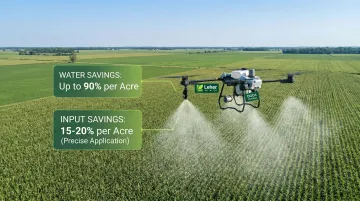
KPIs directly affected:
- Input cost per acre
- Water consumed per kg of yield
- Pesticide volume applied per season
- Overall cost of cultivation
This advantage matters most on high-value crops, in water-scarce regions, and wherever pesticide or fertiliser expenditure represents a large share of operating costs — which, for most Indian smallholders, is most of the time.
Advantage 2: Better Crop Health and More Consistent Yields
No two sections of a field perform identically. Soil moisture, nutrient availability, and pest pressure all vary spatially — and blanket treatments don't account for any of it.
Research from ICAR-affiliated scientists puts national biotic stress losses at 33% of yield — including 9.5% from insects and 6.5% from diseases. In wheat trials specifically, unprotected plots lost between 10.69% and 12.07% of yield. These aren't worst-case scenarios; they're documented field outcomes from normal growing seasons.
The connection to precision agriculture is direct: most of these losses happen because problems aren't caught early enough and aren't spatially targeted when they are caught.
Precision tools — drone imaging, NDVI data, field sensors — allow farmers to detect disease hotspots, pest concentration, or nutrient stress before problems spread. Acting early costs far less than treating an infestation that's already across half the field.
What this looks like in practice:
- Drone imagery flags early pest pressure in a section of a paddy field
- Spraying is deployed to that zone specifically, at the right dose, before the infestation spreads
- The rest of the field receives no unnecessary chemical load
- Marketable yield improves because the crop developed more uniformly
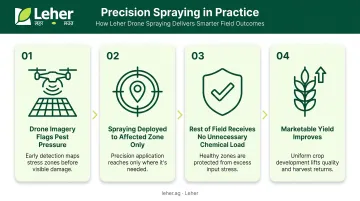
For cotton farmers, the UNDP notes pink bollworm alone destroys 20–30% of India's cotton crop annually, affecting around 6 million farmers. Early, targeted intervention is the only way to reduce that figure without simply applying more chemicals across the board.
KPIs directly affected:
- Yield per acre
- Percentage of marketable produce
- Crop loss rate per season
- Number of unplanned reactive spray rounds
Advantage 3: Long-Term Environmental and Soil Sustainability
The consequences of conventional over-application don't show up in one season. Soil biology degrades, groundwater quality drops, and the farm's productive capacity erodes — across years, not months.
India's National Action Plan on combating desertification cites the SAC's 2021 atlas: 97.85 million hectares — nearly 30% of India's geographical area — was under land degradation or desertification as of 2018-19.
Not all of that is attributable to agrochemical overuse, but repeated over-application of fertilisers and pesticides contributes directly to soil health decline, microbial disruption, and runoff contamination.
Precision agriculture reduces this chemical load by calibrating applications to actual need. Less chemical per hectare means:
- Better preservation of soil microbiology
- Lower residue accumulation in produce
- Reduced runoff into water bodies and aquifers
Export markets are also raising the stakes. APEDA maintains an international pesticide MRL (Maximum Residue Limit) database because importing countries — particularly in the EU — enforce strict chemical residue standards on Indian agricultural exports. Farmers supplying export markets or premium domestic buyers increasingly need to document reduced chemical usage. Precision agriculture creates that documentation by design.
Healthier soil also requires progressively fewer inputs to deliver the same yield — meaning the cost savings from precision agriculture widen over time, not just in the first season it's applied.
KPIs directly affected:
- Soil organic matter and microbiology over 3–5 seasons
- Chemical residue in produce at harvest
- Compliance with agribusiness and export buyer standards
- Input cost trajectory over multiple seasons
What Happens When Precision Agriculture Is Ignored
Avoiding precision agriculture carries a real cost — one that grows larger with every season it goes unaddressed.
Without site-specific data, farmers default to blanket applications. That creates a specific set of structural risks:
- Persistent yield inconsistency from undetected soil variability or late pest response — the 10–12% avoidable wheat losses cited in ICAR research are a direct example
- Rising per-acre costs as input prices increase without any corresponding efficiency gain from targeted use
- Progressive soil and water depletion that reduces the farm's long-term productive capacity with no visible warning signs until yield data or soil tests reveal the decline
For Indian smallholder farmers operating on thin margins — average landholding of 1.08 hectares, limited access to credit, no buffer for a failed season — a single bad year from late pest detection or water mismanagement can push a household into debt that takes years to recover from.
The risks are systemic: each season without better data makes the next one harder to manage.
How to Get the Most Value from Precision Agriculture
Precision agriculture delivers its full value as a consistent practice, not a one-time experiment. Data collected over one season is useful. Data compared across three seasons reveals patterns that drive real decisions.
A practical starting point for Indian farmers:
- Start with drone-based precision spraying — the most accessible and immediately cost-effective entry point; no capital investment required, and the input savings show up in the same season
- Layer in soil testing after the first season to understand field variability and inform nutrient applications
- Add yield tracking to identify which zones and management decisions drive the best output
- Review records at season's end — spray logs, input volumes, and yield outcomes by section reveal where the gains came from and where to adjust
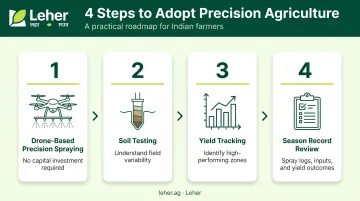
Leher's drone spraying service is built specifically to remove the capital barrier. Farmers book through the Leher App, a DGCA-certified pilot arrives and sprays, and payment happens only after the job is done — no equipment purchase, no upfront cost, no minimum farm size requirement.
Coverage runs up to 50 acres per day, with documented savings of up to 90% on water use and 40% on input volumes — results that show up in the same season, regardless of farm size.
The data only has value when it drives decisions. A spraying history log tells you what was applied, where, and at what cost — that record becomes the baseline every future season is measured against.
Conclusion
The core value of precision agriculture is control — over inputs, over costs, and over what happens across a field during a season. That control compounds: every season of consistent data collection makes the next season's decisions more accurate.
As input costs rise, water scarcity intensifies across states like Punjab, Haryana, Maharashtra, and Andhra Pradesh, and buyers from agribusinesses to export markets raise documentation requirements for chemical use — including APEDA residue standards and EU import limits — precision agriculture shifts from a competitive advantage into an operational baseline. Farms that build these systems now accumulate seasons of usable data, tighter input control, and documented compliance history. Each season without them is a season of costs and risks that won't recover on their own.
Frequently Asked Questions
What do you mean by precision agriculture?
Precision agriculture is a data-driven farm management approach that uses technology — GPS, sensors, drones — to manage fields site-specifically. Rather than applying inputs uniformly across an entire field, it targets applications to where and when they're actually needed, reducing waste and improving outcomes.
What are the 5 R's of precision farming?
The 5 R's are Right product, Right rate, Right time, Right place, and Right method. Together, they form the framework for deciding when and how any agricultural input should be applied to achieve maximum efficiency and minimum waste.
What is an example of precision agriculture?
Drone-based precision spraying is a clear example. A drone maps a field and identifies which zones have pest pressure or nutrient deficiency. It then applies pesticide or fertiliser only to those areas at the correct dosage, skipping zones that don't need treatment.
What is another name for precision farming?
Precision agriculture is also called precision farming, site-specific crop management (SSCM), or smart farming. All terms describe the same approach: using data to vary management practices across a field rather than applying blanket treatments.
What is the difference between precision agriculture and traditional farming?
Traditional farming applies inputs at fixed rates across entire fields, regardless of variability between zones. Precision agriculture uses field data to tailor applications zone by zone, reducing over-application in some areas and under-application in others. The result is less waste and better crop outcomes overall.
How does precision agriculture benefit Indian farmers specifically?
Indian farmers working on small holdings with tight margins benefit most from lower input costs and reduced water consumption, both critical in water-stressed regions like Haryana and Rajasthan. Targeted application also improves crop protection outcomes without needing higher output prices to see a return.