Introduction
Walk through any Indian village during kharif season and you'll spot them — farm workers bent under the weight of 16-litre knapsack sprayers, trudging row after row under the afternoon sun. This has been the backbone of crop protection for Indian smallholders for decades, and with over 31 million operational holdings using hand-operated sprayers (as recorded in the 2016-17 Input Survey), manual spraying remains deeply embedded in Indian farming.
But the economics are shifting fast. Agricultural labour is harder to find — the PLFS 2025 report shows agriculture's employment share fell from 44.8% in 2024 to 43.0% in 2025 — and input costs have risen in step. These twin pressures have pushed farmers to look harder at alternatives.
Drone spraying has moved from novelty to accessible reality. Government schemes like Namo Drone Didi have committed ₹1,261 crore to put 15,000 drones into Women SHG hands, bringing the technology within reach of smallholders who once couldn't consider it.
What most farmers want to know now is straightforward: when you count everything — labour, inputs, time, yield — which method costs less? That's exactly what this article works through.
Key Takeaways
- Manual spraying's true cost per acre is higher than it looks once labour, chemical overuse, and repeat spraying are counted
- Drone spraying uses roughly 8–10 litres of water per acre versus 210–253 litres for knapsack spraying — a stark gap in water-scarce states
- Drone spraying services cost approximately ₹300–700 per acre without requiring equipment purchase
- A drone can spray 1 acre in under 10 minutes; a single manual worker covers roughly 1–2 acres per day
- On farms of 3 acres or more, drone spraying typically wins on total cost once labour, chemical waste, and speed are counted
Manual Spraying vs Drone Spraying: Quick Comparison
| Dimension | Manual Knapsack Spraying | Drone Spraying Service |
|---|---|---|
| Upfront equipment cost | ₹800–₹3,000 (sprayer only) | ₹0 (service model, no equipment purchase needed) |
| Per-acre service fee | Variable (labour + chemicals + water) | ~₹300–700/acre (market rate) |
| Coverage rate | ~1–2 acres/day per worker | 1 acre in under 10 minutes; up to 50 acres/day |
| Water use per acre | 210–253 litres | 8–10 litres |
| Pesticide efficiency | Uneven; over-application common | 30–40% reduction in pesticide use |
| Labour required | 1–2 workers per acre per session | 1 drone pilot for entire farm |
| Chemical exposure risk | High — direct contact for operators | Minimal — pilot operates remotely |
| Re-spraying frequency | Higher due to uneven coverage | Lower due to consistent droplet distribution |
These figures reflect average Indian field conditions based on peer-reviewed research, official government SOPs, and published market data. Actual results vary by crop type, terrain, farm size, and region.
What Is Manual Spraying?
In the Indian agricultural context, manual spraying means using a hand-pumped or battery-assisted knapsack sprayer — typically a 16–20 litre tank worn on the back — to apply pesticides, herbicides, and foliar nutrients across the crop canopy. It remains the dominant method for smallholders, with an estimated 90%+ of India's 140 million farm households still relying on it.
The Cost Structure
The entry cost is low. A basic knapsack sprayer runs ₹800–₹3,000 (a SHAKTI-brand unit on GeM is listed at around ₹1,390). That affordability is real.
But operational costs accumulate quickly:
- Labour: One worker typically covers 1–2 acres per day, meaning a 5-acre paddy farm needs 3–5 working days per spray round
- Chemical volume: Knapsack spraying uses 210–253 litres of water per acre, requiring multiple tank refills and making consistent pressure across the entire field difficult to maintain
- Repeat spraying: Uneven coverage — caused by operator fatigue and variable pump pressure — means some patches receive too much chemical and others too little, raising the likelihood of re-treatment
- Frequency: Most field crops require 3–6 spray rounds per season, multiplying all the above costs
The Hidden Costs
Two factors rarely make it into a farmer's mental accounting:
Health exposure is the first. The WHO identifies pesticide applicators as among the highest-risk groups for chemical exposure. India-focused research from Think Global Health reports that roughly 44% of farmers experience pesticide poisoning annually. Workers typically spray without full PPE — a direct health risk that also translates into lost working days during peak season.
Timing gaps are the second. A spray round that takes 4–5 days across a 5-acre farm leaves early-stage infestations untreated in some areas while others are already sprayed. Catching a fungal outbreak on day one versus day four can mean the difference between containment and crop damage.
What Are Modern Spraying Methods?
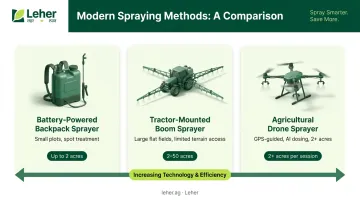
Three modern alternatives are practically relevant for Indian farmers, ordered by technological complexity:
Battery-powered backpack sprayers — motorised pumps reduce physical effort and improve pressure consistency, but navigation and coverage remain manual. Suitable for small plots and spot treatments.
Tractor-mounted boom sprayers — efficient on large, flat fields. Less accessible to smallholders without tractor ownership, and impractical for standing crops, plantations, or uneven terrain.
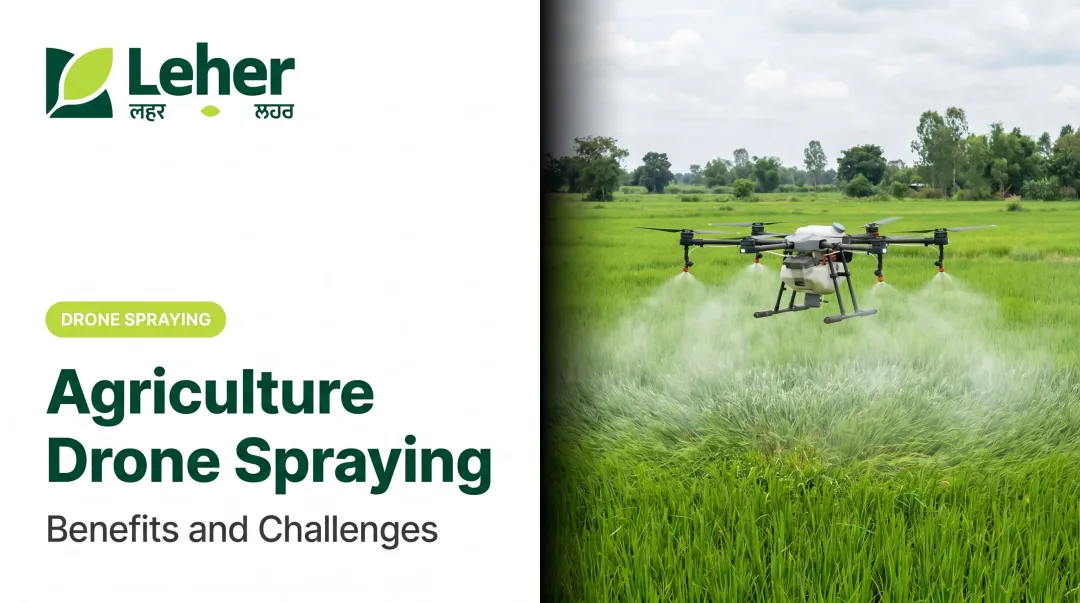
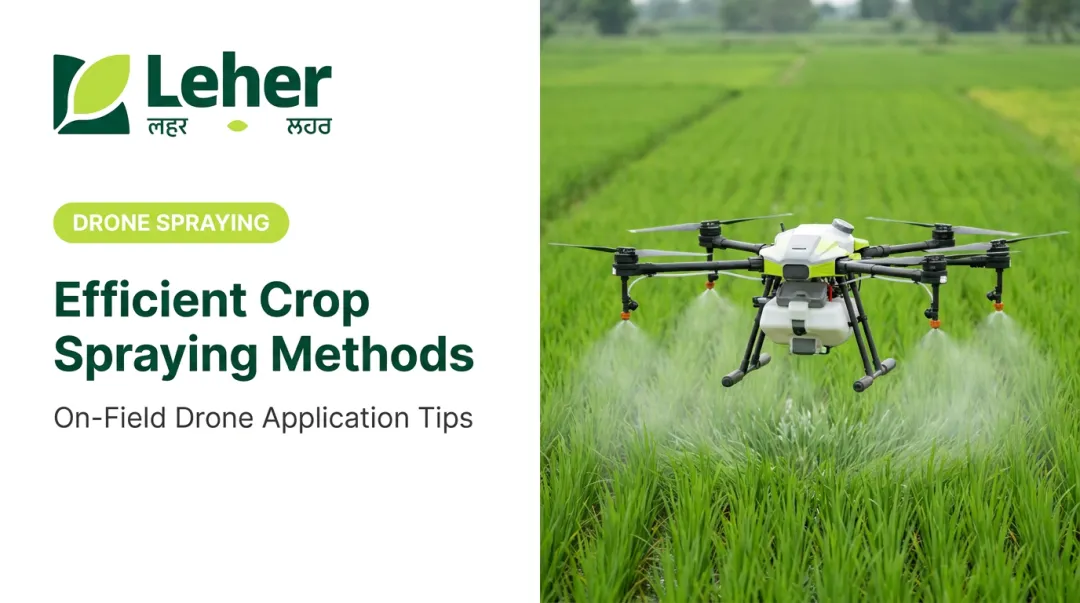
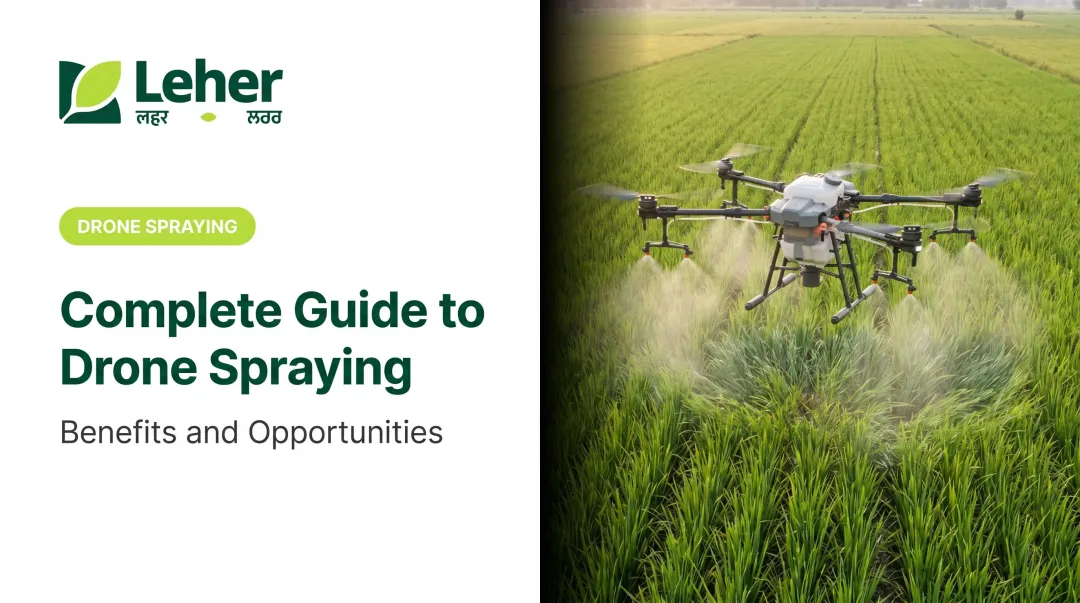
Agricultural drone sprayers — GPS-guided UAVs with precision nozzles, AI-controlled dosing, and consistent spray droplet size. The most efficient option for field crops above 2–3 acres.
Why Drone-as-a-Service Changes the Equation
For most Indian smallholders farming 1–10 acres, buying a drone outright is not realistic. An agricultural spray drone costs several lakhs. This is where the service model matters.
Companies like Leher offer on-demand drone spraying through their app: a farmer books a session, a DGCA-certified pilot arrives and sprays the crops, and payment happens only after the job is done. No drone purchase, no training, no maintenance burden. Per-acre fees in the Indian market currently run approximately ₹300–700/acre.
Key Technical Specs Driving the Efficiency Gap
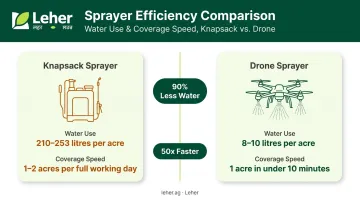
Those service-level advantages are backed by documented performance data. Official government draft SOPs for drone pesticide application specify 20–25 litres per hectare (roughly 8–10 litres per acre). Peer-reviewed research documents knapsack spraying at 520–625 litres per hectare (210–253 litres per acre) — a 90%+ reduction in water use, grounded in official SOP benchmarks and academic comparison studies.
Coverage speed tells the same story. Published benchmarks show drones completing 1 acre in under 10 minutes, while a single manual worker covers 1–2 acres over a full working day.
The True Cost Breakdown
Labour Cost
MGNREGS notified wage rates provide a useful floor for agricultural labour cost. Haryana, one of India's major agricultural states, had the highest notified rate at ₹374/day in 2024–25. Actual agricultural wages in many states run higher during peak season.
For a 5-acre farm needing one spray round:
- Manual spraying: 4–5 labour-days minimum = ₹1,500–₹2,000 in labour alone (before chemicals or water)
- Drone service: 1 pilot, under 2 hours total = covered within the per-acre service fee
Over a season with 4 spray rounds, that labour cost gap adds up to ₹6,000–₹8,000 on a 5-acre holding — before chemicals or water are counted.
Chemical and Water Costs
Drone spraying's precision nozzles and consistent droplet distribution reduce over-application. Published benchmarks indicate 30–40% less pesticide use with drone spraying compared to conventional methods. On a field crop where chemical costs run ₹1,500–₹3,000 per acre per season across all rounds, a 30% reduction translates to ₹450–₹900 per acre saved in chemicals alone.
Water savings matter even more in states like Rajasthan, Haryana, and Maharashtra, where groundwater depletion is a growing constraint. Saving 200+ litres per acre per spray round — across a 5-acre farm with 4 rounds — means over 4,000 litres of water saved per season, a tangible figure wherever groundwater access is limited.
Speed and the Pest Window Problem
This is the cost most farmers never calculate. When a pest surge or fungal outbreak hits:
- Manual spraying across 5 acres may take 4–5 days
- Drone spraying covers the same area in under 2 hours
A delayed response that allows an infestation to spread from 20% of the field to 60% can cut yields by 20–40%, reshaping the economics of the entire harvest. The ability to spray the entire farm on the day of detection, not four days later, is a genuine yield protector.
Per-Season Cost Estimate (5-Acre Farm, 4 Spray Rounds)
A rough per-season, per-acre cost estimate for a 5-acre farm (4 spray rounds):
| Cost Component | Manual Spraying (est.) | Drone Service (est.) |
|---|---|---|
| Labour per acre per season | ₹1,200–₹1,600 | Included in service fee |
| Chemicals per acre per season | ₹2,000–₹3,000 | ₹1,400–₹2,100 (30% lower) |
| Water and logistics | Variable | Near zero |
| Service fee | ₹0 (self-operated) | ₹1,200–₹2,800 (₹300–700 × 4 rounds) |
| Estimated total per acre | ₹3,200–₹4,600+ | ₹2,600–₹4,900 |
At current market rates, drone spraying is cost-competitive with manual methods on chemicals and service fees alone. Factor in faster response to pest outbreaks and tighter labour markets, and the economics shift further in its favour. Note: these are directional estimates based on published market data and official wage benchmarks; actual costs vary significantly by state, crop, and local labour rates.
Real-World Results: What Indian Farmers Are Experiencing
Leher, an agricultural drone spraying service operating across India, has served 30,000+ acres and supported 2,100+ farmers, with its operations in 2024 covering 6,500+ acres. Farmers using the platform report up to 90% water savings and up to 30% reduction in pesticide use compared to conventional methods — figures consistent with the official SOP benchmarks and published industry data cited above.
One documented farmer experience: Rinku Singh, a sugarcane farmer, used Leher's drone spraying service and reported: "The result was very fabulous. That's why I'm spraying again with them. I request every farmer to also take advantage of this service." Repeat usage is itself a data point — farmers who see no difference in outcomes do not rebook.
Government Adoption Is Accelerating
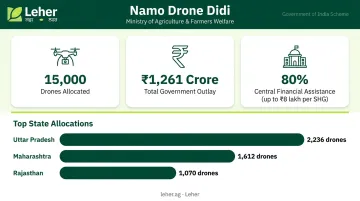
The central government's Namo Drone Didi scheme is actively deploying 15,000 drones to Women SHGs with an ₹1,261 crore outlay for 2023–24 to 2025–26, providing 80% central financial assistance up to ₹8 lakh per drone package. In 2023–24 alone, 1,094 drones were distributed under this and related schemes, with the largest state allocations going to:
- Uttar Pradesh: 2,236 drones
- Maharashtra: 1,612 drones
- Rajasthan: 1,070 drones
Beyond subsidies, ICAR-CPRI has run drone-based crop management trials for potato, reporting significant chemical savings and very low water requirements — institutional validation that drone spraying delivers real agronomic results, not just marketing claims.
The Labour Availability Problem
Agriculture's employment share in India fell from 44.8% to 43.0% in a single year (PLFS 2025). In states where this labour migration trend is most pronounced, finding 4–5 manual spray workers during peak season is becoming genuinely difficult — and expensive when you do find them. For farms above 3–4 acres, drone spraying is increasingly not just a cost decision but a practical necessity.
Which Method Is Right for Your Farm?
Choose Manual or Battery Spraying If:
- Your farm is under 2 acres
- You primarily grow high-value crops needing precise spot treatment
- You have reliable, affordable labour access through the season
- Your terrain or crop structure makes drone operation impractical
Consider Drone Spraying Services If:
- Your farm is 3 acres or more
- You grow field crops — paddy, wheat, cotton, sugarcane, vegetables
- Labour availability or cost is a growing concern in your area
- You want to reduce water and chemical consumption meaningfully
- You cannot afford to wait 4–5 days for a spray round during a pest outbreak
On the Cost Barrier
Many farmers assume drone spraying is for large landholders or well-funded agribusinesses. The per-acre service model eliminates this assumption. Paying ₹300–700 per acre for a drone service round — with no equipment cost, no maintenance, no training burden — is accessible to smallholders, particularly when the chemical savings partially offset the service fee.
Leher's per-acre service works simply: farmers book through the app, a DGCA-certified pilot handles the work, and payment happens only after spraying is done. For farms above 2–3 acres, the math works in the farmer's favour when the full cost picture is counted.
Want to know if drone spraying makes sense for your farm and crop? Contact Leher at +91 9996070333 or visit leher.ag to learn about service availability in your area.
The right method is whichever delivers the lowest true cost per acre, matched to your farm's labour situation and yield goals. For most Indian farms above 2–3 acres, that calculation now points toward drone spraying services.
Frequently Asked Questions
How much does manual spraying cost per acre in India?
Combining labour (₹300–400/day at MGNREGS rates), chemicals, and water, the true cost typically lands at ₹800–₹1,200+ per acre per round. The exact figure varies by region, crop type, and number of spray rounds — but it consistently exceeds what the ₹800–₹3,000 one-time equipment price implies.
Is drone spraying affordable for small farmers with 2–3 acres?
Affordable — and you do not need to buy a drone. Service-based drone spraying at ₹300–700 per acre puts the total cost for a single round on a 3-acre farm at ₹900–₹2,100. Chemical savings from more precise application offset part of that fee over a season.
How many acres can a drone spray in one hour compared to manual spraying?
A drone covers 1 acre in under 10 minutes, meaning 6+ acres per hour under field conditions. A single manual worker covers roughly 1–2 acres per full day. During a pest outbreak, this speed difference is the difference between treating the whole farm on day one versus day four or five.
What are the health risks of manual spraying that farmers should know about?
Manual sprayers are in direct contact with pesticide mist throughout each session, often without adequate PPE. WHO identifies pesticide applicators as among the highest-risk groups for exposure-related illness. Drone spraying removes the operator from the spray zone entirely, eliminating that exposure.
Do farmers need to buy a drone to benefit from drone spraying?
No. Service-based models allow farmers to pay per acre for a trained pilot's visit — no hardware purchase, maintenance costs, or DGCA licensing required. Leher's platform works exactly this way: book, spray, pay after.
How much less pesticide and water does drone spraying use compared to manual methods?
Published benchmarks indicate 30–40% less pesticide use and approximately 90% less water compared to knapsack spraying. Official Indian government SOPs specify 8–10 litres of water per acre for drone application, versus 210–253 litres per acre documented for knapsack sprayers in peer-reviewed research.