Broadcast spraying wastes inputs, accelerates resistance in weeds and pests, and drives up costs that squeeze margins on already small landholdings. For a country where the average farm is just 1.08 hectares, this inefficiency compounds quickly.
This article breaks down precision spraying — what it is, how the technology works, which crops benefit most, and why drone-based delivery is becoming the practical choice for Indian farmers.
Key Takeaways
- Precision spraying applies pesticides, herbicides, or nutrients only where crops actually need them — cutting waste dramatically
- Herbicide savings reach 70–90% with real-time spot spraying systems (43% even in standard maize trials)
- Drones use ~93% less water than knapsack sprayers: 37.5 L/ha versus 500 L/ha
- Benefits extend beyond cost: reduced chemical runoff, lower resistance risk, and less crop damage from over-application
- India's smallholder farm structure makes drones a better fit than tractor-mounted ground sprayers
What Is Precision Spraying and How Does It Work?
Precision spraying applies crop protection inputs — pesticides, herbicides, fertilisers — only to specific areas of a field that require treatment. The contrast with conventional broadcast spraying is straightforward: instead of covering every square metre uniformly, the system targets only where a problem exists.
Two Detection Modes
Most precision spraying systems rely on one of two detection approaches:
- Green-on-brown detection: Identifies green weeds against bare or fallow soil. Simpler to execute and commercially well-established — systems like WEED-IT operate on this principle
- Green-on-green detection: Distinguishes weeds from crop plants within an active growing canopy. More complex, requiring AI-based crop/weed discrimination rather than simple vegetation contrast. Commercial systems using this approach are now available as new sprayers or retrofits
The real-time processing pipeline follows three steps:
- Cameras or sensors scan the field continuously as the machine moves
- Onboard AI identifies target areas in real time
- Nozzles activate only at the precise location of the detected weed, pest, or stress signal
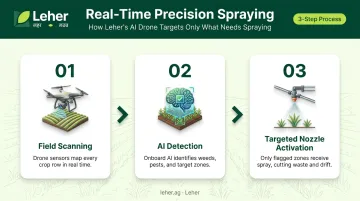
Detection accuracy benchmarks from recent research show RF and SVM models achieving 94–96% accuracy in weed identification.
AI and Imaging Technology
Computer vision models are trained to distinguish crop plants from weed species by analysing shape, colour, spectral signatures, and spatial patterns. More advanced systems — including drone-based platforms like those operated by Leher — use multispectral or hyperspectral imaging to detect stress that's invisible to the naked eye.
This capability shifts spraying decisions from reactive to proactive. Rather than waiting for visible pest damage or weed emergence, farmers can respond to early stress signals before yield losses occur. Camera selection depends on the detection requirement:
- RGB — standard visual imaging for green-on-brown weed detection
- Multispectral — captures beyond-visible wavelengths to flag crop stress early
- Hyperspectral — high-resolution spectral data for detailed disease and nutrient analysis
- Thermal — detects temperature variations linked to water stress or pest activity
Key Benefits of Precision Spraying for Crops
Economic Benefits
Precision spraying cuts costs by reducing the volume of chemical you actually buy and apply. Key findings across field research:
- Iowa State field trials documented an average 76% product savings and roughly ₹1,300/acre in economic savings
- MSU-linked spot spraying research shows 70–90% herbicide savings under applicable conditions
- European maize studies found savings in the 43%+ range with site-specific weed control
Figures vary by crop, weed pressure, and technology — but the direction is consistent. Lower per-application costs also let farmers use more effective (and often more expensive) chemistries in targeted doses that would be unviable at broadcast rates.
Environmental and Soil Health Benefits
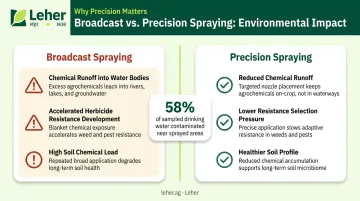
Heavy pesticide use carries documented downstream consequences in India. A survey around Bhopal found 58% of drinking water samples contaminated with organochlorine pesticides above permissible limits. Reducing application volume directly cuts the chemical load reaching water bodies and soil.
Resistance is a separate but related concern. Phalaris minor — a major wheat weed across the Indo-Gangetic Plains — developed resistance to isoproturon in the early 1990s, causing total crop failures in affected areas. Resistant biotypes showed GR50 increases of 2–11 times above susceptible populations. Targeted, lower-rate applications reduce the selection pressure that accelerates resistance development.
Crop Health and Yield Benefits
Broadcast spraying at uniform rates can cause unintended phytotoxicity (chemical injury to plant tissue), particularly in dense canopies where drift and over-application are harder to control. Precision spraying reduces this risk, which translates to better final yield quality, especially in high-value crops.
Water Conservation
A 2024 study published in the Indian Journal of Agricultural Sciences found drone spraying used 37.5 L/ha of spray fluid with no significant difference in herbicide efficacy compared to 500 L/ha applied by knapsack. For water-stressed farming regions across peninsular and north-western India, that ratio matters enormously.
Drone-Based vs. Ground-Based Precision Spraying
Precision spraying is delivered via two main platforms: large ground-based boom sprayers (dominant in large-acreage Western agriculture) and drones (increasingly preferred across Asia, particularly India).
Why Drones Are a Better Fit for Indian Farmers
India's average operational holding declined to 1.08 hectares in 2015–16 — too small and fragmented to justify tractor-mounted precision sprayers. The structural mismatch is significant:
- Ground-based boom sprayers require flat, uniform fields with sufficient row spacing for machinery access
- Many Indian fields are irregular, terraced, or surrounded by bunds that block equipment entry
- Capital cost of precision boom sprayer systems is prohibitive at smallholder scale
Drones sidestep all of these constraints. They navigate small, irregular fields without compacting soil, and farmers don't need to own any machinery.
The drone-as-a-service model takes this a step further. Leher operates on a "Book | Spray | Pay" model: farmers book a spraying session via the Leher App, a DGCA-certified pilot arrives at the farm, completes the spray, and the farmer pays only after the job is done.
Leher has delivered drone spraying across 6,500+ acres, supporting 810+ farmers, with documented results of up to 30% reduction in pesticide use and up to 90% less water consumption compared to traditional methods. For sugarcane, cotton, paddy, wheat, and vegetable farmers, there's no capital investment — just per-service access to precision technology.
Key technical advantages of agricultural drones:
- GPS-guided flight paths ensure consistent, uniform coverage without operator fatigue
- Variable-rate nozzles apply different doses across zones based on crop health maps
- Post-spray data logs create "as-applied" records useful for future planning and input tracking
- Drone spraying covers up to 50 acres per day, with approximately 5 minutes per acre
Ground-Based Systems: Where They Work
Ground-based precision sprayers — camera-equipped boom sprayers with individual nozzle control — perform well in large, flat, open fields with uniform crop rows. They're better suited to scenarios where the farmer already owns a tractor and requires high-volume applications. These conditions are common in large-acreage US and European farms, but rarely match the reality of Indian smallholders.
Ground-based systems are the right fit when:
- Fields are flat, open, and accessible by tractor
- Row spacing accommodates wide boom equipment
- Application volumes are too high for drone payloads
- The farmer or operation already owns mechanised equipment
Which Crops Benefit Most from Precision Spraying?
Precision spraying delivers the highest value where input costs are high and weed, pest, or disease pressure is significant. In India, the picture by crop looks like this:
| Crop | Chemical Pesticide Usage Rate | Notes |
|---|---|---|
| Cotton | 99% of growers use chemical pesticides | Highest per-hectare pesticide intensity |
| Oilseeds & Vegetables | 87% | High treatment frequency |
| Paddy | 35% of area treated | Large absolute volume due to scale |
| Wheat | 34% of area treated | Weed pressure is primary driver |
Cereals account for approximately 41% of chemical pesticide consumption in India, making them the largest single category by market volume.
Crops under sustained weed pressure — transplanted paddy, wheat in the Indo-Gangetic Plains, soybeans — typically show the largest herbicide savings from precision spraying over broadcast application. The economics shift further still in orchard and plantation settings, where canopy density and residue sensitivity make precision application especially valuable. Leher's tea plantation operations have documented approximately 75% less residue per kg of tea, and rubber plantation services have shown up to 50% savings per hectare per round.
Challenges and What to Consider Before Adopting Precision Spraying
Technical Accuracy Limits
Green-on-green detection — spraying within a growing canopy rather than against bare soil — remains more demanding. Lighting conditions, canopy density, and sensor calibration all affect performance. Drone-based AI models are improving continuously, but not all crop growth stages are equally well-supported yet.
Farmer Awareness and Training
Interpreting spraying maps, assessing efficacy, or troubleshooting outputs requires familiarity that many rural farmers don't yet have. The service provider model largely removes this burden: trained operators manage the technology, and the farmer only needs to book and evaluate results.
That said, understanding the regulatory and infrastructure environment still matters — especially for FPOs, CHCs, and anyone exploring ownership or partnership models.
Regulatory and Infrastructure Context
Commercial agricultural drone operations in India fall under the Drone Rules, 2021, issued by the Ministry of Civil Aviation on 25 August 2021, with amendments in 2022 and 2023. Registration and pilot certification are managed through the Digital Sky platform (digitalsky.dgca.gov.in), and all commercial pilots must hold DGCA-issued licences.
The government has actively supported adoption through financial incentives:
- FPOs and Custom Hiring Centres (CHCs): eligible for a 50% subsidy on drone and attachment costs
- Government institutions: can receive 100% cost assistance up to ₹10 lakh for drone demonstrations
- Rural connectivity: mobile and internet penetration (tele-density) rose from 39.84 to 44.16 between March 2023 and March 2024, though remote regions may still face constraints on field data transfer
Frequently Asked Questions
What are the 4 R's of precision agriculture?
The 4 R's stand for Right Source, Right Rate, Right Time, and Right Place — the core principles guiding when, where, how much, and what type of input to apply. Together they form the operational logic of precision farming, minimising waste while maximising crop response.
What are the 4 major types of pesticides?
The four main categories are insecticides (targeting insects), herbicides (targeting weeds), fungicides (targeting fungal diseases), and rodenticides (targeting rodents). Precision spraying is most commonly applied for herbicide and insecticide applications in crop farming contexts.
What is the difference between precision spraying and broadcast spraying?
Broadcast spraying applies chemicals uniformly across an entire field regardless of need. Precision spraying uses sensors and AI to apply inputs only where pests, weeds, or stress are detected — reducing chemical use, cost, and environmental impact by a measurable margin, with input savings of up to 40% reported in Indian field conditions.
How does drone-based precision spraying work?
Agricultural drones use GPS guidance, onboard cameras or sensors, and variable-rate nozzles to fly over fields, detect crop stress or weed presence, and spray targeted areas. A single DGCA-certified pilot can cover up to 50 acres per day, with no soil compaction or crop damage from heavy machinery.
Is precision spraying suitable for small farms in India?
Drone-based precision spraying is particularly well-matched to India's fragmented landholdings. Through service provider models like Leher's app-based booking system, farmers pay per session rather than investing in equipment — making the technology accessible regardless of farm size.
Can precision spraying reduce water usage?
Yes. Drone-based precision spraying uses ultra-low volume application, with field studies in India showing just 37.5 L/ha versus 500 L/ha for conventional knapsack sprayers — a reduction of over 90% — with no significant loss in treatment efficacy.