Introduction
Indian agriculture is under pressure from multiple directions. Input costs keep rising, agricultural labour wages hit ₹390.18 per day in 2023-24 — up nearly 8% year-on-year — and the average farm size has shrunk to just 1.08 hectares. Meanwhile, farmers are expected to produce more, with fewer resources, on increasingly fragmented land.
Drone spraying is showing up as a practical answer to these pressures. On farms across India, operators are already seeing measurable input savings, faster crop coverage, and safer working conditions.
This guide breaks down how drone spraying works, why its operational benefits are well-suited to Indian conditions, and what the opportunity means for farmers and rural entrepreneurs looking to enter the space.
Key Takeaways
- Drone sprayers apply pesticides, fertilisers, and weedicides via GPS-guided multi-rotor aircraft at very low water volumes
- Water use can drop by up to 90%; pesticide consumption by up to 30% versus conventional methods
- A single drone covers one acre in roughly 5–7 minutes — versus several hours on foot with a knapsack sprayer
- Operators stay entirely outside the spray zone, removing direct chemical exposure risk
- Rural entrepreneurs can build a drone spraying business through programs like Leher's Drone Partner Program
What Is Drone Spraying?
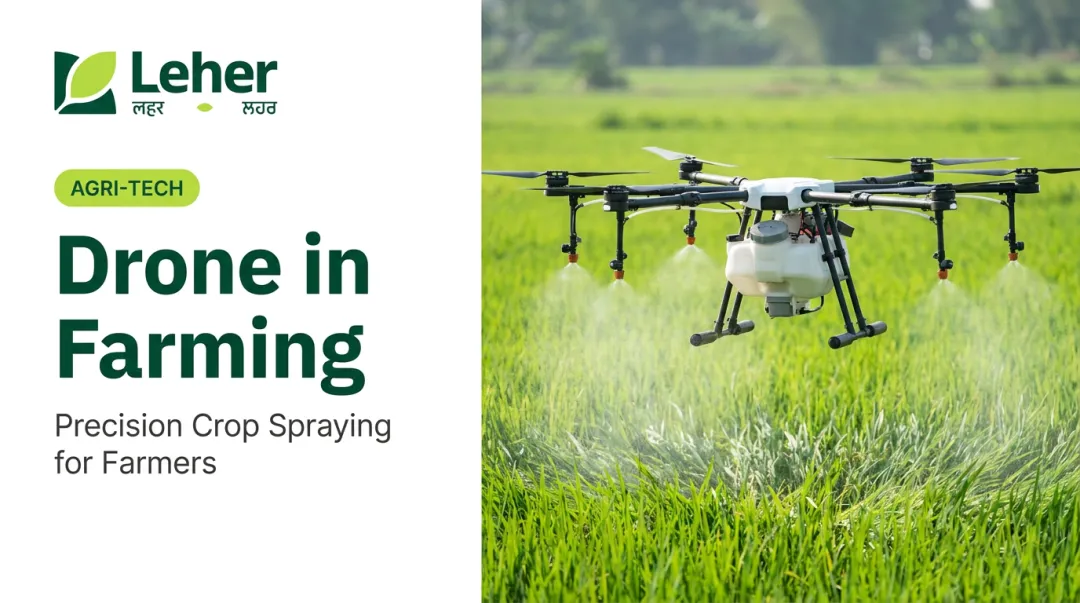
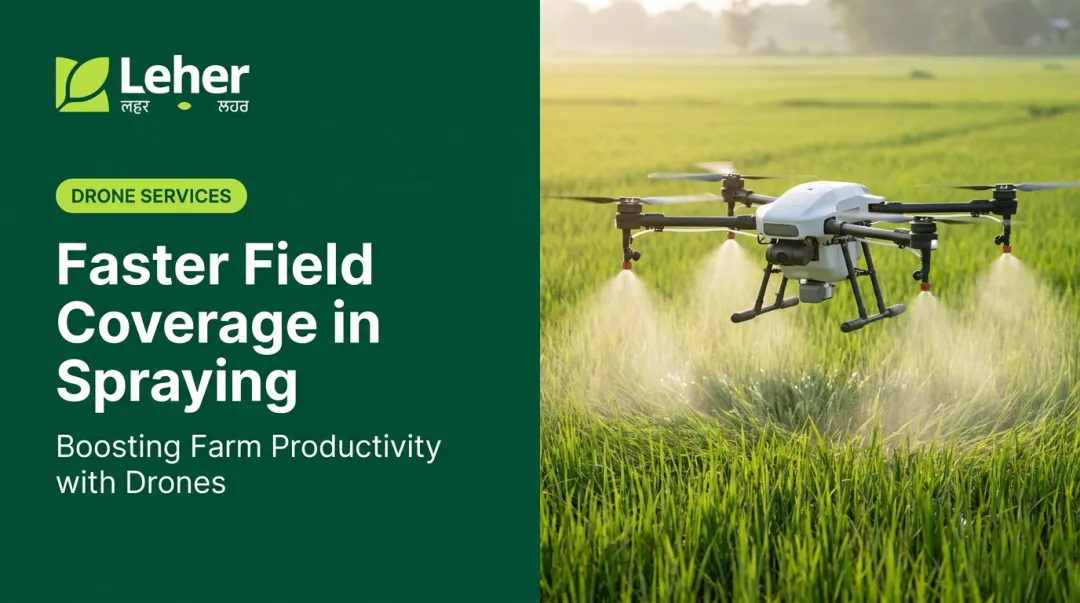
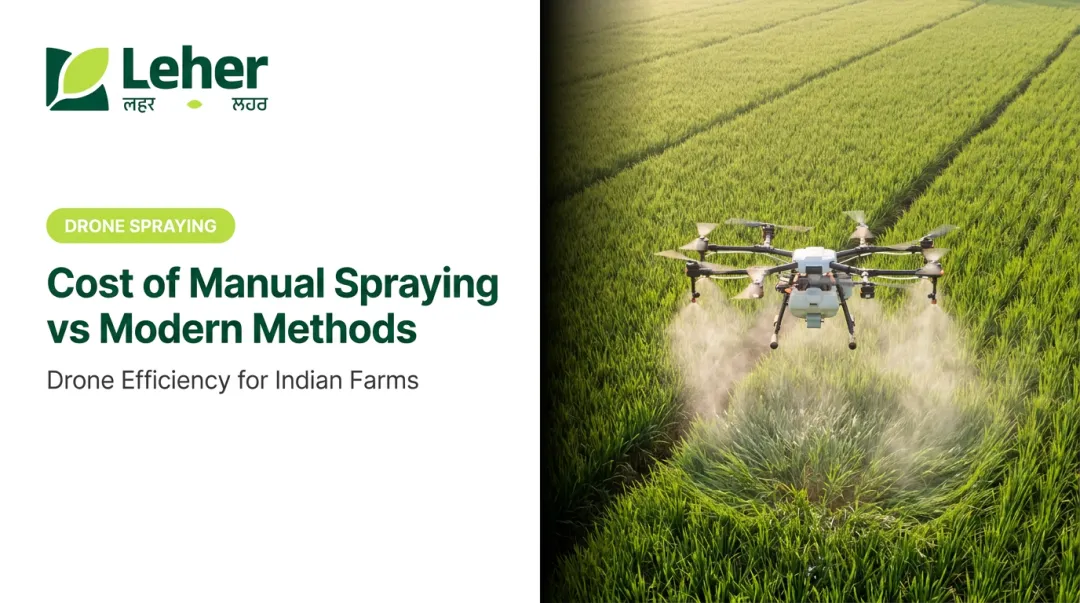
Drone spraying uses unmanned, multi-rotor aircraft fitted with spray tanks, pumps, GPS receivers, and atomising nozzles to apply liquid crop inputs directly onto fields. Flying at 7–12 feet above the canopy, the drone's rotor downwash forces droplets deep into the crop structure — improving coverage without the waterlogging and soil compaction that ground rigs cause.
Where It Works Best in India
The conditions where drone spraying outperforms alternatives map closely onto India's agricultural reality:
- Fragmented smallholder plots where tractor-mounted boom sprayers are impractical
- Waterlogged paddy fields during and after monsoon season
- Late-season crops with dense canopies where driving through would damage yield
- Hillside or terraced plots inaccessible to ground equipment
- Horticulture, tea, and rubber plantations with tall or irregular canopy profiles
86.07% of India's operational holdings are under 2 hectares, according to the Agriculture Census 2015-16 — which is precisely why drone spraying has found such rapid adoption here. Most of India's farms were never a good fit for the large-scale machinery designed for flat, contiguous fields abroad.
Key Benefits of Drone Spraying
The benefits below reflect what changes operationally — input costs, coverage speed, crop health outcomes, and operator safety — when farmers shift from manual or tractor-based spraying.
Precision Input Reduction: Less Water, Less Chemical
Drone sprayers operate at very low carrier volumes. A peer-reviewed Indian field study using a 10-litre battery hexacopter on pigeon pea recorded an application rate of 77.86 L/ha and achieved 92.45% top-canopy thrips control after 10 days — with drift negligible beyond 2 metres from the spray boundary.
Compared to conventional backpack or tractor spraying, the input reductions are significant:
- Water savings: up to 90% versus conventional methods (Leher internal data; industry estimate corroborated by Coromandel)
- Pesticide reduction: approximately 20–30% less chemical required per spray cycle
- Overall input savings: Leher reports roughly 40% input savings across combined agricultural inputs
- Cost impact: approximately 20% reduction in overall farming costs
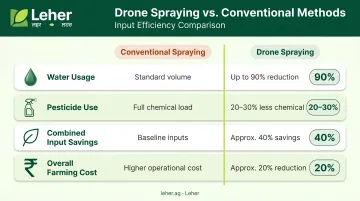
For crops requiring multiple spray cycles per season — rice, wheat, cotton, sugarcane, vegetables — these savings compound across the calendar. In water-scarce regions or areas with documented chemical overuse, the sustainability impact extends beyond cost: lower runoff means less soil contamination and reduced risk to surrounding biodiversity.
Access and Flexibility: Reaching Fields That Equipment Cannot
Ground sprayers compact soil, get stuck in wet fields, and damage late-season canopies. Fixed-wing aircraft are impractical for the small, irregular plots that make up the majority of Indian farmland. Drones bypass both problems.
Key access advantages include:
- Spraying waterlogged paddy fields where walking in is slow and manual coverage is uneven
- Reaching terraced plots on hillsides that no wheeled equipment can navigate
- Covering late-season crops at full canopy height without trampling or yield loss
- Operating on plots bordered by trees, irrigation channels, or other obstacles
India has approximately 11.6 million hectares of waterlogged land — fields where manual spraying is already difficult and ground mechanisation is largely out of the question. Add monsoon-season conditions and the post-kharif window, and the access advantage becomes a direct yield-protection tool.
Operator Safety and Labour Efficiency
Manual spraying — especially with knapsack sprayers — puts operators in direct contact with pesticide mist for extended periods. The health consequences are well documented:
- A South Karnataka survey of 171 farmers found 32.75% reported eye irritation and 25.15% reported headaches from pesticide exposure
- Professional sprayers were 6.66 times more likely to report peripheral sensory neuropathy symptoms than non-sprayers
- In a study of cotton growers, 83.6% of 323 pesticide exposure events showed signs of mild to severe poisoning
Drone spraying removes the operator from the spray zone entirely. The pilot stands at a safe distance; the aircraft does the work.
The labour efficiency gain is equally significant:
| Method | Field Capacity |
|---|---|
| Knapsack sprayer | 0.072 ha/hour |
| Single-wheel boom sprayer | 0.081 ha/hour |
| Agricultural drone (10L hexacopter) | 2.62 ha/hour |
That's roughly a 36x speed advantage over manual methods. For a farm with multiple spray cycles per season, this translates directly into reduced dependency on seasonal labour and faster completion of critical crop protection windows.
Drone Spraying as an Opportunity: For Farmers and Rural Entrepreneurs
Beyond on-farm benefits, drone spraying creates a real income opportunity, particularly for rural youth who cannot farm at scale but can build a spraying services business.
The global agricultural drone market is estimated at USD 3.46 billion in 2025, with projections showing a CAGR of 26.85% through 2034 (IMARC Group). That kind of growth trajectory puts drone spraying firmly in the mainstream of agricultural investment.
The Service Provider Model
The economics work because most Indian farmers — with holdings under 2 hectares — have no reason to own a drone. They need the service, not the asset. A rural drone entrepreneur can:
- Obtain DGCA Remote Pilot Certification
- Acquire a DGCA-approved agricultural drone (through purchase, lease, or financing)
- Register with a drone spraying platform
- Earn income on a per-acre fee model, serving multiple farmers per day
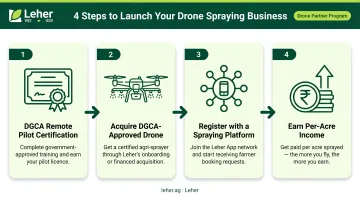
This model already operates at scale in China, Japan, and South Korea, where drone spraying operators have built dense rural networks.
Leher's Drone Partner Program
Leher provides a structured entry path for rural entrepreneurs through its Drone Partner Program. The program currently has 100+ active drone partners, with a stated goal of reaching 1,000 rural drone partners by 2030. Partners receive:
- Guaranteed farming orders through Leher's platform connecting them with farmers
- AIF loan facilitation for drone acquisition
- Drone insurance and Annual Maintenance Contracts (AMC)
- 24/7 technical support covering hardware, software, and logistics
- Order management and route optimisation through the Drone Partner App
India's regulatory environment has also become more accessible. Government schemes such as the Sub-Mission on Agricultural Mechanisation (SMAM) and the Namo Drone Didi initiative are actively subsidising adoption. Namo Drone Didi alone targets 15,000 drones for women's self-help groups, with 80% Central Financial Assistance of up to ₹8 lakh per unit.
How to Get Started with Drone Spraying in India
Getting started depends on your role — whether you want to use drone spraying on your farm or build a business around it, the path is straightforward.
For Farmers
You do not need to own a drone or hold any certification. The simplest step is engaging a certified drone spraying service provider for one field or one spray cycle, then evaluating the results.
Leher's drone spraying service works through the Leher App: farmers book a session, a DGCA-certified pilot arrives at the farm, sprays the crop, and farmers pay only after the job is completed. Leher has covered 30,000+ acres and served 2,100+ farmers across crop types including paddy, cotton, sugarcane, wheat, vegetables, tea, and rubber.
When selecting any service provider, check for:
- Valid DGCA pilot certifications
- Documented per-acre pricing with no hidden charges
- Service across your specific crop type
- References or documented impact data
For Entrepreneurs
The path to operating a drone spraying business involves:
- DGCA Remote Pilot Certificate (RPC) — required under Drone Rules 2021 for commercial agricultural drone operation
- Pesticide applicator licensing — governed by state agriculture departments; check requirements in your state
- DGCA-approved drone — the equipment must carry type certification
- Platform registration — joining a network like Leher's provides order flow, operational support, and financing access
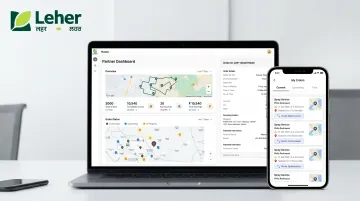
Leher also offers a DGCA-certified Drone Pilot Training program covering agricultural drone operation, with flexible online and in-person formats and job placement support post-certification.
Frequently Asked Questions
How much does drone spraying cost per acre in India?
Per-acre rates vary by region, crop type, and service provider. No government-standardised rate card exists, but service-based models are typically priced per acre with input savings on water and pesticide often offsetting a significant portion of the service fee. Contact providers directly for current pricing in your area.
What certifications are required to operate an agricultural drone in India?
Operators need a DGCA Remote Pilot Certificate under Drone Rules 2021. Pesticide applicator licensing requirements vary by state under respective agriculture department regulations.
How many acres can an agricultural drone spray in a day?
Agricultural drones can cover up to 50 acres per day — roughly one acre every 5–7 minutes. Actual daily output varies by tank capacity, terrain, field shape, and refill logistics.
Is drone spraying effective for all types of crops?
Drone spraying works well for most field crops — paddy, wheat, cotton, sugarcane, vegetables — and plantation crops like tea and rubber. Dense or very tall canopies may require adjusted flight parameters. Approved pesticide-crop combinations in India are governed by CIBRC/PPQS guidelines.
How does drone spraying compare to traditional backpack or tractor spraying?
Drones are 35x faster than knapsack sprayers by field capacity, use up to 90% less water, require only one operator, and keep that operator outside the spray zone. Ground sprayers carry higher chemical volumes per acre, which suits certain applications, but create soil compaction, access limitations, and direct operator exposure risks.
Do small and marginal farmers in India need to own a drone to benefit?
No. The service-based model exists specifically for this reason. Farmers can book a certified drone spraying service on a per-acre basis through platforms like the Leher App, accessing the full operational benefit of drone spraying without any capital investment in equipment.