This isn't a minor inefficiency. India consumed 600.79 LMT of fertilizers in 2023-24, making it the world's second-largest fertilizer consumer. Yet across the country, a 2021 national soil study covering 242,827 samples found zinc deficiency in 51.2% of soils and boron deficiency in 44.7% — clear evidence that volume alone doesn't fix the underlying problem.
The real issue isn't how much fertilizer farmers use. It's whether the right nutrient is reaching the plant through the right pathway at the right time.
Key Takeaways
- Foliar spray delivers nutrients through leaves — fast-acting, ideal for micronutrient correction and critical growth stages
- Soil fertilizer is non-negotiable for macronutrient (N, P, K) supply and long-term soil health
- Neither method replaces the other — foliar spray works as a precision supplement to soil fertilization
- The best results come from using both methods strategically based on crop type, growth stage, and soil condition
- Precise, uniform application is what makes foliar spray effective at scale — drone spraying delivers that consistency across large fields
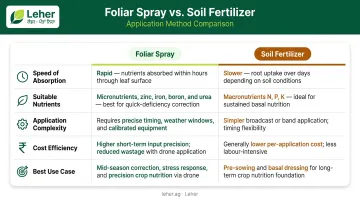
Foliar Spray vs Soil Fertilizer: Quick Comparison
Here's a side-by-side view across five practical dimensions:
| Aspect | Foliar Spray | Soil Fertilizer |
|---|---|---|
| Speed of Absorption | Hours (via leaf stomata and cuticle) | Days to weeks (soil solution → root uptake) |
| Suitable Nutrients | Micronutrients (Zn, Fe, Mn, B); targeted boosts | Macronutrients (N, P, K, Ca, Mg) in large volumes |
| Application Complexity | High — requires precise dilution, timing, coverage | Lower — simpler broadcast or banding at scale |
| Cost Efficiency | Higher per-acre cost; lower volumes needed | More cost-effective for season-long macronutrient supply |
| Best Use Case | Deficiency correction, critical growth stages, impaired root uptake | Base nutrition, long-term soil health, full-season feeding |
Each method serves a distinct purpose — the sections below break down how they work and when to use each one.
What Is Foliar Spray?
Foliar spray applies liquid fertilizer directly to a plant's leaves. Nutrients are absorbed through stomata (tiny pores on leaf surfaces) and the leaf cuticle (the waxy outer layer), bypassing the root system entirely. This makes it a fundamentally different approach to feeding crops — and understanding when to use it starts with how it actually works.
How Absorption Works
Because nutrients skip the soil-to-root pathway, delivery is fast. Research by H.B. Tukey and S.H. Wittwer at Michigan State University — using radioactive isotopes — demonstrated foliar nutrient translocation of up to one foot per hour. A 2024 peer-reviewed rice study found that foliar application of 1% urea + 0.5% ZnSO₄ at tillering increased grain yield by 62.01% compared to untreated controls.
That speed matters most when a crop is at a yield-critical stage and cannot wait days for soil-applied nutrients to move through the root system.
What Foliar Spray Does Well
Foliar spray is most effective for:
- Micronutrient deficiency correction — iron, zinc, manganese, and boron respond especially well
- Boosting crops at critical growth stages: flowering, grain fill, and fruit set
- Compensating for impaired root uptake during waterlogging, cold spells, nematode damage, or high soil pH
- Mid-season supplementation when soil reserves deplete faster than the crop can draw them down
ICAR recommends foliar 0.5% ferrous sulphate sprays for rice and maize iron enrichment, 0.5–1.0% MnSO₄ for wheat manganese deficiency on sandy alkaline soils, and 0.5–2.0% zinc sulphate as a supplement to basal zinc application.
What Foliar Spray Cannot Do
Foliar spray is not a substitute for soil fertilizer — and treating it as one leads to predictable crop nutrition failures. Concentrated nitrogen sprays risk leaf burn, and the volumes needed to supply full-season macronutrients through leaves aren't practical.
Key limitations:
- Cannot supply N, P, K in adequate quantities for full crop nutrition
- Sensitive to wind, rain, and direct sunlight — all three can reduce effectiveness
- Requires precise dilution; too concentrated causes leaf scorch
- Demands uniform coverage — difficult to achieve manually across large areas
Use Cases in Indian Farming
The farms where foliar spray delivers the most measurable value:
- Paddy and wheat — zinc and iron corrections at tillering and grain-fill stages
- Mango and citrus during flowering and fruit development: TNAU recommends 1–2% zinc sulphate for mango, 0.3% for citrus
- Tomatoes and peppers in dry spells — 1% calcium chloride foliar sprays prevent blossom-end rot when soil calcium transport stalls
- Field crops on alkaline soils — where iron and zinc are chemically locked in insoluble forms and root uptake is severely limited
What Is Soil Fertilizer?
Soil fertilizer applies nutrients (granular, powdered, or liquid) directly to the soil, where they dissolve into the soil water solution and are taken up by plant roots. This is how plants obtain most of their mineral nutrition under normal conditions.
Why Soil Fertilizer Is the Foundation
India's 600.79 LMT annual fertilizer consumption reflects what the science confirms: macronutrients must come from the soil. Nitrogen, phosphorus, potassium, calcium, and magnesium are needed in quantities that foliar application cannot realistically supply.
Soil fertilizer also does something foliar spray cannot : it feeds soil microorganisms and builds long-term soil fertility. A single crop cycle's basal application contributes to the biological system that makes nutrients available across future seasons.
Main types relevant to Indian farmers:
- Basal dose — applied before sowing to establish the season's nutritional foundation
- Top dressing — mid-season application (urea being the most common example)
- Fertigation — through drip or flood irrigation systems, combining water and nutrient delivery
Where Soil Fertilizer Falls Short
Soil fertilizer is indispensable, but it has real limitations. These gaps are where foliar spray earns its place:
- High pH soils lock up zinc, iron, and manganese, making them unavailable even when applied in adequate quantities. At high soil pH, availability of Zn, Fe, Mn, and P all decline significantly
- Monsoon leaching — research shows 68–94% of dissolved inorganic nitrogen movement in Indian river systems occurs June–October, reflecting the scale of seasonal nutrient loss
- Slow response time — cannot rescue a crop showing acute deficiency symptoms mid-season
- Uneven distribution — broadcast applications on large fields can create inconsistent nutrition zones
India has 6.73 million hectares of salt-affected soils, concentrated heavily in Gujarat, Uttar Pradesh, Maharashtra, Haryana, and Punjab. On these soils, soil-applied micronutrients often become unavailable before roots can absorb them , making foliar delivery the more dependable option.
Use Cases in Indian Farming
Soil fertilizer is indispensable for:
- Base nutrition across all major field crops — paddy, wheat, maize, cotton, pulses
- Corrective soil amendments (gypsum for sodic soils, sulfur for alkaline pH management)
- Perennial crops and orchards where root systems extract nutrients across full seasons
- Any situation requiring sustained, season-long macronutrient supply
Which Should You Choose?
The right answer depends on the specific situation in front of you. Four factors should drive the decision:
- Type of nutrient needed — macronutrient or micronutrient?
- Urgency — is there an acute deficiency requiring rapid correction?
- Soil and root condition — is root uptake working normally?
- Growth stage — is the crop at a critical yield-determining point?
Choose Foliar Spray When:
- A visible deficiency needs correction within hours, not days
- The crop is at flowering, grain fill, or fruit set — stages where nutrition directly affects yield
- Root uptake is compromised by waterlogging, drought stress, or high soil pH
- A micronutrient like zinc, boron, or iron needs targeted delivery where soil fixation is blocking root absorption
Choose Soil Fertilizer When:
- Building the seasonal nutrition foundation before or at sowing
- Supplying nitrogen, phosphorus, and potassium in quantities that leaves cannot absorb
- Improving long-term soil organic matter and microbial activity
- A slow, continuous nutrient release is needed throughout the growing season
The Case for Using Both
The most productive crop nutrition programs treat these methods as complementary — soil fertilizer as the foundation, foliar spray as a precision supplement at key growth stages.
The challenge for most Indian farmers is the "precision" part of foliar application. Achieving the right concentration, applying at the correct time, and getting uniform coverage across several acres manually is genuinely difficult. Three common failure points:
- Incorrect dilution causes leaf burn
- Poor timing means stomata are closed or the spray evaporates before absorption
- Patchy coverage leaves parts of the field undernourished
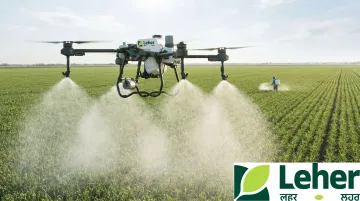
Drone-based spraying addresses all three problems directly. Rather than relying on manual knapsack sprayers — which cover roughly 3 acres per day with inconsistent coverage — Leher's drones cover 50+ acres per day with GPS-guided uniform application, achieving around 40% input savings and 90% water savings compared to conventional spraying. For foliar fertilizer specifically, that precision means the right concentration reaches every part of the field at the optimal growth stage window.
How Precision Application Changes the Foliar Equation
The gap between "foliar spray works in trials" and "foliar spray works on my farm" comes down to application quality. Timing, concentration, and coverage are all critical — and all are difficult to get right manually at scale.
A farmer managing 10–15 acres with a knapsack sprayer faces real trade-offs at every step:
- Spray too early and coverage is slow; spray at midday and heat causes leaf burn
- Mix the solution too strong and you damage the crop
- Apply unevenly and half the field misses the treatment window entirely
Leher has addressed this directly through drone-based precision spraying. Across 6,500+ acres served and 810+ farmers supported in 2024, Leher's drone operations deliver uniform foliar coverage on paddy, wheat, vegetables, and sugarcane — with DGCA-certified pilots ensuring correct dilution and application timing for each crop and growth stage.
The operational difference shows up clearly in the numbers:
- 5 minutes per acre vs. the multi-hour manual equivalent
- Single operator vs. multiple laborers required for manual spraying
- GPS-guided uniform coverage vs. the variable distribution of hand spraying
- ~40% input savings — meaning less fertilizer wasted through over-application or uneven spread
That last point is where foliar fertilizer lives or dies. The method only delivers results when nutrients reach the leaf surface in the right concentration at the right time. Farmers who report that "foliar spray doesn't work" have experienced application failure — not method failure.
If application quality is the variable holding back your foliar results, book a drone spraying session through the Leher App to see what consistent, GPS-guided coverage looks like on your farm.
Conclusion
Foliar spray and soil fertilizer serve distinct purposes — and used together, they cover more ground than either can alone. Soil fertilizer builds the nutritional foundation every crop needs across the full growing season. Foliar spray delivers fast, targeted corrections at the moments that matter most for yield.
For Indian farmers navigating alkaline soils, erratic monsoons, and rising input costs, the smartest approach is an integrated one: use soil applications to establish base fertility, then apply foliar spray precisely when crops need rapid micronutrient support or a growth-stage boost. Services like Leher's on-demand drone spraying directly address the practical barriers to effective foliar application — timing, coverage uniformity, and concentration control — making precision foliar work achievable even for smallholder farms. If you're ready to put foliar spray to work at the right moment, booking a drone spraying session through the Leher App is a practical place to start.
Frequently Asked Questions
Is foliar fertilizer better than soil fertilizer?
Neither is universally better. Foliar spray acts faster and excels at micronutrient correction and growth-stage boosts; soil fertilizer is essential for macronutrient supply and long-term soil health. The best crop nutrition programs use both strategically.
Can foliar fertilizer be used as a soil fertilizer?
No. While foliar nutrients may eventually wash into the soil, they're not formulated or cost-effective as soil fertilizer substitutes. The volumes needed to supply nitrogen, phosphorus, and potassium through leaves are impractical, and concentrated foliar sprays risk burning foliage.
When is the best time to apply foliar spray?
Early morning or late evening — stomata are more open, temperatures are cooler, and the spray is less likely to evaporate or burn leaves. Avoid spraying in direct midday sun, on water-stressed plants, or when rain is expected within a few hours.
Which crops benefit most from foliar spray?
Crops with high micronutrient demand or those on high-pH soils benefit most — particularly paddy and wheat during grain fill, mango and citrus at flowering, and tomatoes during fruiting. Any crop showing zinc or iron deficiency is also a strong candidate.
What are the disadvantages of foliar fertilization?
The main drawbacks are leaf burn risk at high concentrations, reduced absorption when rain or wind interferes, and the inability to supply macronutrients in adequate quantities. Results also depend on precise timing, correct dilution, and uniform spray coverage.
Can foliar spray and soil fertilizer be used together?
Yes — and that's the recommended approach. Soil fertilizer provides the seasonal macronutrient foundation; foliar spray supplements with targeted micronutrients or growth-stage boosts. This integrated strategy is standard practice in high-yield farming and is most effective when foliar application is applied uniformly — something drone spraying handles efficiently at scale.