Introduction
Walk across a typical Indian farm during spraying season and you'll see the same scene repeated millions of times: a farmer or hired worker moving row by row, applying pesticide uniformly across the entire field — whether weeds or pests are present or not. India used 52,466 tonnes of pesticides in 2022-23, and much of that volume lands on soil and patches that need no treatment at all. That pesticide doesn't protect crops — it enters the soil, runs off into water bodies, and accumulates where it shouldn't.
Precision pesticide application takes a different approach: apply chemicals only where sensors or cameras detect an actual problem. Less product used, lower costs, and a healthier farm environment — with the same level of crop protection.
This article breaks down how precision spraying works, why it outperforms broadcast methods, and how drone-based services are making it accessible to Indian smallholder farmers.
Key Takeaways
- Precision spraying applies pesticide only where weeds, pests, or disease are detected — not across the entire field
- Sensors, machine vision cameras, and GPS-guided drones enable real-time detection and targeted nozzle control
- Peer-reviewed studies show 23–55% reductions in chemical use; site-specific systems can reach 70–90%
- Drone-as-a-service models let Indian smallholders access precision spraying without owning equipment
What Is Precision Pesticide Application?
Precision pesticide application means applying herbicides, fungicides, or insecticides only where they're actually needed — targeting specific zones where pests, weeds, or disease are present, rather than treating the entire field.
The alternative — uniform broadcast application across the whole field regardless of actual conditions — is still the default for most Indian farmers using knapsack sprayers or tractor-mounted boom sprayers.
The Three Ways to Reduce Pesticide Use
Three main strategies exist for cutting pesticide volumes:
- Reduce application frequency — spray less often
- Reduce dose — apply a lower concentration across the whole field
- Restrict the treated area — apply the full recommended dose, but only where needed
The third approach is the most effective. It keeps the dose at the target high enough to actually work, but skips clean zones entirely — which is why it avoids the yield and efficacy penalties that come with simply diluting the product across the board.
Two Core Methodologies
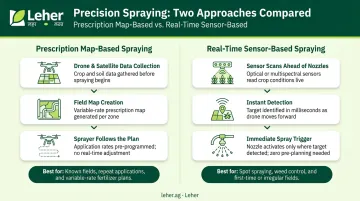
Prescription map-based spraying: Field data (from drones, satellite imagery, or scouting) is collected, analysed, and used to create a spray plan before the equipment enters the field. The sprayer follows the map.
Real-time sensor-based spraying: Detection and application happen simultaneously. Sensors on the equipment scan the field ahead of the nozzles and trigger spray only when a target is detected — no pre-mapping required.
Both approaches reduce treated area compared to broadcast spraying. Prescription mapping suits fields with stable, predictable pest distribution; sensor-based spraying works better for dynamic conditions where pest pressure varies unpredictably across the season.
How Does Precision Spraying Work?
The core mechanism is simple: sensors or cameras mounted on a sprayer or drone detect plant material, weeds, or diseased tissue, then trigger individual nozzles to fire only at those specific locations. Nozzles in clean zones stay off.
Detection: Green-on-Brown vs. Green-on-Green
Two detection modes cover the main use cases:
- Green-on-brown detection identifies any green vegetation against bare soil or crop residue. It's relatively easy — a stark visual contrast. Best suited for fallow fields, pre-emergence herbicide applications, or between-row spraying. Extension research reports 95–98% weed hit rates for camera-based spot spraying systems under these conditions.
- Green-on-green detection is harder. It requires AI-powered cameras to distinguish between crop plants and weeds when both are green. This is needed for post-emergence in-crop applications where simply detecting green material isn't enough.
Chlorophyll fluorescence sensors offer another approach: they detect photosynthetically active plant tissue by reading light reflectance at specific wavelengths, triggering nozzles only when living plant cells are present.
Nozzle Control and Application Precision
Once a target is detected, pulse-width modulation (PWM) valves on individual nozzles open and close in milliseconds. This allows each nozzle to operate independently — one can be spraying while the adjacent nozzle is off — at spray zones as small as 0.8–1.1 metres at field travel speeds. Detection, decision, and application all happen in a single pass — with no separate mapping run required.
Drone-Based Precision Spraying
Ground-based sprayers handle most field applications, but they can't reach every situation. Agricultural drones add a critical capability: access. Drones equipped with multispectral cameras or AI imaging can fly over a field and either:
- Map weed and pest distribution to generate a prescription spray plan, or
- Apply pesticide in real-time using onboard sensors and individually controlled nozzles
ICAR's potato drone trials recorded a drone covering 1.26 hectares in approximately 15 minutes, using only 20 litres of water per hectare — compared to 500–750 litres per hectare for conventional spraying. That water reduction alone illustrates the efficiency difference. Services like Leher's app-booked drone spraying report similar outcomes in field conditions across India — up to 90% less water and coverage of up to 50 acres per day.
Precision Spraying vs. Conventional Broadcasting
Broadcast spraying applies pesticide at a fixed rate across the entire field, regardless of where problems actually exist. It's the dominant practice among Indian farmers — and the main source of unnecessary pesticide load on soils and water.
Here's how the two approaches compare across three dimensions:
| Factor | Broadcast Spraying | Precision Spraying |
|---|---|---|
| Chemical use | Applied to entire field area, including clean zones | Applied only where weeds/pests detected |
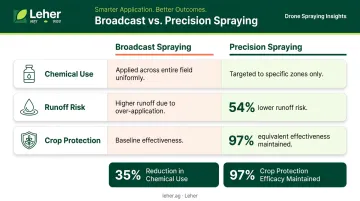
| Runoff risk | Higher — product lands in untargeted areas | Lower — spot spraying reduced herbicide runoff load by 54% vs. broadcast |
| Crop yield | Baseline | Maintained — dose at target points is unchanged |
Spraying less does not mean protecting less. Robotic spot spraying in sugarcane was 97% as effective as broadcast spraying while cutting chemical use by 35%. The recommended dose is still applied wherever pests or weeds are present — product is simply not wasted on areas that don't need it.
That efficiency translates directly into cost savings. International peer-reviewed trials (Agronomy Journal) found herbicide savings from sensor-controlled sprayers ranging from ₹490 to ₹2,600 per hectare (~$5.83–$30.83, non-India benchmark). A separate US soybean demonstration across 415 acres recorded an average 76% product saving — driven simply by how much of the field was already weed-free. The principle holds regardless of geography: the less area that needs treatment, the more input cost drops.
Key Benefits of Precision Pesticide Application
Cost Reduction
Less product applied per pass means lower input spend per season. The savings range is wide because it depends on actual weed or pest pressure:
- Peer-reviewed range: 23–55% reduction in chemical use
- Site-specific systems under low weed pressure: up to 70–90% reduction
- Leher's drone spraying service reports approximately 30% reduction in pesticide use and 40% input savings compared to conventional methods
Fields with lower pest density see the biggest savings — because more of the field is clean and goes untreated.
Water Conservation
Precision spraying dramatically reduces the water volume needed for pesticide dilution and delivery. The ICAR potato trial benchmark is stark: 20 L/ha for drone spraying versus 500–750 L/ha for conventional methods. For water-stressed farming regions across India, that gap determines whether large-scale spraying is viable at all.
Leher's drone service reports up to 90% water savings compared to conventional spraying, consistent with the ICAR potato trial data.
Soil Health and Biodiversity Protection
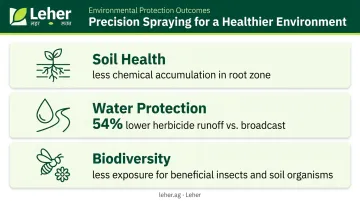
Pesticide applied where it isn't needed accumulates in soil and runs off into drainage systems and water bodies. Every application to a clean zone is unnecessary chemical load. Precision spraying cuts this at the source:
- Reduced chemical accumulation in the root zone
- Lower runoff into irrigation channels and waterways
- Less exposure for beneficial insects, pollinators, and soil organisms that support long-term farm productivity
Application Data as a Management Asset
Each precision spray pass generates a record: where product was applied, where weeds or pests were detected, and how much was used. Over seasons, this builds a field history with real decision value:
- Identify recurring problem zones before pressure peaks
- Time future applications based on pattern data, not guesswork
- Measure whether pest management is delivering results
How Drones Are Transforming Precision Spraying in India
The average Indian operational holding is 1.08 hectares — small, often fragmented, and frequently situated in terrain that makes large ground equipment impractical. Tractor-mounted boom sprayers aren't designed for these conditions. Knapsack sprayers are the default, and a single worker covers roughly 3 acres per day.
Drones change the economics completely.
What Agricultural Drones Deliver in Practice
A drone spraying service like Leher's can cover up to 50 acres per day — roughly 8 times the productivity of manual spraying — with a single trained operator. The system uses GPS-guided flight paths, onboard sensors, and individually controlled nozzles to deliver targeted applications across the field at 5 minutes per acre.
For smallholder farmers, this translates into two concrete advantages:
- Faster turnaround means spraying happens at the right crop stage, not whenever labor becomes available
- Drones can access slopes, paddy fields, and areas near water bodies where ground equipment can't operate safely
Leher's On-the-Ground Impact
Leher delivers drone spraying through a straightforward model. Farmers book via the Leher App, a DGCA-certified pilot arrives at the farm, sprays the crop, and payment happens after the job is done. In 2024, Leher served 6,500+ acres and 810+ farmers, reducing pesticide use by up to 30% and water consumption by up to 90% compared to conventional methods.
Those numbers span multiple crop types and geographies — paddy, cotton, sugarcane, and vegetables across several Indian states.
The Drone-as-a-Service Model
The single biggest shift enabling precision spraying adoption for Indian smallholders isn't the drone technology itself — it's the service model. When farmers access spraying through a trained, certified operator rather than purchasing their own equipment:
- No capital outlay for a drone (which can cost several lakhs)
- No DGCA certification requirement on the farmer
- No technical knowledge needed beyond booking through an app
Government policy is reinforcing this access model at scale. The Government of India's Namo Drone Didi scheme is scaling this model further, targeting 15,000 women Self-Help Groups in 2024–26 to operate drone spraying services for local farmers, with 80% central assistance on drone package costs up to ₹8 lakh. Each SHG is expected to cover 2,000–2,500 acres per year, generating at least ₹1 lakh in additional annual income.
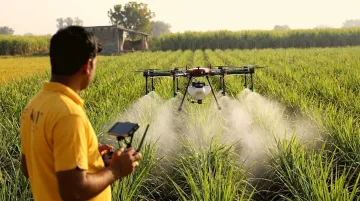
For farmers in remote or underserved regions, this means drone spraying is increasingly available as a local service — not a distant technology.
Common Challenges and How to Overcome Them
Precision spraying isn't without real barriers. Acknowledging them honestly matters for anyone evaluating adoption.
Key challenges:
- Drones carry significant upfront capital costs for individual farmers or operators
- DGCA certification is mandatory for pilots in India — training takes time and has a direct cost
- Heavy canopy cover or high weed pressure reduces proportional savings; the biggest gains come in fields with lower initial pest load
- App-based booking and data-dependent systems require reliable mobile connectivity in rural areas
How service-based models address most of these:
When farmers access precision spraying as a service, the capital and certification burden shifts entirely to the operator. Leher's model requires no equipment ownership from the farmer — just a booking through the app.
Operators in Leher's partner program are supported with:
- AIF loan facilitation for drone acquisition
- Drone insurance coverage
- Annual maintenance contracts
- 24/7 technical support
For farmers in areas where drone services are available, the access question is effectively resolved. The remaining practical point is managing expectations: precision spraying delivers its biggest savings in fields with lower initial weed or pest pressure, where a large proportion of the field is genuinely clean. In heavily infested fields, savings are real but smaller.
Frequently Asked Questions
How does precision spraying work?
Precision spraying uses sensors or cameras on equipment or drones to detect weeds, pests, or crop conditions in real time. When a target is identified, individual nozzles are triggered to spray only at that location — nozzles over clean areas stay off, reducing total product used per pass.
What is the best way to apply pesticides?
The most effective approach combines correct timing (matching application to pest or weed growth stage), correct dosage, and targeted delivery. Site-specific application is the most resource-efficient method — it concentrates the full dose where pest pressure actually exists, not across the entire field.
What is the difference between precision spraying and broadcast spraying?
Broadcast spraying applies pesticide uniformly across the entire field at a fixed rate, regardless of where weeds or pests actually exist. Precision spraying applies only where a sensor or camera detects a target — saving product, reducing costs, and lowering the chemical load on soil and water.
How much can precision pesticide application reduce costs?
Peer-reviewed studies show chemical use reductions of 23–55% under typical conditions, with site-specific systems reaching 70–90% in fields with sparse or patchy weed pressure. Leher's drone service reports approximately 30% pesticide reduction and 40% input savings in Indian field conditions.
Can precision spraying work on small farms?
Drone-based precision spraying is well-suited to small, fragmented plots common in India. Drone-as-a-service models mean farmers don't need to purchase or operate equipment — they book a session through an app, including for plots under 2 acres.
How do drones help with precision pesticide application in India?
Agricultural drones can cover up to 50 acres per day — roughly 8 times the output of manual knapsack spraying. For Indian smallholders, drone-as-a-service models remove the need to own or operate equipment, making that output accessible on a per-session basis.