Introduction
India's farming sector carries a weight few others do. With 146.45 million operational holdings — 86% of them small and marginal, averaging just 1.08 hectares — farmers face a relentless combination of rising input costs, erratic monsoons, labour shortages, and shrinking margins. The average agricultural household earns roughly ₹13,661 per month while spending ₹11,710 on consumption, leaving almost no room for error.
Digital agriculture is the most direct response to this pressure. At its working definition: the systematic application of data, connected devices, and intelligent software to make farming smarter and more resource-efficient — from soil preparation to market access.
This article covers what digital agriculture actually means, the core technologies behind it, how it transforms farm operations, its specific relevance to India, the real barriers to adoption, and where things are headed next.
Key Takeaways
- Digital agriculture spans the entire farming value chain — from field sensors and drones to market platforms and logistics
- Core technologies include IoT sensors, agricultural drones, AI analytics, satellite imagery, and digital market platforms
- Precision input application can cut water use, fertiliser costs, and pesticide load significantly
- India's ₹2,817 crore Digital Agriculture Mission (2024) and updated Drone Rules reflect a clear policy push toward tech-led farming
- Cost, connectivity, and digital literacy are the biggest barriers; shared-service models are already closing the gap
What Is Digital Agriculture?
Digital agriculture is the collection, analysis, and application of electronic data across the entire agricultural value chain — from soil preparation and crop monitoring through to post-harvest handling and market access. The FAO describes this digital shift as a fourth agricultural revolution, where the defining resource is data rather than land or chemical inputs.
How It Differs from Precision Agriculture
These terms are often used interchangeably, but they are not the same:
- Precision agriculture focuses narrowly on on-farm inputs — seeds, water, fertiliser — optimised through sensors and location data
- Digital agriculture extends beyond the farm gate, covering e-commerce platforms, digital credit scoring, supply chain traceability, agri-advisory apps, and market linkage tools
Three Terms Worth Distinguishing
| Term | Meaning |
|---|---|
| Digitisation | Converting information into digital form (paper records → digital databases) |
| Digitalisation | Using digital tools to change business processes |
| Digital agriculture | Applying digitalisation to transform the entire agri-food system |
The arc from Agriculture 1.0 (manual labour) through mechanisation (2.0) and precision agriculture (3.0) to today's Agriculture 4.0 (connected, automated, and data-driven) reflects how farming has steadily shifted from physical effort to information-led decision-making.
India's specific challenges make this progression especially relevant. Water scarcity, climate volatility, and fragmented smallholder plots all demand data-enabled solutions that earlier agricultural revolutions simply could not deliver.
Core Technologies Driving Digital Agriculture
IoT and Sensors
IoT devices — soil moisture sensors, weather stations, livestock trackers — act as the nervous system of a digital farm. They send real-time field data to cloud platforms, allowing farmers to monitor conditions remotely without constant physical presence. In areas with weak cellular coverage, LoRaWAN networks provide low-power, long-range connectivity suited to remote fields and scattered plots.
Drones and UAV-Based Remote Sensing
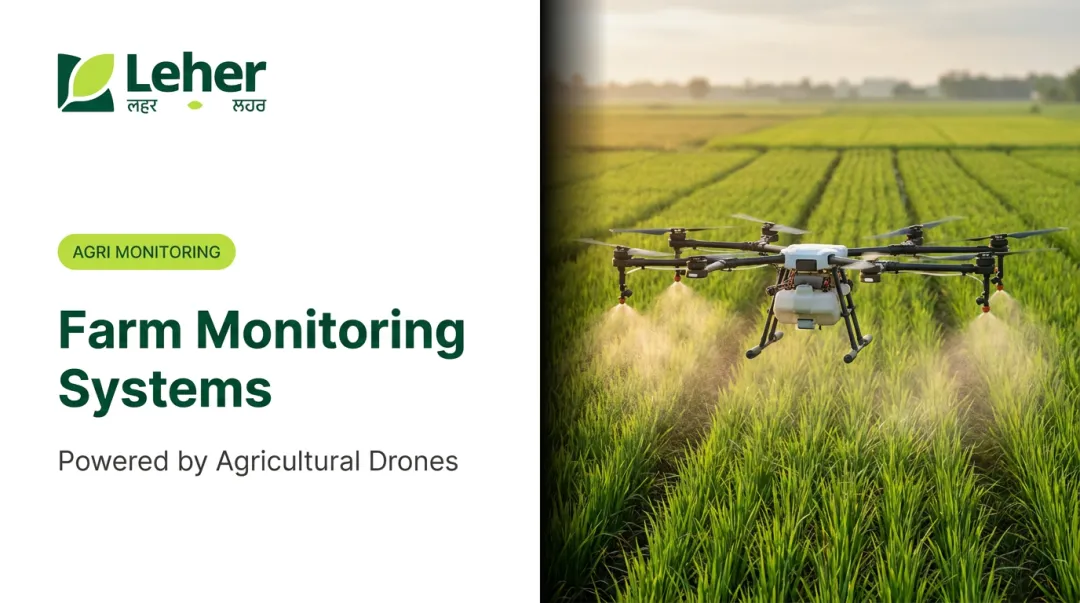
Agricultural drones serve two distinct functions: scouting and action.
For scouting, drones capture high-resolution multispectral imagery. NDVI indices track vegetation vigour; NDRE is better for detecting chlorophyll and nitrogen stress where dense canopies limit NDVI's usefulness. Together, they allow early identification of disease, pest pressure, and nutrient deficiency — weeks before visual symptoms become obvious.
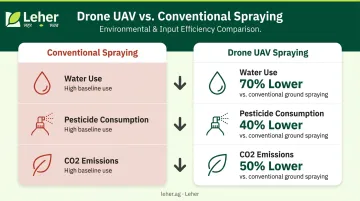
For action, drones deliver precision inputs directly to target zones. A 2025 peer-reviewed study on UAV spraying in India found 70% lower water use, 40% lower pesticide consumption, and 50% lower CO2 emissions compared to conventional spraying — figures that vary by crop and field conditions, but consistently favour drone application over ground-based methods.
Leher's on-demand drone spraying service, booked via the Leher App, puts these numbers into practice at field level: up to 90% water savings, 30% pesticide reduction, and 40% input savings — with a single DGCA-certified operator covering up to 50 acres per day.
In 2024, Leher served 6,500+ acres and supported 810+ farmers. Since founding in 2022, cumulative reach has grown to 30,000+ acres and 2,100+ farmers across India.
AI, Machine Learning, and Data Analytics
AI models process data from multiple sources — satellites, IoT sensors, drone imagery — to generate decisions rather than just observations. The ICRISAT-Microsoft AI Sowing App, for example, produced 10–30% yield increases for farmers following its AI-generated sowing advisories, according to the World Bank AI Repository. These outcomes are project-specific, but they illustrate what AI-guided decisions can deliver when models are built for local conditions.
Satellite and Remote Sensing
Satellite imagery provides wide-area crop health assessments across large fields or regions — useful for identifying broad variability patterns. The limitation is resolution and cloud cover, which makes satellites and drones complementary tools rather than substitutes. Satellites scan broadly; drones diagnose precisely.
Digital Platforms and Mobile Applications
Digital tools now address nearly every layer of the farm operation:
- Farm management software handles field logs, compliance records, and input schedules
- E-extension apps deliver advisory services in local languages, reaching farmers without reliable internet access
- Market linkage platforms like eNAM give farmers real-time mandi price data, reducing the information asymmetry that has historically favoured intermediaries over producers
How Digital Agriculture Transforms Farming Operations
Precision Resource Management
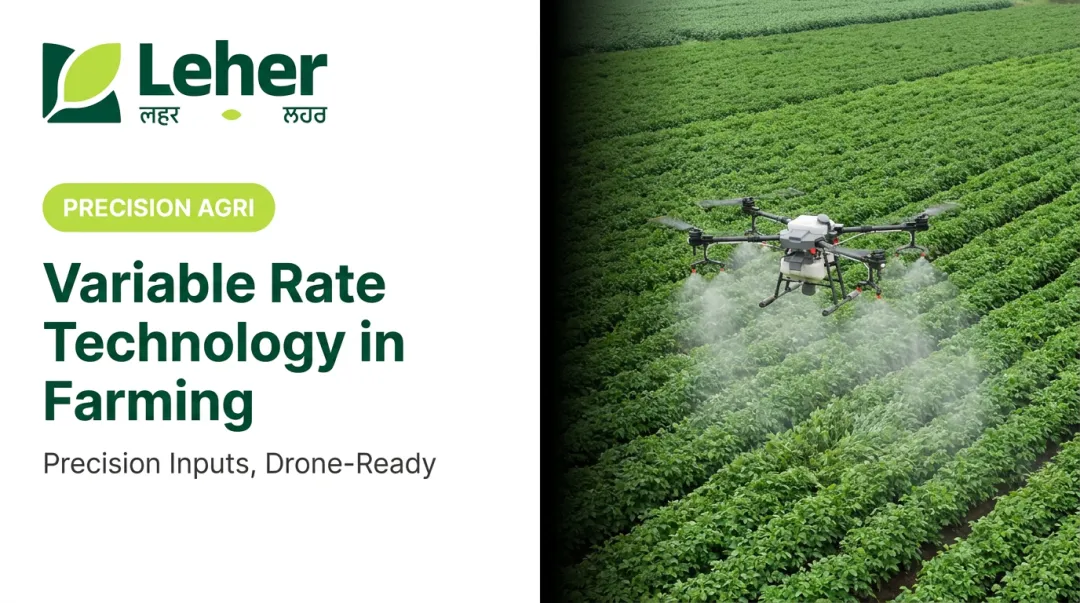
Variable-rate application technology — guided by prescription maps from sensor and drone data — allows farmers to apply exactly the right amount of water, fertiliser, or pesticide in the right place. One life-cycle review cited fertiliser cost savings of USD 258/ha/year in a documented precision agriculture case, alongside 10% total input savings over five years. These figures are context-dependent, but the mechanism is straightforward: less waste means lower costs and less environmental runoff.
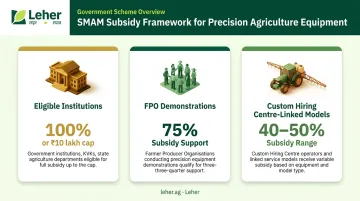
For smallholder India, the more practical route is through shared-service models. India's SMAM scheme supports this directly:
- Up to 100% subsidy (or ₹10 lakh) for eligible institutions
- 75% support for FPO demonstrations
- 40–50% subsidy for Custom Hiring Centre-linked models
This architecture makes precision spraying accessible to farmers who cannot afford their own equipment.
Improved Crop Health Monitoring
Continuous IoT monitoring and periodic drone scans enable intervention before crop losses escalate. Conventional management waits for visible damage — digital monitoring catches stress signals in spectral data before losses occur.
Leher's plantation clients illustrate this well. Crop-specific results from active operations:
- Tea: ~30 minutes per hectare; protects against Blister blight, Tea Mosquito Bug, and Red Dust; ~75% less chemical residue per kg of tea versus conventional methods across 700+ hectares sprayed
- Rubber: ~10 minutes per hectare; up to 50% cost savings per hectare per round
Labor Efficiency and Automation
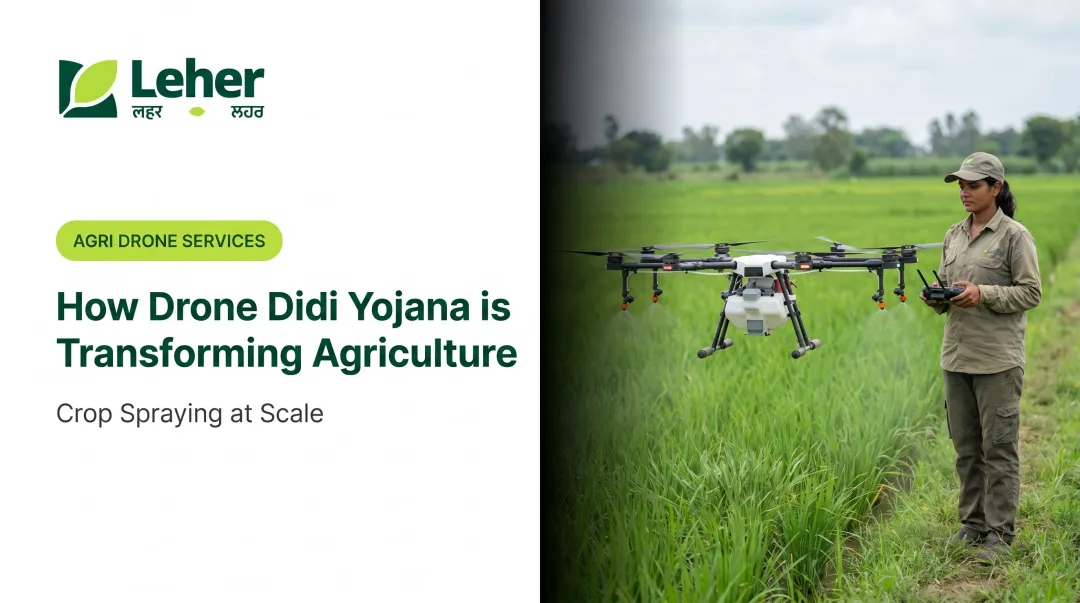
A single drone operator covering 50 acres per day replaces multiple manual labourers, each covering a fraction of that area with far higher chemical exposure. Leher's service requires no human chemical contact during spraying — relevant in a country where pesticide exposure among farm workers is a documented health burden.
IoT-controlled irrigation systems operate on similar logic: pumps activate based on soil moisture readings rather than fixed schedules, cutting water waste without requiring the farmer to be present.
Market Access and Supply Chain Transparency
Digital agriculture extends beyond the field. By March 2026, India's eNAM platform had registered 1.80 crore farmers, 1,656 mandis, and 4,724 FPOs, with cumulative trade reaching ₹4.84 lakh crore. The platform targets real-time price discovery and reduced intermediary control, though independent research suggests market integration outcomes have been uneven across regions.
Blockchain-based traceability adds another layer, with verifiable farm-to-consumer records that:
- Support organic and sustainable certification audits
- Justify premium pricing in export and urban retail markets
- Reduce dependence on intermediary quality claims
Digital Agriculture in the Indian Context
Why India's Challenges Make This Urgent
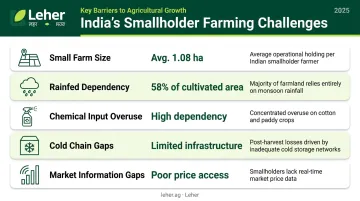
India's farming conditions create a specific kind of pressure that generic digital agriculture frameworks do not always address:
- Average farm size of 1.08 hectares — too small for most commercial precision agriculture equipment
- Rainfed agriculture covers 58% of cultivated area, producing 40% of food output, with no irrigation buffer
- Heavy chemical input dependency across major crops like cotton and paddy
- Limited post-harvest infrastructure and cold chain access
- Poor market information flow for smallholders without digital connectivity
The Policy Environment
India's government has moved aggressively on digital agriculture infrastructure:
- Digital Agriculture Mission (2024): ₹2,817 crore approved, including Agristack (a digital farmer registry), the Krishi Decision Support System, and a national Soil Fertility Profile Map
- Drone Rules 2021: Liberalised drone operations for agricultural use, enabling commercial services like Leher's
- PM-KISAN DBT: The 21st instalment delivered ₹18,000 crore to 9 crore farmers through direct bank transfer, normalising digital financial flows in rural India
- Rural connectivity: TRAI data shows 398.35 million rural internet subscribers as of March 2024, with 94.4% of rural households holding a mobile phone
Leher as Ground-Level Evidence
Leher's model demonstrates what digital agriculture looks like when designed specifically for Indian conditions: small plots, water scarcity, high pesticide dependency, and limited capital.
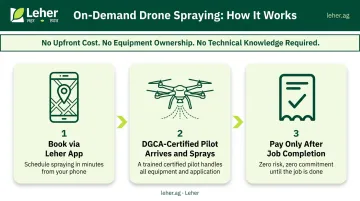
The booking process removes every traditional barrier to adoption:
- Farmer books a spraying session through the Leher App
- A DGCA-certified pilot arrives and completes the spray
- Payment is collected only after the job is done — no upfront commitment, no equipment ownership, no technical knowledge required
Across 30,000+ acres, 2,100+ farmers, and 100+ drone partners, the on-demand model has proven it can scale. Leher's 2030 target: 5 million farmers served and 1,000 rural drone operator-entrepreneurs in the network.
Rural Entrepreneurship as a Co-Benefit
Digital agriculture creates more than better farming outcomes. Leher's Drone Partner Program recruits rural entrepreneurs, provides AIF loan facilitation for drone acquisition, offers drone insurance, annual maintenance contracts, and 24/7 technical support. Partners manage orders through the Drone Partner App, collect payments via QR code, and run their own drone service businesses with Leher's infrastructure behind them.
This creates a direct economic alternative to rural-urban migration — turning local agricultural workers into drone business owners with recurring income, technical skills, and institutional support.
Challenges and Barriers to Adoption
Cost and Access
Drone subsidy caps of ₹4–10 lakh under SMAM are significant relative to average agricultural household income of ₹13,661 per month. Individual ownership is not the answer for most smallholders. Shared services are the practical path forward: Custom Hiring Centres, FPO-coordinated booking, contract spraying, and app-based on-demand models.
The SMAM framework already builds this in. The challenge is awareness and last-mile facilitation — getting farmers to know these options exist and how to access them.
The Digital Divide
Rural connectivity has improved substantially — 83.3% of rural households had internet access within premises in 2025 — but coverage is uneven and bandwidth is patchy. Not every farmer has a smartphone or the literacy to use one confidently.
Practical solutions are already in the field:
- LoRa sensors for low-power, low-bandwidth field monitoring
- SMS and USSD advisory apps for feature phone users
- Voice-based AI advisory services (documented by IFPRI in India) for farmers with low digital literacy
- mKisan reaches nearly 8.93 crore farm families via mobile messaging
Data Privacy and Ownership
The sensors, advisory apps, and precision tools listed above all generate data — and as that data becomes commercially valuable, the question of who owns it (farmers, platforms, agribusinesses, or government) needs clear answers. India's AgriStack includes a consent manager requiring farmer authorisation before data sharing. The Digital Personal Data Protection Act, 2023 provides a broader legal framework. Neither is fully operationalised yet, but both signal that policymakers recognise the risk — and farmers entering digital services today should know their consent rights before signing on to any platform.
The Future of Digital Agriculture
5G, Digital Twins, and Autonomous Systems
5G will enable near-real-time data transfer for autonomous field robots and coordinated drone operations. CGIAR describes 5G-enabled smart agriculture in India as connecting devices across farm, crop, climate, and soil data streams simultaneously — infrastructure that transforms what real-time advisory can look like.
Digital twins — virtual replicas of a farm updated continuously by live sensor data — allow farmers and agronomists to simulate crop scenarios before taking physical action. Research from Wageningen University and others identifies digital twins as a practical near-term tool, with pilot projects already applying the technology to irrigation scheduling and nutrient management decisions.
McKinsey estimates that enhanced connectivity in agriculture could add more than USD 500 billion to global GDP by 2030 — a 7–9% improvement over expected agricultural GDP — driven by the convergence of IoT, AI, and high-bandwidth connectivity.
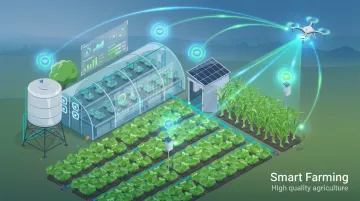
That connectivity also enables something farmers and buyers increasingly demand: verifiable trust across the supply chain.
Blockchain for Transparency
Blockchain-enabled traceability creates a tamper-proof record from field to shelf — without any single intermediary controlling the data. FAO and UNDP have both documented its practical role in agri-food supply chains, connecting directly to SDG goals on zero hunger and reduced inequality. In practice, this means:
- Verifying organic or sustainable certifications at the point of sale
- Creating immutable records of farm origin and handling history
- Supporting fair-trade positioning with evidence buyers and regulators can trust
Reaching India's Millions
The honest assessment: the promise of digital agriculture will only be realised when it reaches smallholder farmers at scale. That requires:
- Affordable or shared-access technology (not individual ownership at ₹10 lakh+)
- Local-language platforms that work on low-end smartphones or feature phones
- Policy support that subsidises services, not just hardware
- Community-based training that builds confidence, not just awareness
This is both the central challenge and the central opportunity for agri-tech in India over the next decade. Companies that solve for the smallholder — in price, language, literacy, and trust — are already showing what that transformation looks like in practice: app-booked drone spraying delivered to a farmer's field, paid only after the job is done, with no equipment ownership required.
Frequently Asked Questions
What is digital agriculture?
Digital agriculture uses connected technologies — sensors, drones, AI, satellites, and digital platforms — to collect, analyse, and act on data across the entire agricultural value chain, from on-farm production to post-harvest markets. The goal is more efficient, sustainable, and equitable farming outcomes.
What is the future of digital agriculture?
Emerging trends include 5G-enabled autonomous machinery, AI-powered predictive crop management, digital twins that simulate farm conditions using live sensor data, and blockchain-based supply chain traceability. Together, these developments are making farming more data-driven and directly connected to global markets.
How does digital agriculture benefit small-scale farmers?
Digital tools cut input costs through precision application, give farmers real-time market price data that strengthens their bargaining power, and connect smallholders directly to buyers. On-demand service models — where farmers pay only after service delivery — remove the barrier of upfront equipment investment.
What role do drones play in digital agriculture?
Drones serve two core functions in modern farming. First, multispectral imaging enables early detection of disease, crop stress, and nutrient deficiency. Second, precision input delivery — pesticides, fertilisers, weedicides — significantly reduces chemical and water use compared to conventional ground-based application.
What are the biggest challenges of implementing digital agriculture in India?
Key barriers include:
- High upfront technology costs relative to smallholder incomes
- Rural connectivity gaps that limit cloud-based tools
- Low digital literacy among older farming communities
- Unclear policy frameworks around farm data ownership and consent
How does digital agriculture contribute to sustainable farming?
Precision resource application — using only the water, fertiliser, and pesticides actually needed, where they are needed — directly reduces chemical runoff, soil degradation, and greenhouse gas emissions. Leher's drone spraying, for example, achieves around 90% water savings and 30% pesticide reduction per application versus conventional methods.