The real challenge is not just the disease — it is the delay in spotting it. Most Indian farmers still rely on manual visual inspection: walking fields, examining leaves, and making judgment calls with the naked eye. By the time visible symptoms are obvious, a disease may already have spread well beyond any single plant.
This guide covers the major types of crop diseases, their early warning signs, the full spectrum of detection methods (from field scouting to AI and drone surveillance), and a practical step-by-step approach to building a proactive detection system.
Key Takeaways
- Crop diseases — bacterial, fungal, viral, or nematode-caused — each have distinct symptoms and require different responses
- Early detection dramatically reduces losses: tomato leaf curl virus caused 98.43% yield loss at 30 days after transplanting, versus just 5.44% at 75 days
- Detection methods span manual scouting, satellite vegetation indices, AI image analysis, and drone-based surveillance
- A structured four-step process — monitor, diagnose, assess, act — shifts disease management from guesswork to a repeatable, field-tested system
- Precision drone technology can compress the gap between detection and treatment, reducing response time and input costs
What Is Crop Disease Detection?
Crop disease detection is the systematic process of identifying abnormal changes in plant health — caused by pathogens, pests, or environmental stress — early enough to enable a meaningful response.
It sits between two other stages in the crop management cycle:
- Monitoring — the ongoing observation of crop health over time
- Treatment — the targeted intervention once a problem is identified
Detection is the bridge. When detection happens early, treatment is targeted and affordable. When it happens late, the intervention window has already narrowed — and so have the options.
Reactive vs. Proactive Detection
Reactive detection is still the norm on most farms: a farmer notices yellowing leaves or wilting plants, investigates, and responds. This approach is better than nothing, but it almost always means the disease has already established itself.
Proactive detection flips the sequence. Using tools like satellite vegetation indices, weather-based risk models, and AI image analysis, farmers can flag stressed zones before visible symptoms appear. Earlier detection means lower treatment costs, less crop loss, and more options for intervention — which is why precision agriculture is moving steadily in this direction.
Types of Crop Diseases and Their Early Warning Signs
Crop diseases fall into two broad categories:
- Biotic — caused by living organisms: bacteria, fungi, viruses, nematodes, or parasitic plants
- Abiotic — caused by environmental stress: drought, waterlogging, nutrient deficiency, temperature extremes
Abiotic stress often weakens plants and makes them more susceptible to biotic disease — so the two frequently compound each other.
Bacterial Diseases
Bacterial pathogens typically enter crops through wounds, insect damage, or natural openings such as stomata, and are activated by warm, humid conditions. Early symptoms include:
- Water-soaked lesions that darken over time
- Wilting despite adequate moisture
- Yellowing along leaf margins
- Vascular discoloration when stems are cut
In Indian paddy fields, the consequences are well-documented. ICAR trials in Haryana recorded a mean yield loss of 29.88% from rice bacterial blight, with susceptible varieties like Pusa Basmati-1 losing up to 45.14% of grain yield when infected early in the season.
Fungal Diseases
Fungal pathogens spread through wind-borne spores, contaminated soil, and infected seeds — making containment especially urgent once the disease is active. Early signs include:
- Circular or irregular leaf spots with defined margins
- Powdery or dusty coatings on leaf surfaces
- Rust-coloured pustules or streaks
- Soft rotting at stems or roots
Rice blast is one of India's most damaging fungal threats, capable of exceeding 75% annual yield loss during epidemic conditions. The disease spreads faster in high-humidity environments with cool nights — conditions common across major paddy-growing states.
With fungal diseases, catching infection before spore dispersal determines whether a farmer manages a small patch or an entire field. Waiting for visible spread is already too late.
Viral Diseases
Viral diseases spread through insect vectors (whiteflies, aphids, thrips), contact, or infected planting material. Symptoms include mosaic patterns, leaf curl, stunted growth, and malformation.
Timing of infection drives severity. Tomato leaf curl disease — prevalent across Indian vegetable belts — has been documented at 90–100% yield loss in severe cases. Infection at 30 days post-transplanting caused 98.43% yield loss; infection at 75 days caused only 5.44%.
Nematode Infections
Nematode infections are soil-dwelling and largely invisible above ground until damage is severe. Root-knot and cyst nematodes cause root galling, restricted water uptake, and stunted growth — with drought-like symptoms even when soil moisture is adequate.
In India, plant-parasitic nematodes cause an estimated 21.3% annual crop loss worth ₹1,02,039.79 million across major crops. Because above-ground symptoms mimic other stresses, nematode damage is routinely misdiagnosed until root inspection confirms it.
Distinguishing Disease from Abiotic Stress
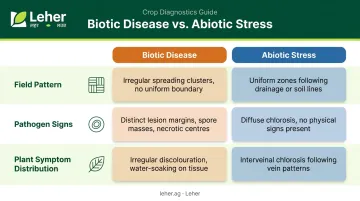
A common and costly mistake: misreading early disease symptoms as nutrient deficiency or drought. Three visual cues help separate them:
- Pattern in the field — Abiotic stress tends to follow soil variation, drainage patterns, or application boundaries. Biotic disease often appears in irregular clusters or spreads outward from an initial point of infection
- Signs of pathogen presence — Fungal diseases often show physical evidence: spore masses, mycelium, or lesions with distinct margins. Nutrient deficiency produces diffuse chlorosis without such signs
- Symptom distribution on the plant — Iron deficiency shows interveinal chlorosis with sharp contrasts between green veins and yellowed tissue. Disease lesions are more irregular and may include necrotic centres, water-soaking, or discolouration that does not follow vein patterns
Methods for Crop Disease Detection: From Field Scouting to AI
Detection methods span a wide range — from a trained scout walking rows to satellite data processed by machine learning algorithms. The right combination depends on farm size, budget, and the speed of response required.
Traditional Visual Scouting
Manual field scouting remains the baseline for most Indian farms. Trained scouts or agronomists walk the field at regular intervals, examining leaves, stems, and root zones for symptoms.
India's Agro-Ecosystem Analysis (AESA) protocol for rice IPM, for example, begins observations 20 days after transplanting, selecting five random spots and observing 20 hills each. This structured approach improves consistency compared to informal observation.
The limitations are real, though:
- Coverage is slow and labour-intensive on larger farms
- Results depend heavily on scout expertise and experience
- Symptoms may already be well-advanced by the time they are spotted
- Scout availability during critical crop stages is often limited
Remote Sensing and Satellite Data
Satellite-based vegetation indices — particularly NDVI (Normalised Difference Vegetation Index) and NDRE (Normalised Difference Red Edge) — detect changes in plant chlorophyll levels and water content by measuring how plants reflect light across different wavelengths.
The value is in early flagging. Hyperspectral studies have shown that potato late blight and early blight were detectable 2 to 4 days before visible symptoms appeared — giving farmers a critical window to act. Satellite platforms like Sentinel-2, which carries three red-edge bands, support chlorophyll-content monitoring at field scale.
These tools do not confirm a specific disease on their own. They identify stressed zones that warrant closer inspection — making them a triage tool rather than a diagnostic one. That diagnostic gap is where AI steps in.
AI and Machine Learning-Based Detection
The PlantVillage benchmark — trained on 54,306 images across 26 disease and healthy plant classes — achieved 99.35% accuracy under controlled conditions, demonstrating that image-based classification can match expert-level diagnosis at scale.
India-specific research has gone further: CNN models trained on 96,206 images across 37 disease categories in 14 Indian crop species have been built and validated by Indian researchers. Apps like Plantix bring this capability to the field — farmers photograph affected leaves with a smartphone and receive a diagnosis within seconds.
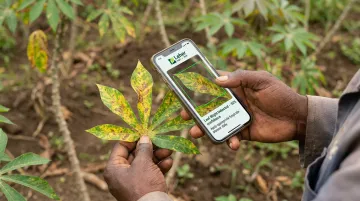
India's National Pest Surveillance System (NPSS), launched on 15 August 2024, now supports AI-assisted pest and disease identification for 61 crops and advisories for 15 major crops — the largest government-backed digital detection rollout to date.
Drone-Based Surveillance
UAVs equipped with multispectral or RGB cameras can scan large areas quickly, capturing both visual and spectral data to identify disease hotspots at scale. Key advantages over ground scouting:
- Speed — covers dozens of acres in a single flight
- Consistency — removes human variability from observation
- Early detection — captures spectral anomalies before they are visible to the naked eye
- Mapping — generates spatial data that delineates affected zones precisely
Drone data can be fed directly into AI models for near-real-time disease mapping. In practice, this means a single drone flight can both flag a stressed zone and generate the imagery needed to identify what disease is causing it — cutting the gap between detection and treatment.
How Crop Disease Detection Works in Practice: A Step-by-Step Approach
Effective crop disease detection follows a repeatable cycle. Skipping follow-up or documentation steps cuts short the learning that makes each season easier to manage than the last.
Step 1 – Monitor and Observe
Continuous monitoring — through scheduled scouting, satellite alerts, or drone passes — provides the baseline needed to detect deviations from healthy crop appearance. Monitoring must be systematic, not reactive. The NIPHM rice IPM protocol begins field observations at 20 days after transplanting precisely because waiting for visible problems means starting too late.
Step 2 – Identify and Diagnose
Diagnosis means matching observed symptoms against known disease profiles to determine the most likely cause. AI-assisted image tools, extension advisories, and agronomist consultation all have a role here.
Treating without a confirmed diagnosis is a costly mistake — applying a fungicide to a bacterial infection, or a pesticide to a nutrient deficiency, wastes money and can worsen the problem.
Step 3 – Assess Severity and Spread
Once a disease is identified, the next question is scale: Is the infection isolated to a few plants, a section of the field, or spreading broadly? This assessment determines:
- Urgency of response
- Type and volume of treatment required
- Whether quarantine or removal of infected material is needed
Drone mapping or satellite data can delineate affected zones accurately, giving farmers a clear picture of where to act first.
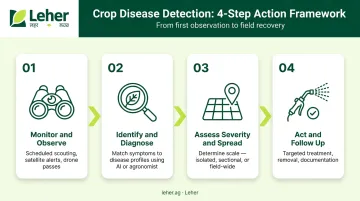
Step 4 – Act and Follow Up
Response actions include targeted pesticide or biological treatment, removal of infected plant matter, and irrigation adjustments. Post-treatment monitoring then confirms whether the disease is under control or resurging.
Documentation matters here. Recording what was detected, when, at what severity, and what worked builds a farm-level record that makes the next outbreak faster to identify and manage.
How Leher's Drone Technology Supports Early Disease Response
Detecting a disease early is only half the challenge. The other half is how quickly and precisely a farmer can respond.
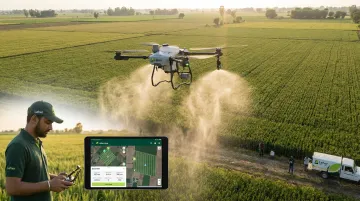
Once disease hotspots are identified — through visual scouting, satellite data, or drone surveillance — Leher's drone-powered precision spraying service connects detection directly to treatment. For farmers managing thin margins, this matters: drones deliver targeted pesticide and foliar input applications with up to 30% less chemical use and up to 90% less water compared to conventional spraying methods.
That translates to lower input costs, reduced environmental load, and less collateral damage to healthy crop zones.
Leher's service covers the crops where disease pressure hits hardest in India:
- Field crops: paddy, cotton, sugarcane, wheat, and vegetables
- Plantation crops: tea (Blister blight and Red Dust) and rubber (Phytophthora)
The service is fully on-demand through the Leher App — a farmer books a session, a DGCA-certified pilot arrives, sprays the crop, and payment is made after completion.
Leher has sprayed 30,000+ acres and supported 2,100+ farmers across India. For individual farmers, FPOs, and large farm operations, the ability to deploy a treatment response quickly — up to 50 acres per day — makes a direct difference in containing disease spread before it reaches healthy fields.
Conclusion
Crop disease detection gives farmers more time to act. The earlier a disease is identified, the more options remain available — and the lower the cost of intervention. That window between healthy crop and significant yield loss is where good detection practice operates.
The tools available to Indian farmers are expanding rapidly:
- Structured AESA scouting protocols for field-level observation
- Government platforms like NPSS for disease identification and advisories
- AI-powered smartphone apps for image-based diagnosis
- Satellite monitoring for large-scale crop health mapping
- Drone-based surveillance for fast, precise field assessment
The methods will keep improving. But consistent monitoring — observing systematically, diagnosing accurately, and documenting outcomes — is what makes any tool effective.
Farmers who build that discipline now respond faster when disease appears — and faster response means more of the crop saved.
Frequently Asked Questions
What are the most common early signs of crop disease that farmers should look for?
Key indicators include unusual spots or lesions on leaves, wilting despite adequate water, discolouration along leaf margins, abnormal growth patterns, and changes in leaf texture or coating. Symptoms appearing in clusters or spreading in patches — rather than uniformly across the field — are a strong signal to investigate further.
What is the difference between bacterial, fungal, and viral crop diseases?
Bacterial diseases enter through wounds or openings and thrive in warm, humid conditions; fungal diseases spread via spores and are the most common and generally treatable type. Viral diseases, transmitted by insects or contact, are the hardest to cure once established — making early detection especially critical.
How do AI and machine learning tools help in detecting crop diseases?
AI models analyse photographs of plant leaves or field zones to identify disease symptoms with high accuracy, often faster than manual inspection. Tools like Plantix are available as smartphone apps, and India's NPSS platform now supports AI-assisted identification for 61 crops — making this capability increasingly accessible to smallholder farmers.
Can drones be used for crop disease detection and treatment?
Yes. Drones equipped with multispectral cameras can identify stressed crop zones before visible symptoms appear, and precision spraying drones can then deliver targeted treatment to affected areas — reducing both response time and chemical use compared to conventional methods.
What happens if crop disease is not caught early?
Late detection allows pathogens to spread rapidly, raising treatment costs and reducing final yield. In severe cases — as seen with rice blast and tomato leaf curl in India — late-stage infection can cause near-total crop failure, making early detection one of the most cost-effective actions a farmer can take.
How can Indian smallholder farmers access better crop disease detection tools?
Several low-cost options are available: the NPSS platform for AI-assisted identification, the Kisan Call Centre (toll-free 1800-180-1551), smartphone apps like Plantix, and on-demand drone spraying services like Leher — bookable via mobile app with no large upfront investment required.