Introduction
Indian agriculture is running a water deficit it cannot afford to ignore. According to CGWB's 2024 groundwater assessment, agriculture accounts for 213.29 billion cubic metres out of India's total annual groundwater extraction of 245.64 bcm — that's 87% of all groundwater drawn going to farms. Meanwhile, states like Punjab and Haryana are extracting groundwater at 156% and 136% of their annually replenishable resources respectively.
The culprit is largely how water gets applied. Traditional flood and furrow irrigation dumps water uniformly across fields — regardless of what different soil zones actually need — leading to waterlogging, soil salinity, runoff, and massive pump electricity bills for farmers who can least afford them.
Precision irrigation changes this equation. Instead of flooding fields uniformly, it delivers the right amount of water to the right zone at the right growth stage — cutting waste without cutting yields.
This guide covers:
- What precision irrigation is and how it works
- Why it matters for Indian farms right now
- The main methods and the technology behind them
- How to choose the right approach for your field
Key Takeaways
- Precision irrigation targets water delivery based on actual crop and soil needs — not fixed schedules or uniform field flooding.
- Four main methods: drip, sprinkler, surface (with laser levelling), and drone-based precision spraying — each suited to different crops and conditions.
- Benefits include up to 90% water savings, stronger yields, lower weed and disease pressure, and preserved soil health.
- Sensors, satellite data, and agricultural drones enable field-specific scheduling — so water reaches the right zone at the right time.
- Small and marginal farmers — 86% of India's operational holdings — can access subsidised systems and on-demand services without heavy upfront investment.
What Is Precision Irrigation?
Precision irrigation is the practice of delivering the right amount of water to the right location at the right time — guided by crop needs, soil conditions, and environmental data rather than habit or convenience.
The contrast with conventional methods is direct. Flood or furrow irrigation treats an entire field as uniform, applying water everywhere regardless of soil variability, crop stage, or actual moisture deficit. Precision systems divide the field into zones, each receiving calibrated moisture based on its specific requirements.
How It Works in Practice
Rather than one blanket application, precision irrigation considers:
- Soil type — clay holds moisture longer than sandy soils and needs less frequent application
- Crop stage — seedlings and flowering plants have different water demands than mature crops
- Field topography — low-lying zones retain moisture; elevated areas dry out faster
- Weather data — recent rain or forecasted temperature affects how much supplemental irrigation is actually needed
Each zone gets exactly what it needs — no more, no less — whether the crop is at germination or peak demand.
When this calibration is in place, the system can go further. Precision irrigation pairs naturally with fertigation — delivering water and dissolved nutrients simultaneously through the same lines. Nutrients reach the root zone directly, improving uptake without adding separate application runs or extra inputs.
Why Precision Irrigation Is Critical for Indian Agriculture
The numbers from CGWB are difficult to look past. India's national stage of groundwater extraction stands at 60.47% overall — but that national average conceals severe regional stress. In Punjab, 75% of assessment units are over-exploited. In Haryana, 61.5% of units are in the same category. Rajasthan is extracting groundwater at nearly 150% of replenishable capacity.
The Consequences of Over-Irrigation
Excessive irrigation wastes water and actively damages farmland:
- Waterlogging raises water tables, cutting off root oxygen and reducing productivity
- Soil salinity builds up when saline irrigation water evaporates and leaves minerals behind, degrading long-term fertility
- Nutrient leaching washes applied fertilisers below the root zone, increasing input costs with no agronomic return
- Groundwater depletion raises pumping costs as water tables drop deeper
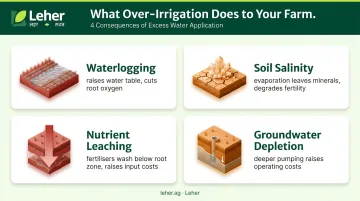
ICAR-CSSRI research confirms that indiscriminate use of brackish irrigation water, poor drainage, and rising water tables are primary drivers of India's soil salinity problem — a cycle that conventional irrigation perpetuates.
The Climate and Economic Pressure
Erratic monsoons are compounding the problem. Rain-fed states can no longer plan around reliable seasonal rainfall, making supplemental irrigation more critical while simultaneously raising the stakes for water efficiency.
For the 86.08% of Indian operational holdings classified as small or marginal (Agricultural Census 2015-16), water mismanagement translates directly into economic pain: higher electricity bills to pump from deeper wells, fertiliser losses from leaching, and yield penalties from waterlogged or salt-stressed soil.
The PM Krishi Sinchayee Yojana (PMKSY) and its "More Crop Per Drop" mandate confirm that precision irrigation is already a national priority, with subsidies in place to help farmers transition.
By end-December 2024, the PDMC component alone had brought 95.58 lakh hectares under micro-irrigation, with ₹21,968.75 crore released since inception.
Key Methods of Precision Irrigation
Four primary methods exist. The right choice depends on matching the method to your crop, soil type, terrain, and water source.
Drip (Trickle) Irrigation
Water moves through a network of pipes and emitters directly to the root zone at low pressure. The surrounding soil stays relatively dry, which:
- Minimises evaporation loss
- Discourages weed germination in inter-row spaces
- Reduces incidence of soil-borne fungal disease
Drip irrigation suits vegetables, fruits, sugarcane, and cotton particularly well. PMKSY/PDMC provides financial assistance specifically for drip system installation.
Subsurface drip irrigation (SDI) takes this further: pipes are buried underground, eliminating surface evaporation entirely. ICAR-CSSRI and CIMMYT published an India-specific SDI manual for cereal systems in 2023, indicating growing institutional support for this variant in wheat and similar crops.
Sprinkler Irrigation
Sprinkler systems spray water through rotating or fixed nozzles, mimicking rainfall. They work across a wide range of crops and terrains but require attention to:
- Wind conditions — strong winds cause uneven distribution and drift loss
- Crop sensitivity — high-pressure sprinklers can damage flowering crops; better suited to cereals and groundnut
- Energy requirements — pressurised systems need reliable power supply
For flat land with cereal crops, sprinklers offer a practical middle ground between the labour-intensity of drip installation and the water waste of flood irrigation.
Surface Irrigation with Laser Levelling
Surface and furrow irrigation remains the most common method in India — particularly for paddy and wheat. Water flows by gravity along furrows or across level basins. Water-intensive by nature, but efficiency improves substantially with laser levelling, which creates a precisely uniform field surface that eliminates low spots where water pools and high spots that stay dry.
This is a pragmatic transition point for farmers not yet ready to shift to drip or sprinkler systems.
Drone-Based Precision Spraying
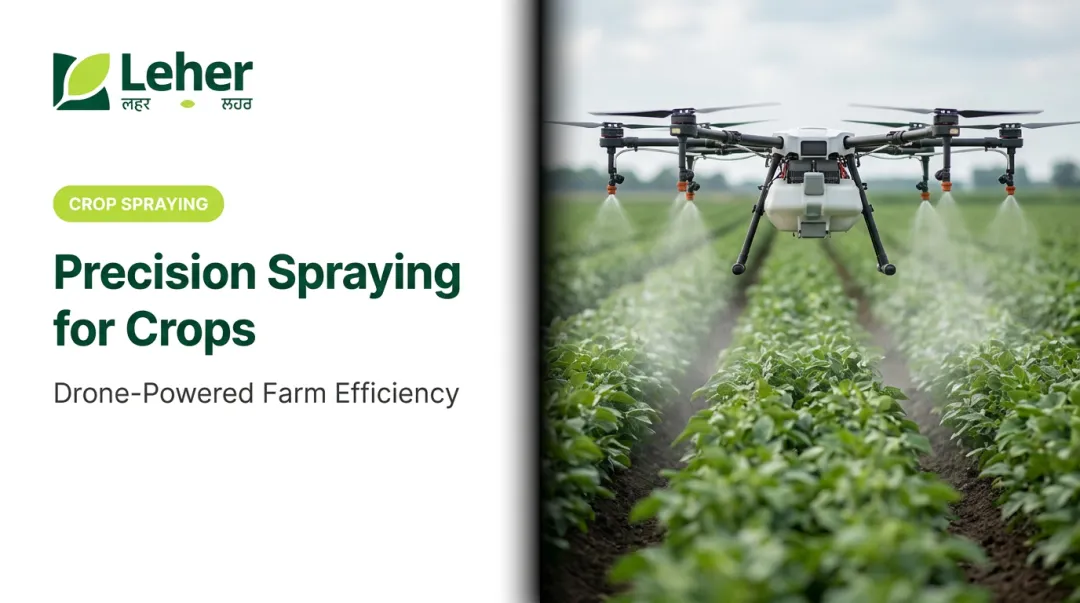
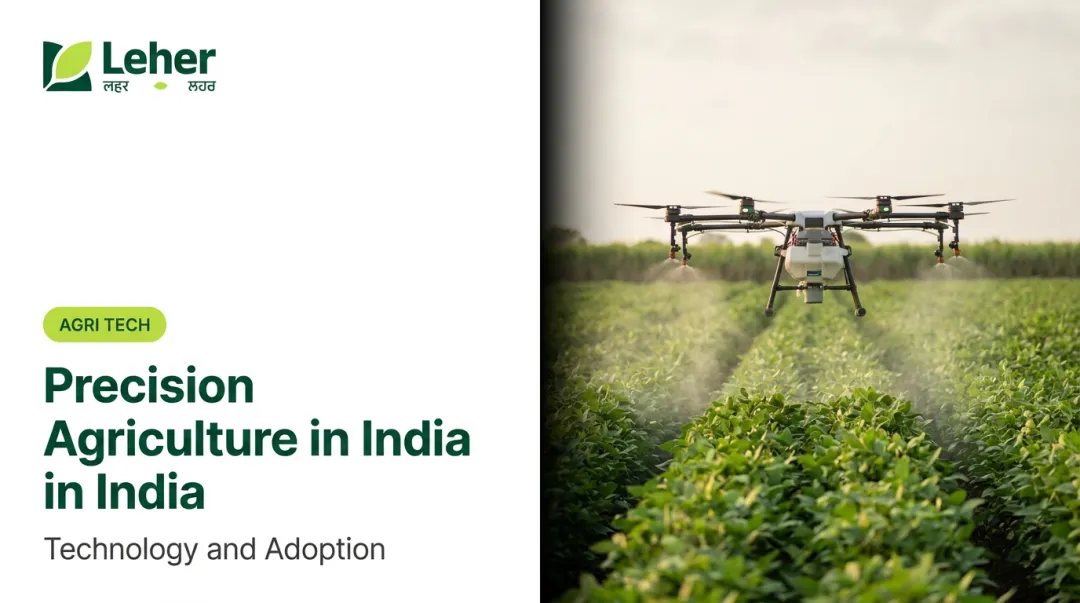
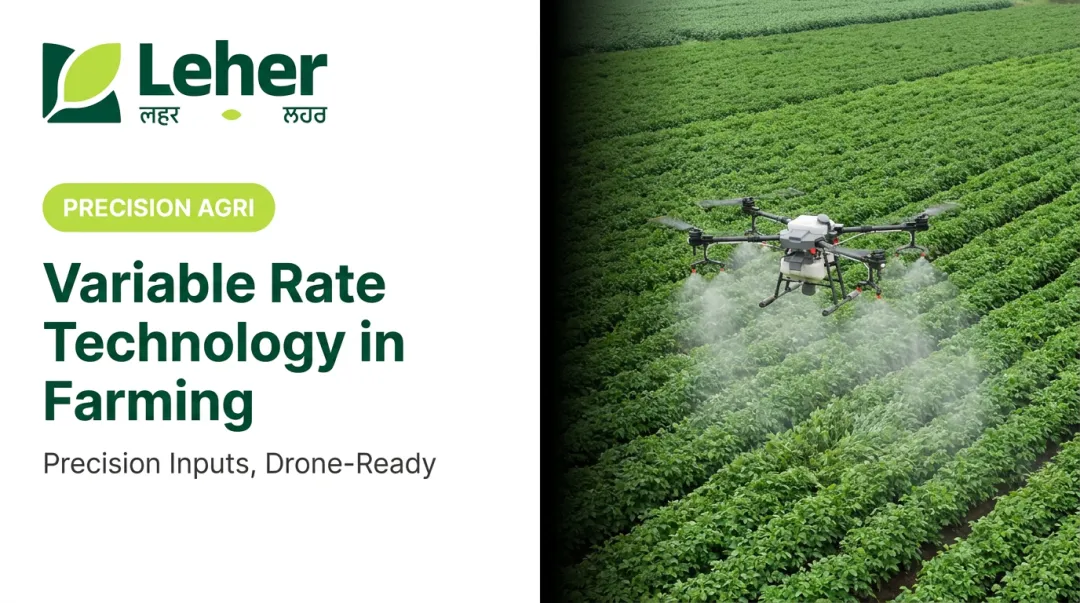
Agricultural drones deliver inputs — pesticides, foliar fertilisers, weedicides — with GPS-guided precision across field zones. This is technically distinct from irrigation, but it belongs in any precision agriculture discussion: drones sharply cut the water used as a carrier medium, often by up to 90% compared to conventional spraying.
Leher's drone spraying service, for example, cuts pesticide use by around 30% and delivers roughly 40% input savings overall. Coverage reaches up to 50 acres per day per operator — about 8x the output of manual spraying. Farmers book through the Leher App with no upfront equipment cost, paying only after the job is done.
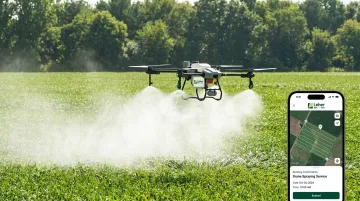
For fragmented landholdings, hilly terrain, or farms with tall dense crops like sugarcane where ground equipment damages plants, drone delivery is often the most practical option for precision input application.
Benefits of Precision Irrigation for Farmers
Water and Cost Efficiency
Every litre of water saved from field application is also a litre that doesn't need to be pumped. For Indian farmers running diesel or electric pumps from increasingly deep groundwater, pump operating costs are a significant expense. Reducing water application directly reduces this overhead.
Precision methods like drip keep water confined to the root zone, where it's actually used — rather than spreading across field surfaces where evaporation, runoff, and deep percolation claim large fractions before reaching the crop.
Yield Improvement
Plants receiving water at the right time and in the right quantity grow with less growth stress. Consistent soil moisture during critical growth stages — germination, tillering, flowering, grain fill — produces more uniform stands and higher yields.
Over-watered crops are just as stressed as under-watered ones. Waterlogged roots lose oxygen access, making them more vulnerable to disease and reducing effective nutrient uptake.
Weed and Disease Suppression
Drip irrigation keeps inter-row soil dry. Weed seeds need moisture to germinate — and if the surface between rows stays dry, germination rates drop significantly.
Lower weed pressure translates directly into:
- Less manual weeding labour during the growing season
- Reduced herbicide spend per acre
- Fewer competitive losses during the early crop canopy stage
- Drier soil surfaces that suppress soil-borne fungal pathogens
Soil Health Preservation
Repeated over-irrigation compacts soil structure, accelerates salinity buildup, and leaches nutrients below root reach. Precision irrigation maintains moisture at levels that support active microbial communities, organic matter decomposition, and the nutrient cycling that keeps soil fertile across multiple seasons.
For Indian farmers managing the same plots year after year, protecting soil structure is as important as the current season's yield — degraded soil costs more to remediate than to protect.
How Technology Powers Precision Irrigation
Modern precision irrigation systems don't run on guesswork. Several technologies now make irrigation decisions more accurate and less labour-dependent:
- Soil moisture sensors measure actual moisture content at root depth and trigger irrigation only when levels drop below crop-appropriate thresholds — removing the risk of both over- and under-watering
- IoT-based controllers automate delivery scheduling based on sensor inputs, weather forecast integration, and crop growth stage data
- Satellite remote sensing — ISRO's EOS-04 operational soil moisture product provides data at 500 m resolution, while NISAR-based products are being developed at 100 m resolution — enabling regional-scale monitoring of soil water status
- Drone multispectral imaging allows pilots to detect crop stress zones before they're visible to the eye, by capturing wavelengths that indicate water or nutrient deficiency; targeted irrigation of only deficit areas reduces overall water use while protecting yield in stressed zones
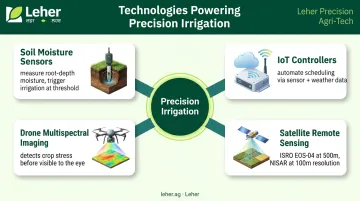
A 2025 India-based study confirmed that drone-mounted multispectral cameras can reliably identify precision agriculture needs at field scale — the capability exists and is being validated in Indian conditions.
For Indian farmers managing water-scarce seasons, this matters: decisions that once relied on experience and guesswork can now be guided by field-level data — reducing waste without sacrificing yield.
How to Choose the Right Precision Irrigation Method
Match the method to your field reality. Key factors:
| Factor | What to Consider |
|---|---|
| Soil type | Clay retains moisture longer; sandy soils need smaller, more frequent doses |
| Crop type | Shallow-rooted vegetables vs. deep-rooted trees have very different delivery needs |
| Farm size | Larger farms benefit more from automated systems; smaller farms may find on-demand services more practical |
| Terrain | Flat land suits sprinkler or surface; fragmented or hilly land suits drone delivery |
| Water source | Borewell, canal, or harvested rainwater each affect pressure, timing, and system choice |
A practical decision guide:
- Small vegetable or fruit farms → drip irrigation, ideally with subsidy support
- Cereal crops on flat land → sprinkler or laser-levelled surface irrigation
- Fragmented holdings, hilly terrain, or tall crops like sugarcane → drone-based precision delivery (services like Leher's on-demand drone spraying, bookable via app, work well here)
- Large open-field or commercial farms → centre-pivot sprinkler or drip tape systems
Subsidies to Know About
Before investing, check what's available. Under PMKSY-PDMC:
- Small and marginal farmers receive 55% financial assistance on the unit cost of micro-irrigation system installation
- Other farmers receive 45% assistance
- North Eastern and Himalayan states receive additional unit cost consideration
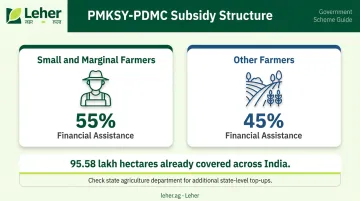
The scheme has already covered 95.58 lakh hectares across India. Visit your state's agriculture department or the PDMC portal to check current state-level schemes — some states top up the central allocation with additional support.
Frequently Asked Questions
What is the meaning of precision irrigation?
Precision irrigation is the targeted delivery of water to crops in the right quantity, at the right time, and in the right location, based on actual crop needs and soil conditions. It contrasts with uniform field-wide application, which ignores variability in soil type, crop stage, and moisture status across different zones.
What is the main goal of precision irrigation systems?
The primary goal is maximising water use efficiency — ensuring crops receive optimal moisture for healthy growth while minimising waste through evaporation, runoff, and deep percolation. Reduced water input also cuts pump operating costs and groundwater withdrawal pressure.
What are examples of precision irrigation?
Main examples include drip (trickle) irrigation, subsurface drip irrigation, sprinkler irrigation, and drone-based precision input delivery. Each suits different crop types, soil conditions, and farm sizes, so the right fit depends on your land and crop requirements.
How does precision irrigation save water compared to traditional methods?
Flood irrigation loses large volumes to evaporation, runoff, and percolation before crops can absorb any of it. Precision systems deliver water directly to the root zone — drip irrigation eliminates most surface evaporation, while drone-based delivery uses water only as a carrier and can cut consumption by up to 90%.
Is precision irrigation suitable for small farmers in India?
Yes, and PMKSY-PDMC subsidies cover 55% of system costs for small and marginal farmers, significantly lowering the barrier. On-demand drone spraying services like Leher's remove the need for any capital equipment investment: farmers book through an app and pay only after the job is done.
What role do drones play in precision irrigation?
Drones deliver pesticides, foliar fertilisers, and crop protection inputs with GPS-guided precision to specific field zones, sharply reducing both input waste and water used as a carrier. Multispectral cameras can also detect crop stress before it's visible to the eye, giving farmers the field data needed for smarter irrigation decisions.