Introduction
Indian farmers spend a significant share of their input budget on crop protection chemicals, yet a large portion of that investment never reaches its target. According to the US EPA, up to 10% of agricultural pesticide applications are lost to drift alone.
This inefficiency has a massive impact in India. With a crop protection market estimated at over ₹20,000 crore (USD 2.5 billion), even small operational losses directly harm the financial stability of farming households.
Spraying efficiency, at its core, means getting the right amount of chemical to the right place at the right time — with minimal losses to drift, evaporation, or runoff. For Indian farmers managing tight input budgets, this directly affects crop health, yield quality, and the overall cost of cultivation.
This guide covers the most common spraying methods used across India, the key factors that determine how efficiently any sprayer performs, and how modern drone-based systems are reshaping what's possible — particularly for the smallholder farms that make up the majority of Indian agriculture.
Key Takeaways
- Maximise target coverage to reduce chemical waste, operational costs, and crop damage.
- Choose the right method—from knapsacks to drones—based on your farm's scale and crop type.
- Optimise nozzles, calibration, travel speed, and weather conditions to boost efficiency.
- Cut water usage dramatically with drones, which use just 20–25 litres per hectare.
- Improve outcomes by checking nozzles, spraying at the right time, and matching the method to the crop stage.
Why Spraying Efficiency Matters for Indian Farmers
The Economics of Waste
Every litre of pesticide that drifts off-target or runs off into the soil is money spent for zero return. For most Indian farming households, crop protection inputs represent one of the largest variable costs per season. When application is uneven or poorly timed, pest control fails — and farmers repeat the application, compounding both cost and chemical load.
According to the Agriculture Census 2015-16, 86.08% of all operational holdings in India are small and marginal farms under 2 hectares. At this scale, even a 15–20% reduction in input waste can meaningfully improve net returns — a margin that separates a profitable season from a loss.
Beyond the direct financial losses, inefficient spraying carries significant environmental and health risks.
Environmental and Health Consequences
Over-application doesn't just waste money. Pesticide runoff can enter surface water through rainfall and irrigation, affecting both soil biology and aquatic ecosystems.
Farmers applying chemicals with manual knapsack sprayers also face direct occupational exposure. Research has documented skin contamination on the head, body, and legs during these operations, with legs often showing the highest exposure levels.
The push toward sustainable agriculture in India makes this more than an individual farm concern. Reducing chemical load protects biodiversity, groundwater quality, and the long-term productivity of the land itself.
Why Method Selection is Critical for Small Farms
These economic and environmental pressures are compounded by a core reality of Indian agriculture: farm size.
India's fragmented landholding structure means large tractor-mounted boom sprayers are often impractical for sub-2-hectare plots. At the same time, manual knapsack sprayers are slow, labour-intensive, and expose operators directly to chemicals. Selecting the right method for a farm's scale and terrain is therefore the foundation of any efficiency improvement.
Common Crop Spraying Methods: From Manual to Mechanised
Manual and Knapsack Sprayers
Knapsack sprayers — both hand-pumped and battery-operated — remain the most widely used method among small and marginal Indian farmers. They are low-cost, require no tractor or external power source, and are available in virtually every agricultural market in the country.
The limitations are real, though:
- Coverage capacity of roughly 0.07 hectares per hour (approximately 1.4 acres per day for a full working day)
- Inconsistent spray pressure as the tank empties
- High labour demand — often two to three workers for meaningful coverage
- Direct operator exposure to pesticides throughout the application
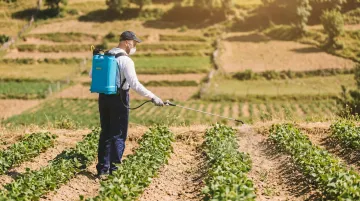
For very small plots with low-canopy crops, a well-maintained knapsack sprayer with the right nozzle remains cost-effective. But for anything beyond a hectare or two, the time and labour costs add up quickly.
Boom and Tractor-Mounted Sprayers
Tractor-mounted boom sprayers offer a substantial step up in coverage uniformity and daily output. A field evaluation of a tractor boom sprayer in cotton reported an effective field capacity of 2.08 hectares per hour — roughly 14 times the output of a manual knapsack operator on the same crop.
Key features that affect performance:
- Boom width: Wider booms cover more ground per pass but require flat, obstacle-free terrain
- Nozzle spacing: Determines overlap and coverage uniformity across the boom
- Tank capacity: Larger tanks reduce refill downtime on bigger fields
- Application volume: Conventional ground spraying commonly uses 375–625 litres per hectare for crops like rice and cotton, per TNAU crop production guidelines
These sprayers work best on large, flat, accessible fields. They are poorly suited to terraced land, waterlogged paddy fields, or fragmented plots — conditions that are common across much of India.
Motorised Mist Blowers and Power Sprayers
Motorised mist blowers use air-assisted delivery to push fine droplets into dense crop canopies — making them particularly useful for orchards, tea gardens, and other tall or thick-canopied crops where flat boom sprayers cannot achieve adequate penetration.
The trade-off: finer droplets and higher air velocity increase drift risk significantly if wind conditions are unfavourable. Mist blowers require experienced operators and careful attention to timing and wind direction to avoid off-target losses.
Drone Sprayers
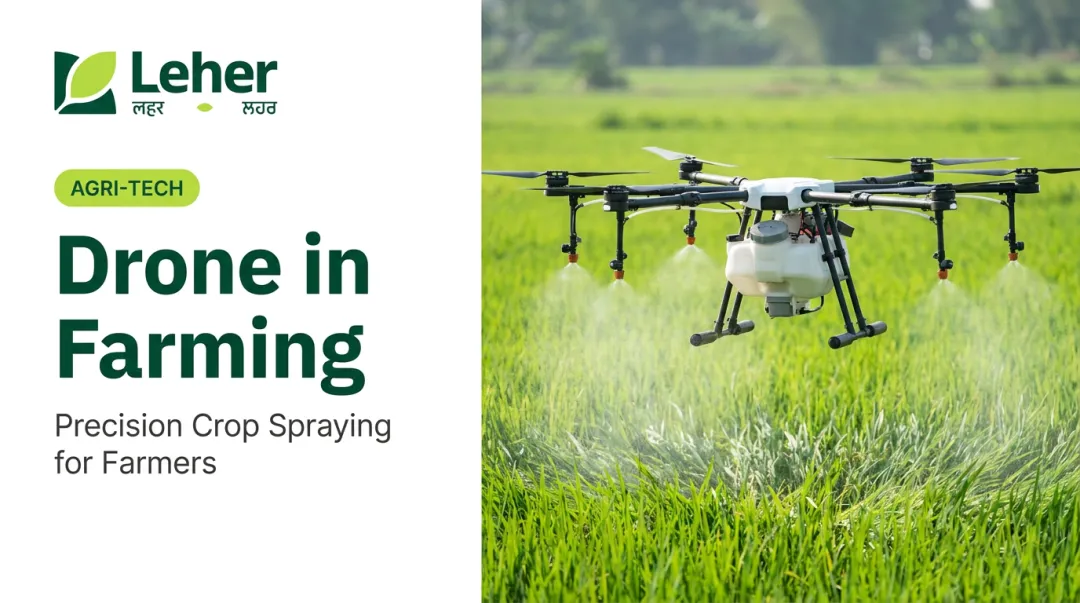
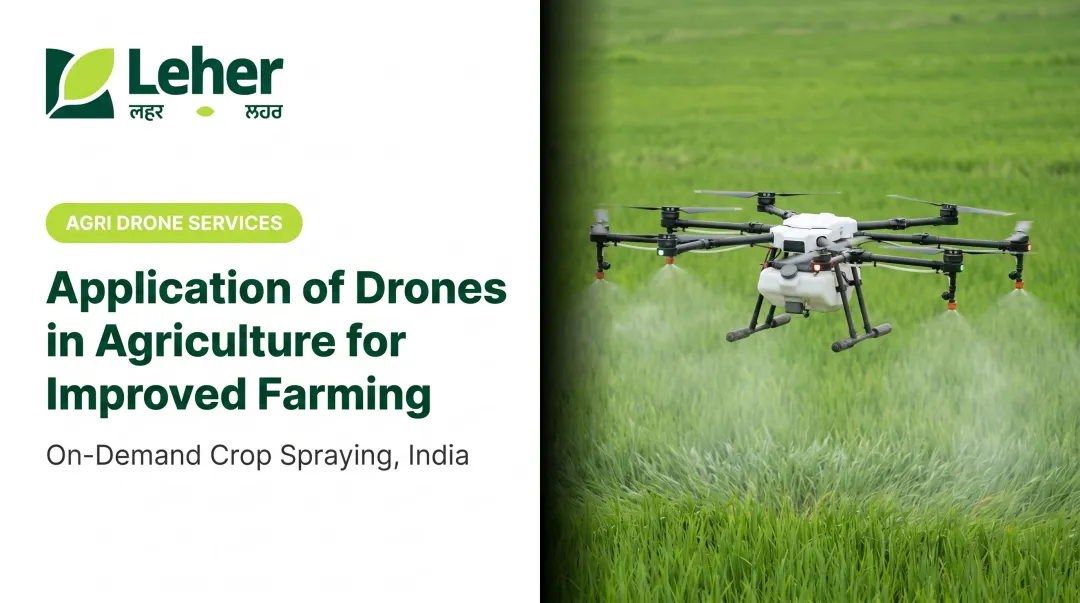
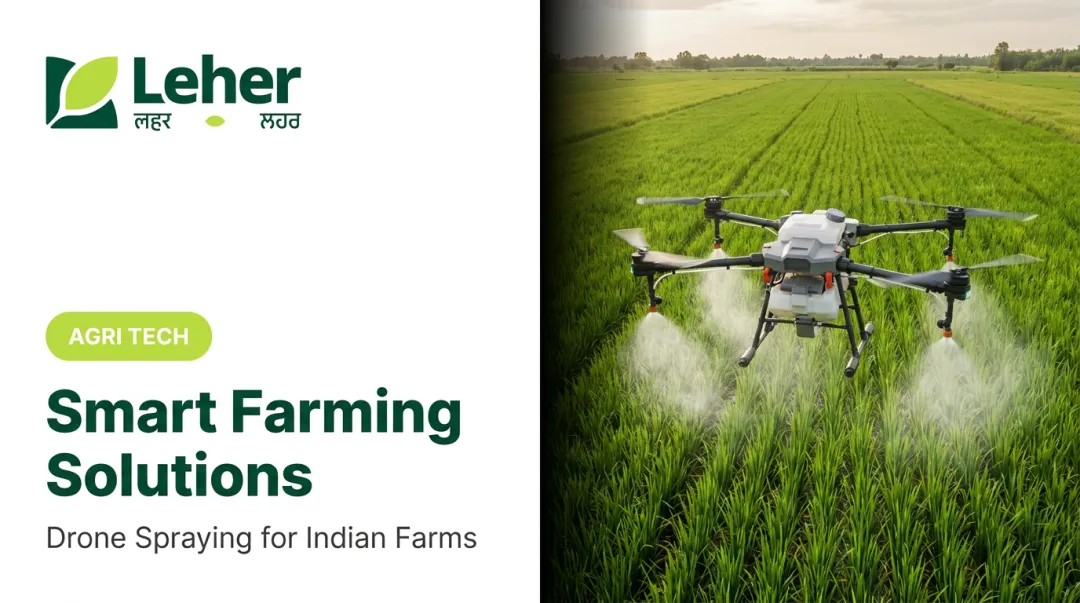
Agricultural drones are the most significant shift in spraying technology available to Indian farmers today. GPS-guided flight paths, precision nozzles, and sensor-based altitude control allow drones to deliver uniform applications across fields that ground equipment simply cannot access effectively.
India's official 2023 crop-specific drone Standard Operating Procedure specifies application volumes of 20 litres per hectare at early crop stages and 25 litres per hectare at full canopy — a fraction of conventional ground spraying volumes. Operating speed is typically 4.5–5.0 metres per second at 1.5–2.5 metres above the canopy.
Practical advantages for Indian conditions include:
- No soil compaction — drones fly above the crop rather than rolling through it
- Access to terraced, waterlogged, or fragmented plots where tractors cannot operate
- No operator chemical exposure — the pilot controls the drone remotely
- Significantly higher daily coverage than manual methods
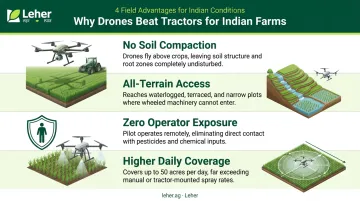
Service models, such as Leher's on-demand drone spraying, make this technology accessible without the high upfront cost of purchasing equipment.
This approach allows a farmer to book a certified pilot through an app for a specific day. The service covers major crops like paddy, cotton, and sugarcane, with the pilot managing the entire application process.
Key Factors That Determine Spraying Efficiency
Nozzle Selection and Droplet Size
Your choice of nozzle is the most important factor you can control. Droplet size determines where the chemical lands and how much is lost.
- Droplets below approximately 150 microns are highly prone to drift — they stay airborne and move with any air current
- Coarser droplets (250 microns and above) resist drift but may not provide adequate surface coverage for fine-textured targets
- India's drone SOP specifically recommends anti-drift nozzles producing 250–350 micron droplets for aerial application
Matching nozzle type to the application is also crucial. For example, herbicides applied to open soil before crop emergence can use coarser, lower-drift droplets.
However, fungicides and insecticides targeting leaf surfaces—especially the undersides—require finer droplets for better canopy penetration and coverage.
Sprayer Calibration
Calibration means verifying that what your sprayer actually delivers per acre matches the intended application rate. A deviation of just 10–15% from the target volume can result in under-dosing (leading to failed pest control) or over-dosing (causing crop damage and excess residue).
A simple field check before each season:
- Mark out a known distance in the field
- Fill the tank to a measured level and spray the marked area at normal operating speed and pressure
- Measure how much water was used
- Calculate actual litres per acre and compare to the chemical label recommendation
- Adjust pressure, nozzle size, or speed until output matches the target
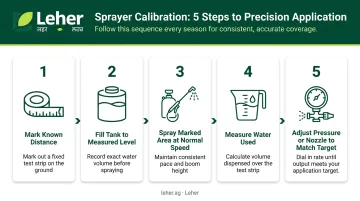
This takes 20–30 minutes and can prevent an entire season's applications from being ineffective.
Weather and Timing Conditions
India's drone SOP provides clear guidance on operational weather limits: wind speed below 3 m/s, temperature below 35°C, and relative humidity above 50%. These thresholds apply broadly to any spraying method, not just drones.
In practical terms for Indian conditions:
- Early morning (before 9 AM) and late evening (after 5 PM) generally satisfy all three conditions during warm seasons
- Midday spraying in summer combines high temperature, low humidity, and elevated wind — maximising evaporation of fine droplets and drift risk
- Spraying immediately before rain wastes the application; waiting for a dry window of at least 4–6 hours after application is advisable
Travel Speed and Application Rate
Speed and application rate are directly linked. Increasing tractor speed without adjusting pressure or switching to a larger nozzle reduces the volume delivered per acre — often without the operator realising it.
This is where Pulse Width Modulation (PWM) technology provides a significant advantage. PWM systems adjust the duty cycle of nozzle solenoids to maintain a consistent flow rate even as travel speed changes. The result: the application rate stays on target whether the machine is slowing for a headland turn or accelerating on an open run.
Variable-rate spraying studies report chemical volume savings of 12–73% compared to fixed-rate systems, depending on the crop and field variability. For drones, the same principle applies — maintaining consistent output per unit area regardless of flight speed variations.
The Rise of Smart and Drone-Based Spraying in Indian Agriculture
Smart spraying, at its most practical, means applying chemicals only where crop protection is needed — rather than blanket-treating an entire field at a uniform rate regardless of actual pest pressure. On-board sensors, GPS mapping, and variable-rate nozzle control make site-specific application possible.
Research from USDA ARS shows that intelligent spray-control technology can reduce spray drift by up to 87% while maintaining effective pest and disease control. Variable-rate application studies report input savings of 12–73% compared to conventional blanket applications.
Recognizing these advantages, the Indian government is actively creating a policy environment to accelerate the adoption of this technology.
Government Support Is Building the Infrastructure
India's policy environment is actively supporting drone-based agriculture — though the support mechanism is primarily service-model focused, not individual ownership:
- ICAR/KVK institutions can receive 100% of drone cost up to ₹10 lakh for demonstrations
- Farmer Producer Organisations (FPOs) receive grants of up to 75% of drone cost for demonstrations
- Custom Hiring Centres operated by cooperatives or FPOs receive 40% of basic drone cost up to ₹4 lakh
- NaMo Drone Didi scheme allocates ₹1,261 crore to provide drones to 14,500 Women Self Help Groups during 2024–26, with 80% of drone package cost covered up to ₹8 lakh
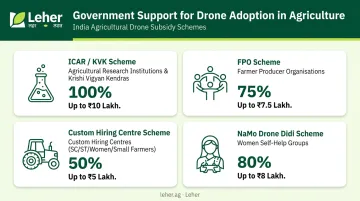
The government has released ₹129.19 crore for Kisan Drone promotion, including ₹52.50 crore to ICAR for 300 drones and demonstrations across 75,000 hectares. The ecosystem being built — through FPOs, CHCs, KVKs, and women's SHGs — points toward a service model where farmers access drone spraying on demand rather than owning equipment individually.
This is where service providers like Leher come in. By connecting farmers with trained drone pilots through the Leher App, the company makes precision spraying accessible to smallholders who cannot justify the capital cost of ownership.
The platform reports 90% water savings and a 30% reduction in pesticide use compared to conventional methods, with pilots covering up to 50 acres per day.
Practical Tips to Improve Spray Efficiency on Your Farm
No matter which spraying method you use, a few consistent habits can make a significant difference in your results and costs:
Before Each Spraying Season
- Test every nozzle output at rated pressure and replace any nozzle deviating more than 10% from specification — worn nozzles cause streaking, over-application in some zones, and under-application in others
- Calibrate the sprayer against a known area and adjust until actual output matches the chemical label recommendation
During Application
- Check wind speed before starting — if you can feel a consistent breeze, wait for a calmer window
- Spray early morning or late evening during hot months; avoid midday entirely for fine-droplet applications
- Maintain consistent travel speed — do not rush headlands or slow unnecessarily mid-field without adjusting pressure
After Each Use
- Rinse the tank, boom, and lines thoroughly after every use. This is crucial when switching between herbicides, fungicides, or insecticides to prevent crop damage from chemical residues.
- Inspect nozzle tips for wear, blockage, or distortion and store them clean
Choosing the Right Technology for Modern Farming
While traditional methods have their place, modern challenges in Indian agriculture often require modern solutions.
- Traditional Boom Sprayers: Often used for open, flat ground, but can cause soil compaction, struggle with uneven terrain, and fail to penetrate dense crop canopies.
- Manual Knapsack Sprayers: Suitable for very small plots but are slow, labor-intensive, and expose the operator to direct chemical contact, making them impractical for commercial farming.
- Agricultural Drone Spraying: This method overcomes many traditional limitations. Drones provide uniform coverage on any terrain, reach deep into the crop canopy, and reduce water usage by up to 90%. They are ideal for dense crops like sugarcane, flooded paddy fields, and large-scale operations where speed and precision are critical.
Frequently Asked Questions
What is spraying efficiency?
It's the percentage of spray that hits the target (e.g., a leaf or weed) instead of being lost to drift or runoff. Precision drone systems use anti-drift nozzles and low volumes to achieve much higher efficiency than conventional methods.
How many litres of spray per acre?
Conventional methods often require 375–625 litres per hectare. In contrast, India's drone SOP specifies just 20–25 litres per hectare (about 8–10 litres per acre) thanks to concentrated formulas and precision delivery.
Which sprayer is best for agriculture?
It depends on your farm. Knapsacks are for small plots, and tractors work for large, flat fields. Drones are ideal for varied terrain (terraced, waterlogged) and are accessible to Indian smallholders through on-demand services.
What is the best time to spray crops?
The best times are early morning or late evening when it is cool, calm, and humid. India's drone SOP requires wind below 3 m/s, temperature under 35°C, and humidity above 50% to minimize drift and evaporation.
How does drone spraying compare to manual spraying?
A service like Leher's can cover up to 50 acres per day, versus just 1–1.5 acres with a manual knapsack. Drones also provide more uniform coverage, eliminate operator chemical exposure, and use dramatically less water.