Introduction
Weeds cost Indian farmers enormously. A 2018 Crop Protection assessment estimated roughly USD 11 billion in weed-caused losses across 10 major crops — USD 4.42 billion in rice alone, USD 3.376 billion in wheat. Foliar spray herbicide remains the most widely used post-emergence response, applied directly to actively growing weed leaves across paddy, wheat, cotton, and sugarcane fields throughout India.
Yet results frequently disappoint. Farmers spray during peak afternoon heat, apply before forecast rain, use incorrect dilution ratios, or catch weeds too late in the season. The herbicide isn't at fault. The application is.
This guide is for farmers, drone operators, and agri-professionals who want consistent outcomes. It covers timing, preparation, mixing sequence, spray technique, and the practical steps that prevent costly retreatment.
Key Takeaways
- Foliar herbicides work only on actively growing, already-emerged weeds — systemics translocate to kill roots; contacts kill only touched tissue
- Apply early morning or late afternoon on calm days; skip midday heat, rain-forecast windows, and stressed plants
- Always add a compatible non-ionic surfactant to improve leaf coverage and cuticle penetration
- Check the label's rainfast period before spraying — it varies by product from 30 minutes to several hours
- Calibrate your sprayer before each use to keep nozzle output within ±10% of the rated flow
When Should You Use Foliar Spray Herbicide?
Foliar herbicide is a post-emergence tool. It has no effect on seeds yet to germinate, and it performs poorly on mature, dying-back weeds. Active vegetative growth is when application delivers results.
Optimal vs. Problematic Conditions
| Condition | Optimal | Avoid |
|---|---|---|
| Weed stage | Seedling to early vegetative (3–4 inches or less) | Mature, flowering, or senesced |
| Temperature | 65°F–85°F (18°C–29°C) | Peak afternoon heat above 35°C |
| Humidity | Moderate to high | Very low (thickens cuticle, reduces uptake) |
| Wind | 3–10 mph | Below 2 mph (inversion risk) or above 15 mph |
| Rain forecast | No rain within rainfast window | Rain expected within 1–4 hours |
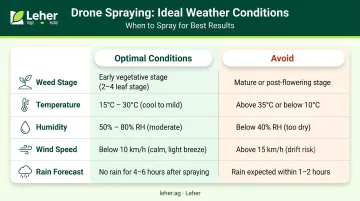
Moisture stress thickens the leaf cuticle, reducing herbicide absorption, even if the weed looks lush enough to spray. If weeds are visibly wilted or under clear drought pressure, wait for recovery conditions before applying.
Indian Seasonal Context
- Kharif season: Post-emergence window for paddy and cotton typically falls 15–21 days after transplanting or crop establishment — match application to weed emergence, not just calendar date
- Rabi season: For wheat, the critical Phalaris minor control window aligns with early tillering (Zadoks Z12–Z13 for some herbicides)
- Selective vs. non-selective: Use selective herbicides for in-crop broadcast application; reserve non-selective products like glyphosate for spot treatment well away from desirable crop plants
What You Need Before Applying Foliar Spray Herbicide
Don't start mixing until all five prerequisites are confirmed:
- Correct herbicide product: Systemic (translocated) for perennial and deep-rooted weeds; contact for annual weeds where surface kill is sufficient. Confirm target weed species appears on the CIB&RC-registered label
- Non-ionic surfactant: Reduces surface tension on waxy leaf surfaces, improving droplet spread and cuticle penetration — a 2020 peer-reviewed study found a non-ionic adjuvant reduced glyphosate GR50 by 22–24%, with measurably lower leaf-droplet contact angle. Only add if the label permits it
- Calibrated sprayer: Knapsack, boom, or drone — ICAR guidance requires each nozzle's output to stay within ±10% of nominal output at recommended pressure — deviations cause uneven coverage across the treated area
- Weather check: No rain within rainfast window, wind 5–16 km/h, temperature not at peak afternoon heat, and relative humidity not excessively low
- PPE: Gloves, protective eyewear, and mask as specified on the herbicide label — required regardless of application method
How to Apply Foliar Spray Herbicide (Step-by-Step)
Poor weed control outcomes almost always trace back to one skipped step: calibration, wrong mixing order, or a missed weather check before starting.
Setup and Preparation
Calibrate first. Fill the sprayer with water only, spray a measured area, collect and measure output, and compare to the nozzle specification. If output deviates by more than 10%, clean, adjust, or replace the nozzle before proceeding.
For drone-based application, confirm flow rate, nozzle size, flight altitude, and speed match the herbicide label requirements and the drone's validated operating parameters.
Mix in the correct sequence:
- Fill tank to 75% capacity with water
- Add surfactant and agitate
- Add herbicide concentrate last
- Top up to final volume

Never add herbicide concentrate to an empty or near-empty tank. Incorrect order causes incomplete dissolution, clumping, and uneven concentration throughout the mix.
Initiating Application
Start early morning after dew has dried, or late afternoon — both periods offer moderate temperatures, better humidity conditions, and calmer wind than midday. Confirm the weather forecast again at the point of starting, not just the night before.
Before the first spray pass, verify:
- Nozzle producing medium-to-coarse droplets (not a fine mist)
- Steady, consistent pressure maintained at the nozzle
- Marker dye visible on treated plants if dye has been added
Operating and Monitoring During Application
Walk or fly at a consistent pace. Hold the nozzle at the recommended height above the weed canopy, as upper, younger leaf tissue absorbs herbicide more readily where the cuticle is less developed.
Watch actively during the pass for:
- Missed patches — indicates nozzle blockage or pressure drop; stop and correct
- Fine mist drifting sideways — indicates excessive pressure or wind pickup; reduce pressure or pause
- Off-target spray reaching desirable crops — stop immediately, especially with non-selective products
For broadcast treatment across larger areas, drone-based application through services like Leher maintains consistent flight height, speed, and spray uniformity — reducing the patchy coverage and off-target drift that commonly occur with manual knapsack spraying at farm scale.
Completing Application
Flush the sprayer with clean water immediately after each session. Residual herbicide degrades plastic nozzle components, and partial blockages in the next session cause uneven application rates with no warning sign until coverage suffers.
Herbicide labels consistently recommend against storing prepared mix. Dispose of leftover mixed solution according to the label's instructions — do not save it for the next day.
Where Foliar Herbicide Spray Is Commonly Used in Indian Agriculture
Foliar herbicide application spans most major Indian crop systems, but the right approach varies by crop stage, dominant weed species, and infestation density. Timing, product selectivity, and application method all shift depending on what's growing — both the crop and the weeds competing with it.
| Crop | Key weeds targeted | Common post-emergence approach |
|---|---|---|
| Paddy/Rice | Echinochloa colona, Cyperus rotundus | Broadcast application 15–21 days after transplanting |
| Wheat | Phalaris minor, broadleaves | Early tillering window; selective herbicides by weed species |
| Cotton | Trianthema portulacastrum, broadleaves | At 2–4 leaf weed stage; selective graminicides or broadleaf products |
| Sugarcane | Creeper weeds, Striga | Inter-row applications; halosulfuron-methyl or 2,4-D combinations |
| Soybean | Commelina communis, grasses | Imazethapyr or sodium-acifluorfen combinations |
Application approach by scale:
- Smallholder farmers typically use knapsack backpack sprayers for targeted spot treatment of specific weed patches — practical for small plots with mixed infestation
- Larger farms and FPOs benefit from boom sprayers or drone-based broadcast treatment for dense, uniform infestations across multiple acres — covering ground faster with more consistent coverage per acre
For farmers who want drone-based weedicide application without owning equipment, platforms like the Leher App let individual farmers book on-demand drone spraying sessions, while FPOs and large contractors can arrange coordinated coverage across consolidated holdings.
Best Practices for Effective Foliar Herbicide Application
These aren't optional refinements — each one directly affects whether a single application delivers clean control or forces retreatment.
Target small, actively growing weeds. Young seedlings have a less-developed cuticle and a higher surface-area-to-mass ratio. A study on Phalaris minor in northwestern Indian wheat found sulfosulfuron at 25 g/ha gave more than 80% control when applied at the early tillering stage (Z12–Z13). Still, timing should match the label's weed-stage window, not just the earliest possible date — some herbicides perform better at a slightly later stage.
Respect the rainfast period without exception. Product-specific windows in reviewed labels range from 30 minutes (paraquat) to 1 hour (quizalofop-p-ethyl, fenoxaprop-p-ethyl). Some systemic products may need longer depending on temperature and weed stress. Partial wash-off before translocation is complete converts a clean application into a partial treatment that requires a costly follow-up.
Choose the right nozzle. Medium-to-coarse droplets reduce drift while providing adequate foliar contact. Fine droplets improve coverage but significantly raise drift risk — a particular concern during variable-wind kharif season conditions in India.
Rotate herbicide modes of action every season. Weedscience.org documents Indian Phalaris minor resistance extending from isoproturon to multiple modes of action including ACCase and ALS herbicides. Repeated use of the same chemical group on the same weed population selects for tolerant biotypes. Plan mode-of-action rotation as part of your integrated weed management programme — not as a reaction to failure.
For large-scale or repeat applications, drone spraying offers a measurable advantage. Leher's drone spraying systems cover up to 50 acres per day with consistent flight height and spray uniformity — reducing herbicide use by up to 30% and water consumption by up to 90% compared to conventional methods.
This is particularly relevant for broadcast foliar treatments across paddy, wheat, or cotton, where coverage consistency directly determines efficacy.
Conclusion
Effective foliar herbicide application comes down to discipline, not volume. Spray the right product at the right weed stage, under the right weather conditions, with a calibrated sprayer and correct mixing sequence. Do that consistently, and you get clean, cost-effective weed control. Cut corners on any of those steps, and you're paying twice: once for the application that didn't work, and once for the retreatment.
Build the habit of following the sequence. Respect the label. Monitor during the spray pass and correct problems immediately. Farmers who do this consistently spend less on inputs, lose less to failed applications, and carry better yields into harvest.
Frequently Asked Questions
What is foliar spray herbicide?
Foliar spray herbicide is a post-emergence weed control method where herbicide solution is sprayed directly onto actively growing weed leaves. Contact types kill only the tissue they touch; systemic types absorb through the cuticle and translocate through the plant to kill roots and underground reproductive structures.
What is the best time to apply foliar herbicide?
Early morning (after dew dries) or late afternoon, when temperatures are moderate and winds are calm. Avoid midday heat due to volatilisation risk, days with rain forecast within the rainfast window, and periods when weeds are drought-stressed — stress thickens the cuticle and significantly reduces absorption.
What is the difference between systemic and contact foliar herbicides?
Use systemic herbicides on perennial weeds — they travel through the plant to kill root systems, preventing regrowth. Choose contact herbicides for annual weeds where thorough surface coverage is sufficient and root kill is not required.
Why is a surfactant needed for foliar herbicide application?
The waxy cuticle on leaf surfaces repels water-based sprays, causing droplets to bead rather than spread. A non-ionic surfactant reduces surface tension, allowing the spray to coat the leaf as a thin film and improving herbicide absorption.
How do I prevent herbicide drift during foliar application?
Use medium-to-coarse droplet nozzles, spray within the 3–10 mph wind speed range, and maintain the correct nozzle height above the weed canopy. Avoid application during peak afternoon heat when air turbulence and evaporation increase the proportion of fine, drift-prone droplets.
Can foliar herbicides be applied using drones?
Yes. Drones deliver foliar herbicide at a consistent height and speed, producing uniform coverage across the canopy while reducing operator exposure. They are particularly effective for large or difficult-to-access plots. Leher's drone spraying service covers paddy, wheat, cotton, and sugarcane crops across India, covering up to 50 acres per day with up to 90% water savings over conventional methods.