Introduction
India's commercial drone sector has shifted from early-adopter curiosity to serious business territory. Drone Rules 2021 simplified the regulatory path, the PLI scheme incentivised domestic manufacturing, and demand from agriculture, infrastructure, and real estate has created genuine commercial opportunities across the country.
For aspiring drone entrepreneurs — whether a rural operator looking to serve local farmers, an agri-tech founder, or an agri-service contractor — the temptation is to buy equipment and start flying. The business plan step gets skipped.
That's why many early-stage drone businesses struggle: without a written roadmap covering financials, legal setup, pricing, and client acquisition, the business runs on optimism rather than strategy.
This guide walks through how to write a drone business plan that's actually useful — a grounded, honest plan built on real numbers and executable from day one.
Key Takeaways
- A drone business plan defines your niche, services, pricing, costs, legal structure, and growth strategy — treat it as a living document, not a one-time submission
- India's agriculture drone market is projected to grow from ₹25,200 crore in 2025 to ₹1.82 lakh crore by 2034 — niche clarity determines who captures that growth
- Your financial section must cover startup costs, monthly operating costs, revenue forecasts, and a break-even calculation
- DGCA registration, Remote Pilot Certificate, and Digital Sky Platform compliance are legal requirements — build them into your plan from the start
- Short, honest plans with realistic projections outperform elaborate templates
What Is a Drone Business Plan?
A drone business plan is a written document that answers six questions:
- What will your business do?
- Who will it serve?
- How will it make money?
- What will it cost to operate?
- How will it grow?
- What are the risks, and how will you manage them?
Think of it as an internal decision-making tool — the document you use to pressure-test whether the business actually makes sense before spending money on equipment, DGCA registration, or pilot training. A pitch deck or investor presentation comes later, once the fundamentals hold up.
Common formats drone businesses use:
- A one-page lean plan for a solo agricultural spraying operator in a single district
- A 10–15 page plan for a team-based agri-drone startup seeking angel funding or government scheme support
- A section-by-section document that covers operations, financials, compliance, and marketing — developed over 2–3 weeks of careful research
The format matters less than the honesty. A five-page plan with real numbers beats a 30-page document built on optimistic assumptions.
Why Start a Drone Business in India Right Now
India's agricultural drone market sits at USD 302.3 million in 2025 and is projected to reach USD 2.18 billion by 2034, growing at a 23.84% CAGR — numbers that reflect genuine structural demand, not speculative growth.
What's Driving Client Demand Right Now
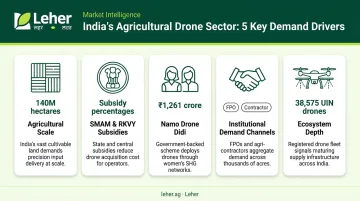
Four factors are generating real, repeat client demand right now:
- Agricultural scale: India has approximately 140 million hectares of net sown area. Mechanisation rates remain uneven — sowing and planting operations sit at around 40%, according to PIB data, creating significant headroom for drone-based input application
- SMAM & RKVY subsidies: Central schemes cover up to 100% of drone costs for eligible institutes, 75% for FPO demonstrations, and 40–50% for Custom Hiring Centres
- Namo Drone Didi: ₹1,261 crore allocated to support 15,000 Women Self-Help Groups as drone service providers, with 80% assistance up to ₹8 lakh per drone package
- Institutional demand channels: Farmer Producer Organisations, agribusiness contractors, and plantation estates are actively procuring drone spraying — these aren't one-off clients, they're repeat buyers
- Ecosystem depth: As of February 2026, PIB reports 38,575 UIN-registered drones and 39,890 certified remote pilots in India — a functioning ecosystem with trained operators, regulatory infrastructure, and active commercial demand
Leher covered 6,500+ acres and served 810+ farmers in 2024 alone — within two years of operations. That's a concrete benchmark for what focused execution in agricultural drone services can deliver in rural India.
How to Write a Drone Business Plan – Step by Step
The sections below follow the order in which you should develop them. Each one builds on the previous. Don't skip to financials before you've defined your niche — the numbers won't make sense without that foundation.
A well-written 10–15 page plan with honest projections is more useful than a 50-page document that hasn't been stress-tested.
Step 1 – Define Your Niche and Business Model
The most common early mistake is trying to serve every client type from day one: agricultural spraying, real estate photography, infrastructure inspection, and mapping — all at once. That spreads your equipment, time, and marketing across too many fronts.
Choose one primary niche first. The leading options in India right now:
- Agricultural spraying (pesticide, foliar fertiliser, weedicide application)
- Infrastructure and real estate aerial photography
- Construction site mapping and survey
- Inspection services (power lines, solar farms, industrial facilities)
Agricultural drone spraying has the most structured demand in rural India currently, with documented subsidy support, FPO procurement channels, and crop-specific recurring revenue (farmers spray multiple times per season).
Once your niche is fixed, your business model follows from it:
| Model | Best for | Revenue structure |
|---|---|---|
| Owner-operated solo | Single pilot, lean startup | Per acre / per job |
| CHC rental service | Rural entrepreneur, FPO-linked | Per rental / per day |
| Team-based service company | Multiple pilots, larger geography | Contract / retainer |
| SHG-linked service provider | Women-led rural business | Per acre, scheme-funded |
These decisions determine your cost structure, scalability, and what the financial section of your plan will actually look like.
Step 2 – Conduct Market Research and Competitive Analysis
Before projecting revenue, answer these questions for your chosen geography:
- Who is your target client — individual farmers, FPOs, agribusiness contractors, or plantation estates?
- What problem are they paying to solve — labour scarcity, input efficiency, coverage speed, or all three?
- Who else is already operating in your district or state, and where are the gaps?
- Is there enough paying demand in your target area to sustain the business at your chosen price point?
For agricultural operators, this research means understanding crop cycles and seasonal demand in your target area. Paddy sowing runs June to August, wheat sowing October to December — your spraying demand peaks follow these windows. A business plan that ignores seasonality will produce revenue projections that are wrong in both directions.
For institutional channels, research whether FPOs in your target district are already procuring drone services, and whether CHC infrastructure exists that you could partner with or compete against.
Step 3 – Define Your Service Offerings and Pricing Structure
Write out exactly what your service includes — and what it doesn't. Vague service descriptions are one of the most common causes of client disputes and scope creep.
For each service, document:
- What crops or use cases it covers
- What the client receives as a deliverable (coverage report, spray log, before/after data)
- What is explicitly excluded (e.g., chemical inputs are client-supplied)
- Your geographic coverage radius
On pricing: verified farmer-facing per-acre rates vary by region and crop type, and aren't available from a single authoritative source — which means your research must come from local intelligence. Talk to FPOs, agri-input dealers, and operators currently active in your area.
Before locking in a rate, run this check:
- Revenue per job must cover equipment wear, travel, pilot fees (if you have employees), insurance, and platform costs
- Leave a margin that can absorb a slow week or an equipment issue
- Underpricing to win early clients is a trap that's difficult to exit once farmers associate your service with a low rate
Step 4 – Build Your Financial Projections
Most drone business plans get the financials wrong in one of two ways: skipping the hard numbers entirely, or building projections on best-case assumptions. Neither survives contact with the first slow month.
Startup costs to document:
- Drone equipment (and subsidy eligibility under SMAM, RKVY, or Namo Drone Didi)
- DGCA-approved Remote Pilot Certificate training — IGRUA lists Small drone course fees at ₹55,000 + GST and Medium drone course at ₹65,000 + GST as reference points
- DGCA registration fees (nominal under current Digital Sky fee schedule)
- Spare parts and consumables buffer
- Insurance (third-party liability at minimum; hull insurance for high-value equipment)
- Initial marketing and client acquisition spend
Monthly operating costs to model:
- Maintenance and repairs
- Travel and logistics
- Pilot salaries (if not solo-operated)
- Platform or software subscriptions
- Insurance renewal allocation
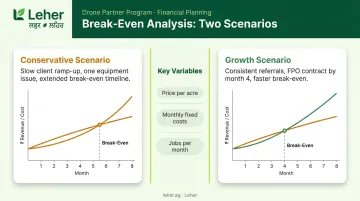
Break-even calculation: At your chosen price per acre (or per job), how many jobs per month cover all your costs? How many months will it realistically take to reach that job volume? Model two scenarios — conservative (slow client ramp-up, one equipment issue) and growth (consistent referrals, FPO contract secured by month four). The gap between them tells you how much risk your plan carries.
Step 5 – Address Legal Setup, DGCA Compliance, and Risk
Business structure options for Indian drone operators:
- Sole Proprietorship — easiest to set up, full personal liability, suitable for solo operators testing the market
- Partnership — for two or more founders, shared liability, moderate administrative burden
- OPC (One Person Company) — limited liability for solo founders, more credible for institutional clients
- Private Limited Company — preferred for team-based operations seeking external investment
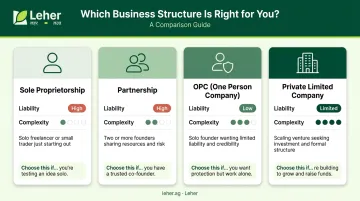
Consult a CA before registering — the tax and liability implications differ meaningfully.
DGCA compliance requirements (non-negotiable):
- UIN registration of your drone on the Digital Sky Platform (required for all drones except Nano category)
- Remote Pilot Certificate from a DGCA-approved training organisation (mandatory for all commercial operations except Nano drones)
- Compliance with category rules — Small drones (2kg–25kg) cover most agricultural sprayers; Medium (25kg–150kg) for specialised applications
- SOPs for agricultural spraying as specified by the Agriculture Ministry
Risk coverage:
- Third-party liability insurance is the minimum requirement for any commercial operation
- Hull insurance is advisable for agricultural drones given field operating conditions
- Document your incident management process before you take your first paying client
Step 6 – Plan Your Marketing and Client Acquisition Strategy
For agricultural drone businesses in rural India, the most effective client acquisition channels are almost never digital advertising.
High-yield channels for agri-drone operators:
- Direct outreach to FPOs (eligible for 75% government grants on drone demonstrations — this creates a motivated buyer)
- Partnerships with agri-input dealers and fertiliser companies (they already have farmer relationships)
- Agricultural extension officers and Krishi Vigyan Kendras
- Lead Fertiliser Companies identified under Namo Drone Didi implementation
Your first 90 days — be specific:
- Identify three FPOs or large farms in your target district
- Offer two free demonstration flights with full documentation (spray logs, before/after crop health data)
- Use demonstration results as proof-of-service for referrals
- Aim for five paying clients before month three
Trust-building in agricultural communities happens through demonstrated results, not marketing materials. Collect data from every job — acres covered, inputs saved, time versus manual spraying — and use it consistently.
Step 7 – Outline Your Operations and Growth Plan
Document your client workflow before you launch:
- Inquiry received (app, phone, referral)
- Site assessment and scheduling confirmed
- Flight completed, spray log recorded
- Payment collected (cash or digital)
- Follow-up and referral request
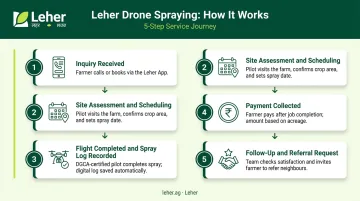
Mapping this workflow prevents the inconsistency that kills early-stage service businesses. If your client experience varies by job, referrals won't follow.
Capacity planning:
- A single pilot with one agricultural drone can realistically cover up to 50 acres per day under optimal conditions — but factor in travel, weather delays, and maintenance
- Set a trigger point: at what job volume will you need a second pilot or additional drone? How will you fund that expansion (reinvested revenue, AIF loan, partner program)?
Set measurable milestones:
- Month 3: first five paying clients, first FPO conversation initiated
- Month 6: break-even reached, at least two repeat clients
- Month 12: defined revenue target, decision point on second drone or second pilot
Conclusion
A drone business plan works when it's grounded in honest research, realistic financials, and a clearly defined niche. The plans that fail are built on optimistic projections, generic templates, or assumptions that haven't been tested against what clients in a specific geography will pay.
Treat the plan as a working decision-making tool, not a document you write once and forget. Build in scheduled reviews tied to real operational milestones:
- 90 days in: Validate your pricing, client acquisition assumptions, and operational costs against actual field results
- Six months: Assess whether your niche is generating repeat contracts or if demand is shifting — especially relevant if you're targeting seasonal crops
- Annually: Revisit regulatory requirements (DGCA compliance windows, updated drone operation guidelines) and adjust growth targets accordingly
- After major contracts: Use large FPO or agribusiness engagements as natural checkpoints to recalibrate capacity and cost structure
The market will tell you what it needs. Your plan's job is to keep you positioned to respond.
Frequently Asked Questions
How much does it cost to start a drone business in India?
Verified startup cost components include DGCA-approved RPC training (around ₹55,000–₹65,000 + GST for Small/Medium drone courses at IGRUA), nominal DGCA registration fees, insurance, and equipment. Total startup costs vary significantly by niche and equipment tier. Government subsidy schemes under SMAM, RKVY, and Namo Drone Didi can substantially reduce initial equipment costs for eligible applicants — check current scheme eligibility before finalising your budget.
Do I need DGCA certification to start a drone business in India?
Yes. A Remote Pilot Certificate from a DGCA-approved training organisation is mandatory for all commercial drone operations in India (except Nano category drones). Your drone must also be registered on the Digital Sky Platform with a UIN before any commercial flights. Operating without these is an illegal commercial activity, not a grey area.
Which drone business niche is most profitable in India right now?
Agricultural drone spraying, real estate aerial photography, and infrastructure inspection are the highest-demand niches currently. Agricultural spraying leads on near-term growth — government subsidy infrastructure, FPO procurement demand, and India's farming scale make it the most structured entry point for new operators in rural geographies.
How long does it take to break even in a drone business?
Break-even timelines depend on startup costs, pricing, and how quickly you acquire paying clients. Lean drone service businesses in India that secure their first clients within two months can realistically reach break-even within 6–18 months. Higher equipment costs or slower client ramps will push that timeline further out.
How much does a 1,000 drone show cost?
Drone light show pricing for 1,000 drones typically starts around ₹10 lakh and can reach ₹1 crore or more depending on duration, choreography complexity, location, and operator. This is a distinct specialised niche requiring dedicated equipment and trained teams — not comparable to agricultural spraying or inspection businesses in setup or client base.
Can I start a drone business without prior flying experience?
No prior flying background is required to enrol in a DGCA-approved Remote Pilot Certificate programme — prerequisites are age 18+, 10th grade completion, and valid identity documents. That said, real operational competence comes from supervised practice; passing the RPC is the regulatory minimum, not a readiness signal for commercial work.