Introduction
Walk through most Indian farms today and you'll see the same practice repeated season after season: a fixed dose of fertilizer broadcast uniformly across the entire field, regardless of what the soil needs. The result? Over-application in already-fertile patches drives nutrient runoff into waterways, while deficient zones receive too little to support healthy crop growth.
The scale of this problem is hard to ignore. India's Soil Health Card programme found that following soil-test-based recommendations reduced chemical fertilizer use by 8–10% while simultaneously increasing yields by 5–6%—and that 92% of farmers had not used balanced fertilizers or micronutrients before the scheme. Precision fertilizer application exists to fix exactly that mismatch.
This guide covers how: what precision fertilizer application means in practice, the 4Rs framework that underpins it, the technologies making it possible, and how pay-per-use service models in India now make these tools accessible to small and marginal farmers — no equipment ownership required.
Key Takeaways
- Precision fertilizer application uses soil data and spatial mapping to apply nutrients where crops actually need them—not uniformly across fields
- The 4Rs framework—Right Source, Rate, Time, and Place—is the globally recognised foundation for nutrient use efficiency
- Technologies like VRT, NDVI sensing, IoT soil sensors, and drone-based spraying enable variable-rate nutrient delivery tailored to each field zone
- Drone-as-a-service models eliminate equipment ownership costs, making precision fertilizer access viable for small landholders
- Indian field trials report 15–35% nitrogen reductions and higher yields when SSNM replaces blanket application
What Is Precision Agriculture Fertilizer Application?
Precision agriculture fertilizer application means using spatial data, field mapping, sensors, and smart technology to apply nutrients at the right rate, time, place, and form. The goal is to match inputs to the specific needs of different zones within a field—rather than treating every square metre the same.
Uniform Application and Its Costs
Conventional broadcasting applies a single fixed rate across every square metre. In practice, this creates two simultaneous problems:
- Over-application zones: Nutrient-rich areas receive excess fertilizer, driving runoff into waterways, groundwater contamination, and greenhouse gas emissions
- Under-application zones: Deficient patches receive too little, causing yield loss, poor crop quality, and progressive soil degradation
A 2021 study analysing 242,827 soil samples across 615 Indian districts found micronutrient deficiencies in 58.6% of soils for sulphur, 51.2% for zinc, and 44.7% for boron. These aren't just statistics—they show that blanket NPK application actively misses the nutrients many soils need most.
Site-Specific Nutrient Management (SSNM)
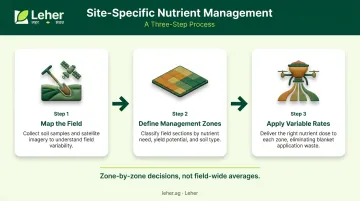
The foundational principle behind precision fertilization is SSNM. The field is first mapped and divided into management zones based on soil variability, crop history, and collected data. Fertilizer decisions are then made zone by zone, not field-wide.
SSNM typically involves three core steps:
- Map the field: Collect soil samples and sensor data to identify variability across zones
- Define management zones: Cluster areas with similar nutrient profiles, yield history, or soil type
- Apply variable rates: Prescribe different fertilizer rates for each zone based on actual need
This matters especially in India, where fertilizer subsidies totalled approximately ₹1.64 lakh crore in 2024–25 against total consumption of 600.79 LMT. Optimising how that fertilizer is applied, not just how much is purchased, is both a farm-economics and a national fiscal priority.
The 4Rs of Precision Fertilizer Application
The 4Rs framework—Right Source, Right Rate, Right Time, Right Place—is the globally recognised foundation of precision nutrient management. All four criteria must be met simultaneously. Optimising just one without the others delivers partial results at best.
Right Source
Selecting the right source means matching the fertilizer type to the specific deficiency identified in each management zone through soil testing or remote sensing. Soil pH, organic matter, and moisture conditions all affect which formulation a plant can actually absorb.
Given the widespread micronutrient deficiencies across Indian soils, source selection goes well beyond choosing between urea and DAP. Several deficiencies affect more than half of tested soils:
- Zinc — impacts grain development and enzyme function
- Sulphur — critical for protein synthesis and oilseed quality
- Boron — essential for flowering and fruit set
Blanket NPK application leaves all three entirely unaddressed.
Right Rate
Variable Rate Technology (VRT) automates rate precision by reading a prescription map and adjusting application dynamically as equipment moves across the field—delivering the exact quantity each zone needs at each growth stage, with no surplus and no shortfall.
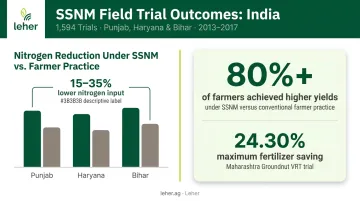
Indian field evidence validates this approach. Nutrient Expert SSNM trials across 1,594 side-by-side rice and wheat trials in Punjab, Haryana, and Bihar (2013–2017) reduced nitrogen application by 15–35% versus farmer practice, with over 80% of farmers achieving higher yields. A Maharashtra VRT study on groundnut reported a maximum fertilizer saving of 24.30% through on-the-go variable rate application.
Right Time
Crops have distinct nutrient demands at each growth stage—early vegetative growth, tillering, flowering, grain fill, and ripening each pull different nutrients in different quantities. Applying nitrogen during grain fill is largely wasted; applying it at tillering is precisely when it drives yield.
Real-time monitoring tools and crop growth models help farmers synchronise fertilizer delivery to these windows, maximising uptake and minimising losses through volatilisation or leaching.
Right Place
Placement method determines how much of an applied nutrient actually reaches the plant:
| Method | How It Works | Best Used When |
|---|---|---|
| Broadcasting | Spreading fertilizer over soil surface | Large areas, basal applications |
| Banding | Placing fertilizer near the seed/root zone | High-value crops, starter nutrients |
| Fertigation | Dissolving nutrients in irrigation water | Drip-irrigated crops |
| Foliar spraying | Applying liquid nutrients directly to leaves | Micronutrient corrections, fast uptake |
Drone-based foliar spraying excels at canopy-penetrating micronutrient delivery. GPS-guided flight paths ensure uniform coverage even in dense crop conditions where ground equipment would cause soil compaction.
Key Technologies Enabling Precision Fertilizer Application
Precision fertilizer management relies on a stack of complementary technologies. Each contributes a different layer of data or delivery capability.
Remote Sensing and GIS-Based Soil Mapping
Satellite imagery and drone-mounted multispectral sensors detect crop stress and nutrient deficiency by analysing vegetation indices like NDVI (Normalised Difference Vegetation Index). These signals, invisible to the naked eye, show up as spatial patterns that GIS platforms translate into field maps.
The output is a visual prescription map showing which zones are deficient, which are adequate, and which are showing signs of toxicity or stress. Instead of guessing at field needs, farmers get a zone-by-zone nutrient picture before they apply anything.
A West Bengal wheat study validated NDVI sensor-based nitrogen management in Indian field conditions, confirming that spectral sensing can guide variable nitrogen decisions in smallholder settings.
Variable Rate Technology (VRT)
VRT is the delivery mechanism that reads the prescription map and automatically adjusts fertilizer flow rates in real time based on GPS position. As an applicator moves across the field, the system increases output in deficient zones and reduces it in already-fertile areas.
The Maharashtra groundnut VRT study reporting 24.30% maximum fertilizer savings illustrates the practical cost-reduction potential—though this figure is crop and system-specific and should not be generalised across all contexts.
IoT Sensors and Real-Time Monitoring
Soil sensors measure moisture, pH, and NPK levels continuously, while plant-wearable sensors track physiological indicators like leaf temperature and chlorophyll content. Together, they shift fertilizer management from reactive (responding after deficiency symptoms appear) to proactive (intervening before crop performance suffers).
This continuous data stream is especially valuable for high-value crops where a two-week deficiency window can meaningfully reduce marketable yield or quality.
Drone-Based Precision Spraying
Agricultural drones fly GPS-guided paths at low altitude, applying liquid fertilizers and micronutrient sprays with spatial precision that ground equipment cannot replicate on uneven terrain. Key advantages over conventional ground methods:
- Eliminates soil compaction caused by heavy machinery
- Reaches irregular, sloped, and waterlogged fields that ground equipment cannot
- Applies at ultra-low carrier volume, cutting water requirements significantly
- Delivers even canopy penetration for foliar applications
- Covers up to 50 acres per day
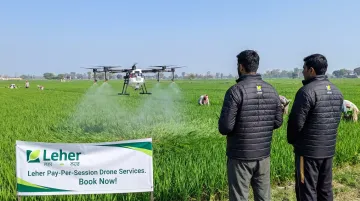
Service-based drone spraying models make these advantages accessible without capital investment in equipment. Leher operates this way through the Leher App: a farmer books a session, a DGCA-certified pilot arrives, sprays the crop, and payment is collected only after the job is done. In 2024, Leher served 810+ farmers across 6,500+ acres, covering sugarcane, paddy, cotton, wheat, and vegetables.
The government's Namo Drone Didi scheme targets deployment of 15,000 drones to women SHGs across 2024–25 and 2025–26, with each SHG expected to serve approximately 2,000–2,500 acres per year. This policy push confirms that drone spraying as a service model is becoming mainstream in Indian agriculture.
Benefits of Precision Fertilizer Application for Indian Farmers
Economic Savings
Applying fertilizer only where and when it is needed reduces per-acre input costs directly. Soil Health Card-based recommendations alone showed an 8–10% reduction in chemical fertilizer use nationally. SSNM approaches in Indian rice-wheat systems reduced nitrogen application by 15–35% versus farmer practice.
Precision does not always mean a smaller total fertilizer bill immediately. Nutrient Expert trials found that some farmers in the western Indo-Gangetic Plains saw costs rise because precision revealed chronic under-application of potassium. Precision means optimised, not automatically reduced. Nutrient balance improvements typically translate to yield gains that more than offset any corrected inputs.
Environmental Protection
Excess nitrogen in Indian soils carries serious environmental consequences:
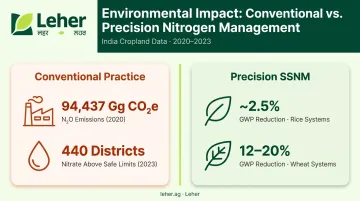
- Agricultural soils were India's largest single N₂O emission source in 2020, contributing 94,437 Gg CO₂e per the national GHG inventory
- Nitrate above drinking-water limits was detected in 440 districts in 2023, up from 359 districts in 2017
Precision nitrogen management directly addresses both risks. Nutrient Expert SSNM reduced the global warming potential of rice systems by ~2.5% and wheat systems by 12–20% compared with farmer practice—a measurable climate benefit from better fertilizer decisions alone.
Yield and Crop Quality
Delivering the right nutrients at the right growth stage improves both yield volume and marketable quality. Evidence from Indian field conditions:
- SHC-based recommendations: 5–6% yield increase
- Odisha Rice Crop Manager SSNM trials: 17–19% grain yield increase versus farmer fertilizer practice
- Nutrient Expert trials: over 80% of farmers achieved higher yields
Challenges in Adopting Precision Fertilizer Application in India
Cost and Access Barriers
India's average operational farm holding is just 1.08 hectares, with small and marginal holdings comprising 86.08% of all operational holdings. Individual ownership of VRT equipment, soil sensor networks, or drones is not a realistic pathway for most farmers.
Service-based models change this equation. Leher's drone-as-a-service approach—where farmers pay per session after service completion with no equipment investment—makes precision foliar fertilizer application accessible without capital outlay. The government's drone subsidy model under Drone Didi covers 80% of drone and accessory costs (capped at ₹8 lakh), further reducing the barrier for service providers.
Knowledge and Expertise Gaps
Prescription maps, NDVI outputs, and soil sensor dashboards require interpretation skills that most farmers currently lack. Bridging this gap takes more than distributing reports — it demands active, on-the-ground support. Adoption in Indian SSNM trials increased measurably when farmers received hands-on guidance rather than just written recommendations.
Three delivery channels have proven effective:
- Extension services that translate technical outputs into local-language action steps
- On-farm demonstrations where farmers observe precision application firsthand
- Intuitive app interfaces that surface recommendations without requiring data literacy
Infrastructure and Connectivity
Rural teledensity in India reached 59.19% as of March 2024, and total internet subscribers exceeded 954 million—but coverage remains uneven across agricultural regions. Real-time monitoring and data-driven fertilizer decisions depend on connectivity that some areas still lack.
Closing this gap is a stated government priority. The Cabinet-approved Digital Agriculture Mission (outlay: ₹2,817 crore) includes a digital crop survey planned for 400 districts — building the data infrastructure that variable-rate and sensor-driven fertilizer decisions depend on.
Frequently Asked Questions
What are the applications of precision agriculture?
Precision agriculture covers fertilizer and nutrient management, precision irrigation, pest and disease monitoring, yield mapping, and variable rate input application. All applications share the same goal: matching resource use to actual field needs rather than applying inputs uniformly.
What are the 4 methods of fertilizer application?
The four main methods are broadcasting (spreading fertilizer across the soil surface), banding (placing fertilizer in concentrated strips near the root zone), fertigation (dissolving nutrients in irrigation water), and foliar spraying (applying liquid nutrients directly onto plant leaves).
How does drone spraying improve fertilizer efficiency?
Drones apply fertilizers via GPS-guided flight paths at low altitude, ensuring even coverage at low carrier volumes. This reduces water use and prevents over-application in any single zone. Drones can also access terrain that ground equipment cannot reach, resulting in more consistent nutrient distribution with less environmental impact.
Is precision agriculture fertilizer application suitable for small farms in India?
Yes, particularly through app-based pay-per-session models where farmers book a drone spraying session and pay only after the job is completed, with no equipment ownership required. This makes precision fertilizer application accessible to small and marginal farmers who cannot justify individual technology investment.
What is the difference between precision farming and conventional farming?
Conventional farming applies uniform inputs across an entire field regardless of spatial variability. Precision farming uses data from soil maps, sensors, and remote sensing imagery to tailor inputs to the specific needs of different zones within the same field. This targeted approach reduces input waste and improves crop outcomes.
How do soil sensors help in fertilizer application?
Soil sensors continuously measure parameters like moisture, pH, nitrogen, phosphorus, and potassium levels. Farmers use this data to apply fertilizers precisely where and when deficiencies appear, preventing over-application and ensuring nutrients are available when crops actually need them.