
Introduction
When a fungal outbreak hits standing paddy or rust creeps across a wheat field, farmers have hours, not days, to respond. But the same monsoon rains that create peak disease pressure also flood field paths, making tractor-mounted sprayers useless exactly when they're needed most.
Many Indian farmers still rely on manual backpack spraying or ground-based boom sprayers. These work under ideal conditions. In the field, waterlogged plots, dense late-season canopies, and labor shortages mean they can fall short at the worst possible moment.
This article explains the field-level benefits of aerial drone spraying for Indian farmers: faster coverage, safer access after rain, lower water use, and more uniform crop protection. For context, Leher reports 6,500+ acres sprayed and 810+ farmers served in 2024.
Key Takeaways
- Drone spraying reaches wet, flooded, or inaccessible fields during peak disease windows
- India’s drone spraying SOP specifies low-volume application of 20–25 L/ha
- A single drone can cover up to 50 acres per day, versus roughly 3 acres with traditional methods
- Rotor downwash helps droplets reach lower canopy layers missed by manual spraying
- Services like Leher let farmers book on demand and pay after spraying is complete
What Is Aerial Spraying for Crop Protection?
Aerial spraying means applying crop protection products from an aircraft or drone flying over the field instead of using ground equipment.
Common applications include:
- Pesticides for insect and pest control
- Fungicides for disease management
- Herbicides and weedicides for weed control
- Foliar fertilisers for nutrient application
In Indian agriculture today, this usually means multi-rotor UAVs (unmanned aerial vehicles), not the fixed-wing crop dusters associated with older aerial application. These drones fly at 1–3 metres above the crop canopy, delivering spray at low volumes with controlled droplet sizes between 100–250 microns, as specified in India's Ministry of Agriculture SOP for drone pesticide application.
India has built a formal regulatory framework for drone-based spraying. The DGCA Drone Rules 2021 govern aircraft compliance, pilot certification, and airspace requirements. Pesticide approvals for drone application are handled separately by CIB&RC/PPQS under the Ministry of Agriculture — as of the 2022 interim list, 477 formulations were approved, spanning chemical pesticides, biopesticides, and combination fungicides and insecticides.
With those flight and input approvals in place, aerial spraying works best as a targeted tool. It delivers the most value when timing, terrain, or crop stage makes conventional spraying impractical.
Key Benefits of Aerial Spraying for Crop Protection
The benefits below focus on operational outcomes: timing, cost, crop health, and risk.
Benefit 1: Timely Application Regardless of Field Conditions
A missed application often causes more damage than a poor one.
Drones operate over waterlogged, flooded, and recently irrigated fields where tractor-mounted sprayers would cause soil compaction and crop damage. A farmer can apply a fungicide during a disease-pressure window even after three consecutive rain days have made the field physically impassable by vehicle.
Why the timing gap matters:
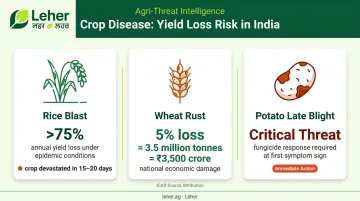
- ICAR reports rice blast can cause more than 75% annual yield losses under epidemic conditions; under favourable weather, a rice crop can be devastated within 15–20 days
- ICAR's wheat rust data shows a seemingly modest 5% loss translates to 3.5 million tonnes of grain and approximately ₹3,500 crore in economic damage nationally
- For potato, ICAR's Rabi advisory classifies late blight as a critical threat requiring fungicide response at the first sign of symptoms — delays are costly
Missing a spray window doesn't just allow disease to spread. It typically forces corrective treatments, which are more expensive and less effective than preventive applications timed to early disease onset.
When this matters most:
- Monsoon season, when disease pressure peaks alongside waterlogged fields
- Late-season applications on tall crops like sugarcane or standing corn, where ground sprayers physically cannot pass without damaging the crop
- Dense paddy fields where delayed application in flooded conditions creates a genuine access barrier
ICAR-CPRI's drone trials on potato crops demonstrated that a drone can spray about 1.26 hectares in 15 minutes; manual spraying can take hours and often spans multiple worker-days.
KPIs affected: spray window compliance rate, number of corrective treatments per season, crop loss percentage from disease or pest, soil compaction incidents.
Benefit 2: Precision Coverage with Reduced Input Use
Manual backpack spraying and tractor boom sprayers depend on consistent routes and speeds. In practice, that consistency often breaks down: missed rows, overlapping passes, and variable application rates are routine.
Drone sprayers follow GPS-guided flight paths with programmed application rates across defined field boundaries. This reduces the human-error gaps that create unsprayed patches, which can become reinfestation hotspots and force additional spray rounds.
The low-volume advantage:
India's official drone spraying SOP specifies 20–25 L/ha spray volume. Conventional ground sprayers typically apply far higher volumes. This low-volume precision means fewer refill cycles per field, less water hauled to remote plots, and less chemical deposited outside the target zone.
Leher's drone spraying delivers about 90% water savings and around 30% reduction in pesticide use compared to conventional ground methods. For farmers, that means lower seasonal input costs and reduced chemical load on soil and nearby water systems.
Canopy penetration:
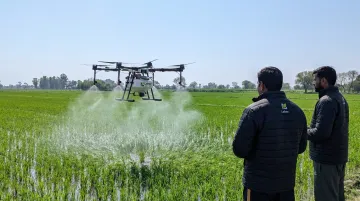
Drone rotor downwash actively pushes spray droplets downward into lower canopy layers, giving it a physical advantage over ground sprayers that rely on passive contact. This matters for crops like paddy, wheat, and vegetables where pests shelter beneath upper leaves.
Who benefits most from precision:
- Smallholder farms with irregular field shapes, where mapped routes reduce missed edges
- Small and marginal holdings, which PIB-cited Agriculture Census 2015–16 data places at about 86% of India's total
- Crops requiring repeated applications, such as potatoes and vegetables, where input savings compound across spray cycles
- Seasons with elevated pesticide prices, when waste reduction matters more
KPIs affected: pesticide volume used per acre, water consumption per treatment, spray coverage uniformity, active ingredient waste rate, long-term soil health indicators.
Benefit 3: Applicator Safety and Elimination of Manual Exposure Risk
Manual backpack spraying puts the operator in direct, sustained contact with pesticide chemicals through skin absorption, inhalation during mixing, and accidental spills. This is the standard reality for millions of spray workers across Indian farms.
Drone spraying removes the operator from the application zone entirely. The pilot controls the drone from a safe distance, never entering the area being sprayed. This eliminates the primary occupational hazard of crop protection work on Indian farms.
India's Ministry of Agriculture drone spraying SOP explicitly requires PPE for drone operators and mandates operational precautions, including wind speed limits and buffer zones near water bodies and residential areas.
The bigger safety gain is physical separation: the pilot stays outside the spray zone, which PPE alone cannot replicate in manual spraying.
Where this matters most:
- High-frequency spray schedules, such as weekly fungicide rounds on potatoes or vegetables, where cumulative operator exposure is highest
- Hot and humid conditions during monsoon season, where PPE compliance drops as heat stress increases
- Farms where retaining trained, willing spray laborers is a persistent challenge — reducing chemical exposure risk makes drone operation a more sustainable role
For sugarcane and paddy, two crops where Leher's drone operators have served significant acreage, dense canopy, wet soil, and repeated seasonal applications make manual spraying especially hazardous. Drone spraying offers a practical safety improvement in those conditions.
KPIs affected: operator chemical exposure incidents, days lost to health issues post-spraying, PPE compliance rate, labor availability during peak spray periods.
What Happens When Aerial Spraying Is Skipped or Delayed
Spray timing is the first thing to suffer when fields are too wet for tractors. Relying only on manual or ground-based spraying creates avoidable costs:
- Missed spray windows let fungal diseases and insects establish. Corrective sprays often cost more and protect less than preventive application.
- Wet-field ground passes compact soil, reduce water infiltration, and damage root zones. The yield loss builds quietly across seasons.
- Patchy manual coverage leaves untreated strips that become reinfestation hotspots, forcing extra spray rounds and higher seasonal input costs.
The risk is practical, not theoretical. At national scale, even a 5% wheat yield loss can translate into losses measured in crores of rupees. On a 5-acre paddy farm, missing a blast spray during epidemic conditions can wipe out most of the season's crop.
How to Get the Most Value from Aerial Spraying
To make aerial spraying pay off, plan timing, flight settings, and booking before pest pressure peaks:
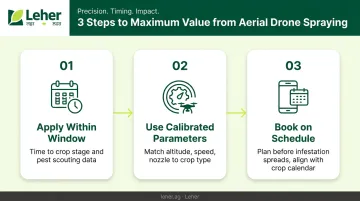
Apply within the recommended window — preventive or early-intervention spraying usually protects yield better than spraying after visible damage spreads. Match timing to crop growth stage and pest scouting data.
Use calibrated flight parameters — match altitude, flight speed, nozzle type, and application rate to the crop and product. An experienced, certified drone spraying provider will adjust settings because paddy, potato, and sugarcane need different spray patterns.
Book on schedule, not in crisis — drones are most useful when spraying is planned before visible infestation spreads. Preventive scheduling aligned with the crop calendar turns aerial spraying into a routine protection tool, not a last resort.
For Indian farmers who want aerial spraying without managing equipment or pilots, services like Leher let them book on-demand drone spraying through the Leher App.
The process is simple: book in three steps, meet the DGCA-certified pilot at the farm, and pay after the job is completed. That keeps the service practical for smallholders, FPOs, and larger farms with limited drone experience.
Conclusion
Aerial drone spraying's core value is practical: it delivers crop protection when and where conventional methods fail, including flooded fields, dense canopies, and labor gaps that often coincide with peak disease pressure.
The individual benefits compound. Faster coverage means spray windows get met. Low-volume precision means less input cost per treatment. GPS-guided consistency means fewer reinfestation patches. Operator separation means fewer health incidents and more reliable labor availability across the season.
For India's smallholder majority, many working small, irregular plots where every spray cycle affects a season's income, app-booked drone spraying services such as Leher bring aerial protection within reach. Farmers can treat crops on the right day, not the next day a field becomes accessible.
Frequently Asked Questions
What is aerial spraying?
Aerial spraying applies crop protection products, such as pesticides, fungicides, herbicides, or foliar fertilizers, from drones or aircraft. In India, most farm use cases involve low-altitude multi-rotor UAVs with GPS-guided flight paths.
What are the benefits of aerial spraying?
Aerial spraying helps farmers spray on time, reach wet or dense fields, cut water and pesticide use, and reduce operator exposure. Drones also cover more area per day than manual spraying.
What is the cost per acre for drone spraying?
Rates vary by crop, terrain, spray type, and local service provider. In India, drone spraying is often benchmarked around ₹600 per acre, but farmers should confirm current rates before booking.
How does drone spraying compare to manual or ground-based spraying?
Drones can cover up to 50 acres per day, compared with roughly 3 acres manually. They use less water, keep workers out of the spray zone, and reach fields ground sprayers cannot access.
Is aerial spraying safe for crops and the surrounding environment?
Yes, when operators use approved inputs, correct calibration, and India’s official SOP limits for wind, droplets, spray volume, and buffer zones. GPS-guided paths also help reduce off-target drift.
Which crops benefit most from aerial spraying in India?
Paddy, wheat, potato, sugarcane, cotton, tea, and rubber benefit most. These crops often have dense canopies, time-sensitive disease pressure, or repeated spray needs.