Differences Between Drone and Manual Spraying Methods

You know that farming is a delicate balance of nurturing crops and protecting them from an array of threats. From pests and diseases to nutrient deficiencies and weeds, a single unchecked problem can devastate a season's hard work. This is precisely why crop spraying is one of the most critical and non-negotiable activities in modern agriculture.
An effective application ensures that every plant receives the right amount of chemical, leading to healthier crops, higher yields, and better-quality produce. It's an indispensable practice for safeguarding your investment and securing your livelihood. Yet, how you execute this task, manually or with advanced technology, can make a world of difference.
In the sections that follow, we will break down the key differences between manual and drone spraying methods, empowering you to make an informed decision for your farm.
Key Takeawys
Manual spraying is low-cost and suited for small farms, but it's slow, inefficient, and poses health risks to the operator.
Drone spraying has a higher initial cost but leads to significant long-term savings on labour, water, and chemicals.
Drones are faster, more precise, and safer, allowing you to treat a larger area in less time while protecting workers.
The best method depends on your farm's size and budget, but drone rental services are an accessible way to try the technology without a large upfront investment.
What are the Key Spraying Metrics in Agriculture?

Before we compare different methods, it's crucial to understand the metrics that define a successful spray operation. Effectiveness in crop spraying comes from a precise application that maximises results and minimises waste.
Here are the most important metrics you need to consider:
Application Rate
This is a measure of how much spray mixture is applied to a specific area.
The rate is typically measured in litres per hectare.
The correct rate ensures you meet the manufacturer's recommendations for a specific chemical, guaranteeing its effectiveness.
Applying too little makes crops vulnerable, while applying too much risks chemical runoff, plant damage, and financial loss.
Droplet Size and Uniformity
This refers to the size of the spray droplets, which directly impacts how well the chemical is applied.
Droplet size is measured in microns and affects both coverage and drift.
Smaller droplets offer excellent coverage but are more susceptible to wind drift and evaporation.
Larger droplets are less prone to drifting but may bounce off leaves, leading to poor coverage.
The goal is to achieve a uniform droplet size that maximises coverage while minimising drift.
Spray Coverage
This metric measures how evenly the spray is distributed across the target area.
High-quality coverage means every leaf and plant receives a consistent dose of the chemical.
Poor coverage leaves gaps where pests, weeds, or diseases can thrive, compromising the entire application.
Achieving uniform coverage is a primary goal of any spraying technique.
Drift
This is the movement of chemical particles away from the intended target area.
Drift is a significant concern because it can damage neighbouring crops, contaminate water sources, and pose health risks.
Minimising drift is not only an agricultural best practice but is also often a legal and environmental necessity.
Also Read: How to Use Foliar Spray Fertiliser Effectively
How is Spraying Done Currently in India?

In India, a vast majority of spraying operations are still carried out using traditional, manual methods. These practices are deeply ingrained in the agricultural landscape, particularly among small-scale and marginal farmers.
While more advanced methods are emerging, manual spraying remains the most common approach for several reasons, including its low initial cost and simple operation.
Dominance of Manual labour
Spraying is a labour-intensive task, often performed by individual farmers or hired farmhands who walk through the fields carrying the spraying equipment. The most widely used tool is the knapsack sprayer, which is carried on the operator's back.
These come in three main types:

Manual Knapsack Sprayers: Operated by a hand pump, these are the most basic and affordable.
Battery-Operated Knapsack Sprayers: These use a rechargeable battery to power the pump, reducing manual effort.
Petrol-Engine Sprayers: These are used for larger areas and provide higher pressure.
Tractor-Based Spraying
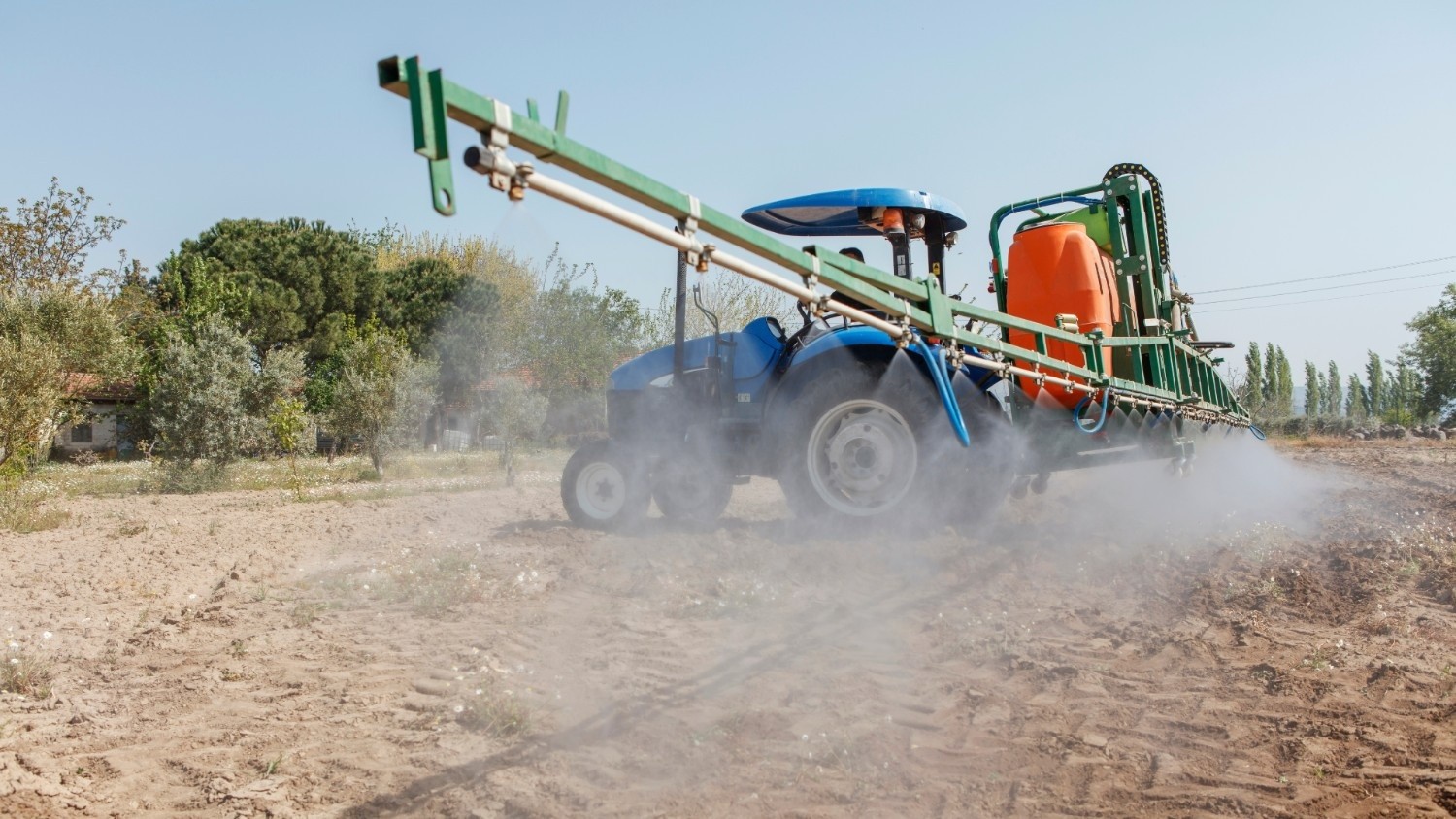
For medium to large farms, tractor-mounted boom sprayers are also common, offering a more mechanised approach than knapsack sprayers.
These systems consist of a large tank and a long horizontal boom with multiple nozzles, which allows for simultaneous spraying over a wider area.
This significantly increases efficiency compared to manual methods, but they are limited to larger, open fields where a tractor can operate and cannot manoeuvre in closely seeded plants or reach difficult spots.
Manual spraying also becomes highly impractical for certain crops. For example, once sugarcane reaches full height, the dense stalks make it nearly impossible to walk through with a sprayer, often leaving farmers with cuts or injuries.
Cotton poses another challenge with its sharp thorns that make it unsafe for operators to carry equipment inside. Even in rice fields, farmers risk damaging 5–7% of their crop just by walking through the paddies, and the footprints often encourage weed growth in those spots.
These challenges show the limitations of traditional spraying, even before considering efficiency or labour shortages.
Also Read: Uses and Benefits of Agricultural Machinery
Why are Drones Emerging as Better Alternatives for Spraying?
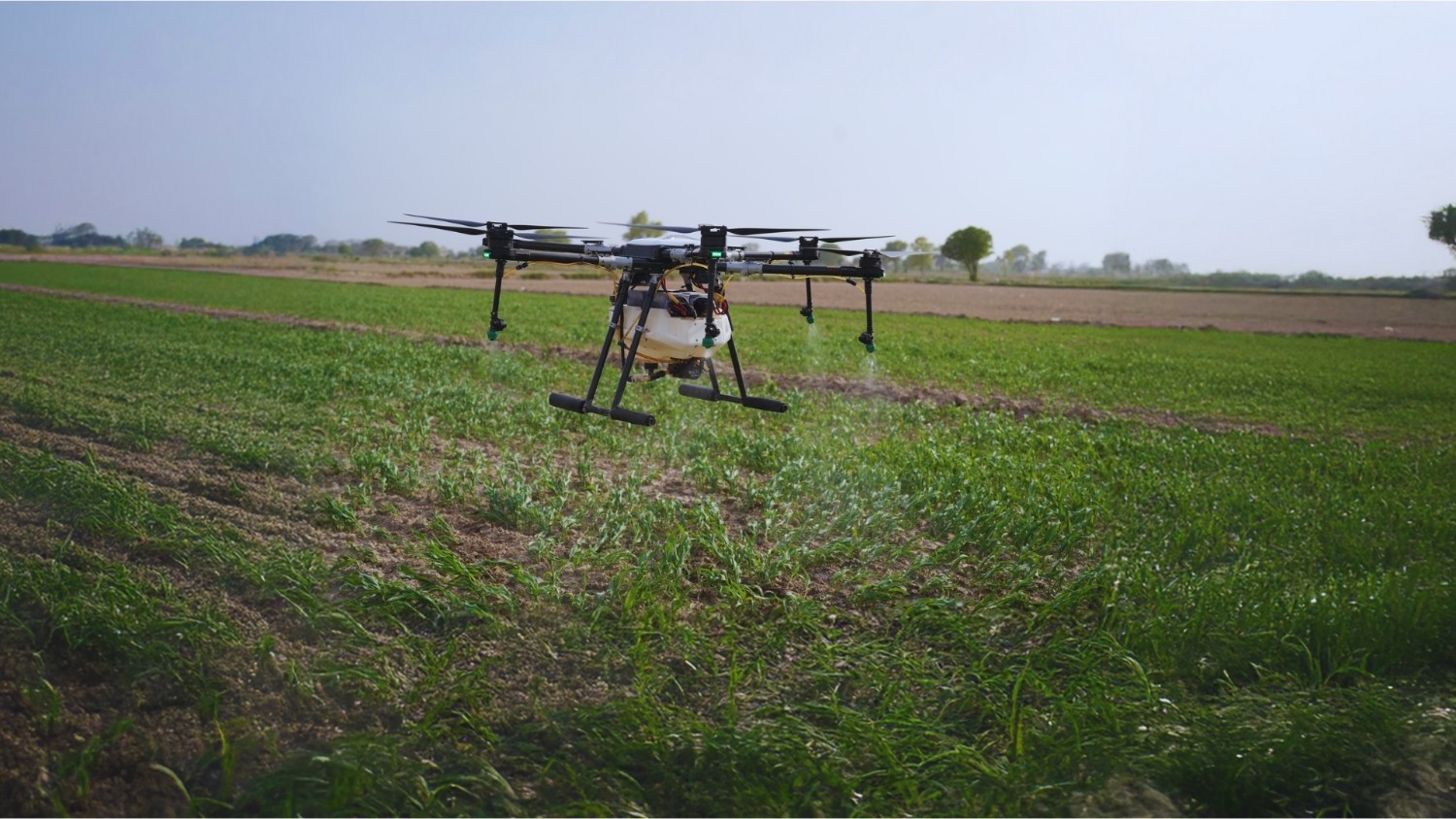
Drones are rapidly gaining popularity as an alternative to manual spraying methods due to their ability to address many of the challenges faced by traditional techniques.
They are a modern, technology-driven approach that offers significant advantages in efficiency, precision, safety, and long-term cost.
Drones are particularly valuable in crops where manual or tractor spraying is nearly impossible. In tea and rubber plantations, the steep slopes and dense plantings make it unsafe and exhausting for labourers to spray by hand.
Similarly, in orchards like mango or pomegranate, the chemicals need to reach the upper canopy, something ground sprayers struggle with. Drones can easily cover these vertical and uneven terrains, ensuring uniform coverage across every layer of the crop.
Unmatched Efficiency
Drones are incredibly fast and efficient, allowing for the quick and timely application of chemicals, which is critical for preventing crop loss.
Studies have shown that a drone can achieve an effective field capacity of 4ha/h, a stark contrast to the knapsack sprayer's mere 0.082ha/h.
The average operational speed of a drone sprayer is 13.201km/h, while a knapsack sprayer operates at an average of 1.833km/h.
This speed is crucial for time-sensitive applications, such as a sudden pest outbreak, allowing farmers to respond quickly and effectively.
Given the crucial role of speed in preventing crop loss, you can put this efficiency to work for you. Explore Leher’s drone rental services to get started with your first session.
Enhanced Precision and Coverage
Equipped with advanced technology, drones provide a highly uniform application of chemicals, ensuring better coverage and less waste.
A study found that the average application rate for a drone was only 26.96L/ha compared to the knapsack sprayer's rate of 490.28L/ha.
The drone's low-altitude flight and the powerful downward force from its propellers, known as "downwash," push the spray droplets deep into the crop canopy.
This ensures that the chemical reaches all parts of the plant, including the undersides of leaves, which is often missed with manual spraying.
Superior Safety
Drone spraying significantly improves safety by removing the need for direct human contact with hazardous chemicals.
The most significant benefit of drone spraying is the complete elimination of direct human contact with hazardous chemicals.
A study highlighted that the drone spraying system exhibited highly effective pesticide utilisation, reaching up to 85%, whereas the knapsack sprayer had a maximum utilisation of only 30%.
The WHO estimates a substantial number of pesticide-related illnesses and deaths annually, especially in developing countries, a risk that drone spraying drastically reduces.
Want to improve safety on your farm and protect your workers? Discover how our drone spraying services can help you minimise chemical exposure and associated risks.
Economic Advantages
Despite the initial investment, drones offer significant long-term savings through reduced operational costs and increased yields.
Drones have been shown to provide water savings of up to 94.51% compared to traditional knapsack spraying.
They reduce chemical usage by minimising overspray and drift, leading to a much higher pesticide utilisation rate.
The precision application can also lead to an increase in crop yields, providing a clear return on investment.
Adaptability and Soil Health
Drones can operate in various terrains and conditions, preventing soil damage and improving the overall health of the land.
Drones can easily navigate difficult or uneven terrain, such as hilly areas or waterlogged fields, where tractors and manual labourers cannot go.
Since they fly over the crops, they also eliminate soil compaction caused by heavy machinery, which improves soil health and allows for better water penetration and root growth.
Also Read: Maximise Your Crop Yield with a Pesticide Spraying Drone
Drone Sprayer vs Manual Sprayer
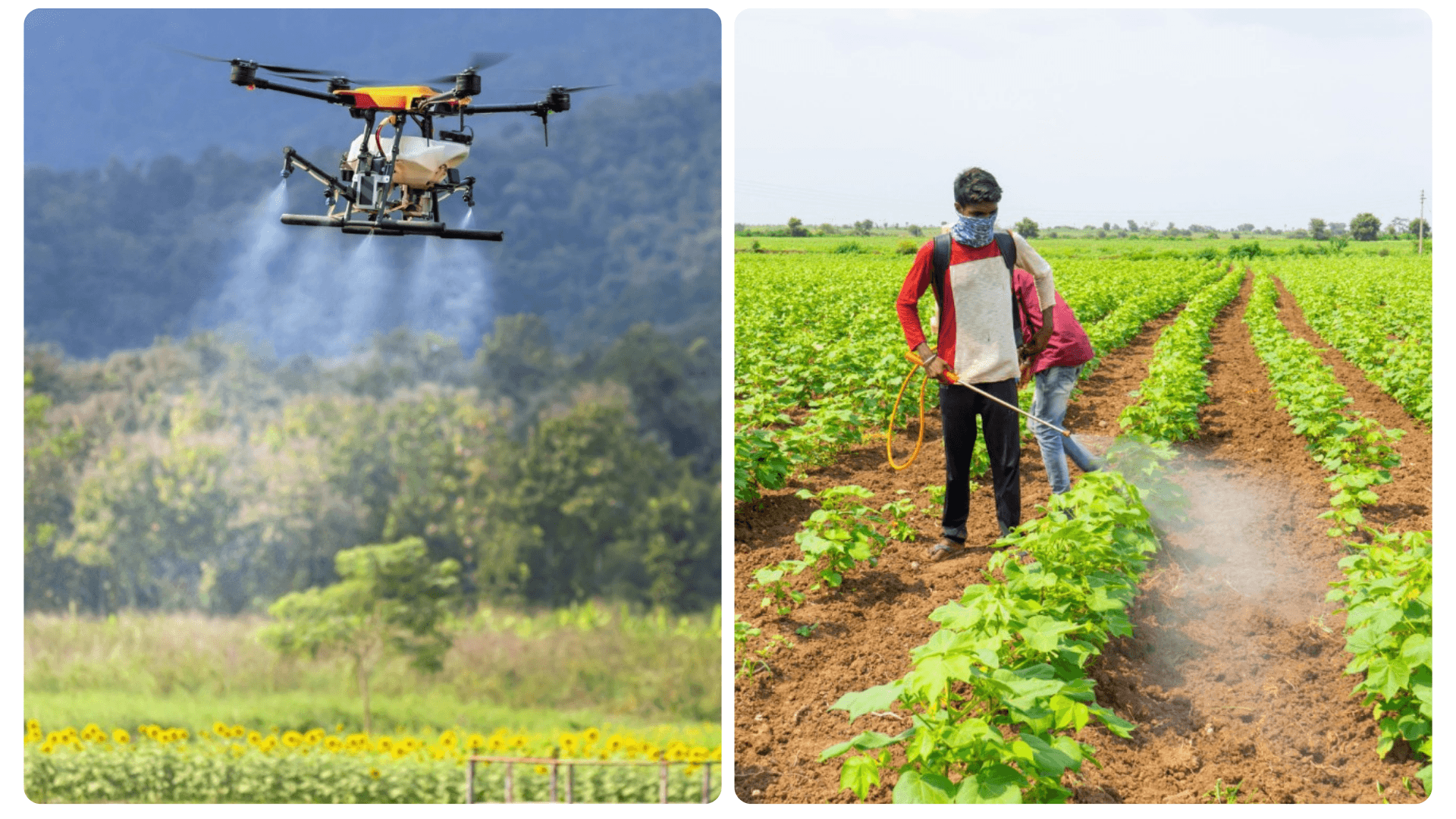
A side-by-side comparison of the key metrics to help you visualise the advantages of each method.
Which Type of Spraying is Best for You?
Deciding between drone and manual spraying depends entirely on your specific circumstances. There is no one-size-fits-all answer, so it's important to ask yourself a few key questions to determine the best fit for your farm.
How large is your farm?
For very small, fragmented land holdings, the cost of a drone might be hard to justify for a single owner. However, if your farm is a few acres or more, especially with a large-scale crop like sugarcane or paddy, the efficiency and speed of a drone will save you significant time and money over the long term.What is your budget?
Manual sprayers have a very low initial cost, making them accessible to almost everyone. Drones, on the other hand, require a larger upfront investment. It’s important to remember that this investment can often be offset by long-term savings on labour, water, and chemicals.
It's also important to note that you don't necessarily have to purchase a drone. Many private companies, such as Leher, now offer drone rental services at an affordable rate. This allows you to experience the benefits of drone spraying without the high upfront cost of ownership.What is your terrain like?
If your fields are flat and easy to walk on, manual spraying is physically manageable. But if your land is hilly, uneven, or prone to waterlogging, a drone is the clear winner. It can access difficult areas with ease, ensuring uniform coverage without putting anyone at risk or compacting your soil.For crops like chilli, which require precise coverage across delicate plants, drones provide far more uniform application than manual spraying, while also saving significant labour.
Is labour availability a concern?
In many parts of India, finding reliable and skilled farm labour is a growing challenge. Drones can effectively address this shortage by performing the work of several people in a fraction of the time, allowing you to reallocate your workforce to other tasks.
Ultimately, the best spraying method is the one that meets your needs for efficiency, safety, and cost-effectiveness. While manual spraying is a viable option for many, drone technology offers a path toward a more precise, sustainable, and profitable future for Indian agriculture.
Here is a simplified cost comparison to help you make a more informed decision:
Cost Factor | Manual Spraying | Drone Spraying |
Initial Setup Costs | ₹1,200 to ₹20,000 | ₹3.45 to ₹25 lakhs |
Training & Certification | Informal training / knowledge transfer | Around ₹ 29,500 (including GST) |
Operational Cost per Acre (Approx.) | ₹292-₹1,500 (depending on region/wages) | ₹300- ₹700 |
Labour Cost per Acre | ₹162 to ₹405 | ₹162 to ₹283 |
Energy Consumption per Acre | 148.08 MJ/acre | 59.45 MJ/acre |
Equipment Lifespan | 5-10 years | 5-8 years (with 1-2 year battery cycles) |
Annual Maintenance Cost | 5-15% of equipment cost | 10-20% of the equipment cost |
Breakeven Farm Size for ROI | N/A | 2421+ acres annually |
Return on Investment | N/A | 14-65 days of operation |
To determine if drone spraying is the right solution for your farm, consider a detailed consultation. A professional assessment can provide a clear picture of potential cost savings and improved crop yields based on your specific operational needs. Contact Leher to learn more.
Conclusion
Manual spraying is a low-cost, familiar method that's been used for generations, but it comes with limitations in speed, safety, and precision. Drones, on the other hand, require a significant initial investment, but they offer unparalleled efficiency, precision, and a major boost to safety.
The best option for you ultimately depends on your farm's size, your budget, and the specific challenges of your land. While manual methods remain a viable choice for small-scale farming, drone technology offers a path toward a more efficient, sustainable, and profitable future for Indian agriculture. You can also explore drone rental services to get the benefits without the upfront cost of ownership.
Get the Benefits of Drone Spraying Without the High Costs
The high upfront cost of agricultural drones can be a barrier for many farmers. That's where Leher comes in. We offer an innovative, practical, and affordable solution that allows you to harness the power of drone technology without the burden of ownership and maintenance.
With Leher, you can:
Get affordable drone rental services at competitive prices.
Make easy bookings via our simple, intuitive mobile app available on both Google Play Store and the App Store.
Choose from flexible rental plans tailored to your farm's size and specific needs.
Experience quick and efficient service for timely and effective spraying.
Don't let the cost of a drone hold you back. Leher provides a path to a more efficient, sustainable, and profitable future for your farm.
Frequently Asked Questions (FAQs)
Q. What kind of chemicals can drones spray?
A. Drones are versatile and can spray a wide range of agricultural chemicals, including herbicides, insecticides, fungicides, and liquid Fertilisers. Their precision allows for targeted application, ensuring the right chemical is used for the specific crop and pest. The drone's nozzles can be adjusted to handle different viscosities and droplet sizes.
Q. Is drone spraying effective in all weather conditions?
A. Drone spraying is most effective in calm weather to minimise drift and ensure accurate application. High winds or heavy rain can compromise the results, so operations are typically scheduled for periods with favourable conditions. Many drones come with weather sensors that can help operators determine the best time to spray.
Q. How is drone spraying regulated in India?
A. In India, drone spraying is regulated by the Directorate General of Civil Aviation (DGCA). Farmers and service providers must adhere to specific guidelines regarding drone registration, pilot certification, and operational zones. These regulations are in place to ensure safety and prevent misuse of the technology.
Q. How do drones avoid obstacles like trees or power lines?
A. Modern agricultural drones are equipped with advanced obstacle avoidance systems using sensors such as radar, LiDAR, and computer vision. These systems allow the drone to detect and navigate around obstacles in its path automatically. Operators can also pre-program flight paths to account for known obstacles.
Q. What is the average battery life and coverage area of a single drone?
A. The average battery life for a typical agricultural drone is around 10-15 minutes, depending on the payload and flight conditions. A single battery can cover approximately 1 to 2 hectares per charge. Most drone services use multiple batteries and a fast-charging system to ensure continuous operation in the field.
Q. Can I use a drone for crops other than standard grains?
A. Yes, drones are highly adaptable and can be used for a wide variety of crops, including fruits, vegetables, tea, and even vineyards. Their ability to navigate diverse terrains and provide targeted spraying makes them suitable for high-value and speciality crops where precision is crucial. The drone's flight path can be customised for different row spacings and plant heights.
Let’s Grow Together!
Interested in drone spraying solutions? Connect with us today.